GRE Quant lesson · Remainders
GRE remainders: n = qd + r, two divisors and remainder patterns
Remainders on GRE Quant: writing n = qd + r, meeting two remainder conditions, remainders of sums and products, and remainders hidden in decimals.
The core idea
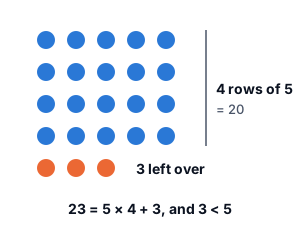
A remainder is what's left after taking out as many whole divisors as possible, so n = qd + r with 0 ≤ r < d. Write that equation, or test the smallest number that fits, and remainders of sums, products and multiples become simple arithmetic on the remainders.
Core ideas
Words used here
- Divisor: the number you divide by. In 38 ÷ 9, the divisor is 9.
- Quotient: how many whole times the divisor fits. 9 fits into 38 four times (4 × 9 = 36), so the quotient is 4.
- Remainder: what is left over: 38 − 36 = 2. It is always 0 or more, and always less than the divisor.
- Multiple: the divisor times a whole number, such as 36 = 4 × 9.
- Reduce a remainder: take out full groups of the divisor until what is left is smaller than the divisor.
- Least common multiple (LCM): the smallest positive number that all the given numbers divide. LCM(4, 5) = 20.
- Units digit: the last digit of a whole number. The units digit of 347 is 7.
- n = qd + r: the number n is q full groups of the divisor d, plus the remainder r, with 0 ≤ r < d. For example, 38 = 4 × 9 + 2.
- The smallest positive n with remainder r is r itself (when r > 0): 2 ÷ 9 is 0 with remainder 2. The next ones add d each time: r + d, r + 2d, …
- Sums and products: replace each number by its remainder, add or multiply, then reduce.
- Decimals: if n ÷ d = q.f (a whole part q and a decimal part 0.f), then the remainder is r = 0.f × d.
- Two conditions: list the numbers that fit one condition and test them against the other. The pattern repeats every LCM of the divisors.
Try it. What are the quotient and the remainder when 100 is divided by 7?
Show the answer
- 7 × 14 = 98, and 7 × 15 = 105 is too big. So the quotient is 14.
- Remainder: 100 − 98 = 2.
- In the form n = qd + r: 100 = 14 × 7 + 2.
The form n = qd + r
Write the number as a multiple of the divisor plus the remainder: n = qd + r. Then write whatever the question asks about in the same form.
Why it works. Division with a remainder says: n is some number of full groups of d, plus a leftover smaller than d. Adding a multiple of d only makes more full groups, so only the leftover part decides the new remainder.
How to spot it: "when n is divided by d, the remainder is r. What is the remainder when n + k (or 2n) is divided by d?"
Example. When n is divided by 7, the remainder is 4. What is the remainder when n + 10 is divided by 7?
- n = 7q + 4, for some whole number q.
- n + 10 = 7q + 4 + 10 = 7q + 14.
- 14 = 7 × 2, so 7q + 14 = 7(q + 2). That is a multiple of 7.
- The remainder is 0.
- Check with the smallest n, which is 4: n + 10 = 14, and 14 ÷ 7 = 2 with remainder 0. ✓
Trap: answering 14 (4 + 10). A remainder must be less than the divisor, 7.
Try it. When n is divided by 6, the remainder is 5. What is the remainder when 2n is divided by 6?
Show the answer
- n = 6q + 5, so 2n = 12q + 10.
- 10 = 6 + 4, so 2n = 12q + 6 + 4 = 6(2q + 1) + 4.
- The remainder is 4.
- Check with n = 5: 2n = 10, and 10 ÷ 6 = 1 with remainder 4. ✓
Edge cases.
- 0 ≤ r < d always. A "remainder" of 14 for a divisor of 7 means you can still make 2 more groups.
- If n < d, the quotient is 0 and the remainder is n itself: 3 ÷ 7 leaves 3.
- The smallest n with remainder r is r itself. It is a quick number to test with.
- A smaller divisor can be fixed when a bigger one isn't. Knowing n ÷ 12 tells you n ÷ 4 (4 divides 12), but not n ÷ 8.
GRE-level example. When n is divided by 12, the remainder is 9. What is the remainder when n is divided by 4?
- n = 12q + 9.
- 12q = 4 × 3q is a multiple of 4, so it adds nothing to the remainder.
- 9 = 4 × 2 + 1, so the remainder is 1.
- Check with n = 9, 21 and 33: each leaves 1 when divided by 4 ✓. (Divided by 8, they leave 1, 5 and 1, so that remainder isn't fixed.)
On the GRE (Quantitative Comparison). When n is divided by 12, the remainder is 9. Quantity A: the remainder when n is divided by 4. Quantity B: 1. Since 4 divides 12, n = 12q + 9 leaves the same remainder as 9, which is 1: the quantities are equal. Change the divisor in Quantity A to 8 and the answer changes: 8 doesn't divide 12, and n = 9 leaves 1 while n = 21 leaves 5, so with Quantity B = 3 the relationship cannot be determined.
Check yourself. n leaves remainder 7 when divided by 9. What remainder does 5n leave?
Check your answer
5 × 7 = 35 = 3 × 9 + 8, so the remainder is 8. (Check with n = 7: 35 ÷ 9 leaves 8.)
Two remainder conditions
List the numbers that meet one condition, and check each against the other. Once you find the smallest number that meets both, the others are that number plus multiples of the least common multiple (LCM) of the two divisors.
Why it works. If two numbers both meet both conditions, their difference leaves remainder 0 for each divisor, so it is a common multiple of 5 and 4. That is why the solutions are spaced exactly one LCM apart.
How to spot it: "leaves remainder a when divided by m and remainder b when divided by n".
Example. What is the smallest positive integer that leaves remainder 2 when divided by 5 and remainder 3 when divided by 4?
- Numbers with remainder 2 when divided by 5: start at 2 and add 5 each time: 2, 7, 12, 17, …
- Test each one with 4: 2 ÷ 4 = 0 remainder 2 (no). 7 ÷ 4 = 1 remainder 3 (yes). ✓
- The smallest is 7.
- LCM(5, 4) = 20, so the others are 27, 47, 67, … (7 + 20k for whole numbers k). Check 27: 27 = 5 × 5 + 2 and 27 = 6 × 4 + 3. ✓
Trap: adding the remainders or the divisors (5 or 9) without checking either condition. 5 leaves remainder 0 when divided by 5, and 9 leaves 4.
Edge cases.
- "One short" of each divisor. Remainder 2 on ÷ 3 and remainder 3 on ÷ 4 both mean n + 1 is a multiple: n + 1 is a multiple of 12, so n = 11, 23, 35, …
- Some pairs have no solution. Remainder 1 on ÷ 4 makes n odd; remainder 2 on ÷ 6 makes n even. No number does both.
- Count solutions in a range by stepping by the LCM from the smallest one.
GRE-level example. How many positive integers less than 100 leave remainder 2 when divided by 5 and remainder 3 when divided by 4?
- The smallest is 7 (found above).
- The others are 7 + 20k: 7, 27, 47, 67, 87. The next, 107, is too big.
- Answer: 5.
Numeric Entry. "What is the smallest positive integer that leaves remainder 2 when divided by 5 and remainder 3 when divided by 4?" List 2, 7, 12, 17 … and test each: 7 = 4 + 3 works. Type 7. The numbers that fit repeat every 20 (the LCM), so below 100 they are 7, 27, 47, 67 and 87: 5 of them.
Check yourself. What is the smallest positive integer that leaves remainder 2 when divided by 3, remainder 3 when divided by 4 and remainder 4 when divided by 5?
Check your answer
Each time n is one short of a multiple, so n + 1 is a multiple of 3, 4 and 5. The LCM is 60, so n = 59.
Remainders of sums and products
Replace each number by its remainder, add or multiply, and reduce. This works because the multiples of the divisor add nothing to the remainder.
Why it works. Write a = 9p + 5 and b = 9q + 7. Then ab = 81pq + 63p + 45q + 35. Every term except 35 is a multiple of 9, so ab leaves the same remainder as 35.
How to spot it: two numbers with known remainders, and a question about their sum, product or multiple.
Example. a leaves remainder 5 and b leaves remainder 7 when divided by 9. What remainder does ab leave when divided by 9?
- Multiply the remainders: 5 × 7 = 35.
- Reduce: 35 = 3 × 9 + 8.
- The remainder is 8.
- Check with real numbers: a = 14 and b = 16 fit. 14 × 16 = 224, and 224 = 24 × 9 + 8. ✓
Powers work the same way, one factor at a time. To get each next remainder, multiply the last remainder by the base and reduce. For powers of 3 divided by 7:
| Power | 3¹ | 3² | 3³ | 3⁴ | 3⁵ | 3⁶ |
|---|---|---|---|---|---|---|
| Remainder (÷ 7) | 3 | 2 | 6 | 4 | 5 | 1 |
(3 × 3 = 9 → 2; 2 × 3 = 6; 6 × 3 = 18 → 4; 4 × 3 = 12 → 5; 5 × 3 = 15 → 1.) After 3⁶ the cycle of 6 starts again. 50 = 6 × 8 + 2, so 350 is in position 2 of the cycle, like 3². Its remainder is 2.
Trap: stopping at 35, which is larger than 9.
Try it. a leaves remainder 2 and b leaves remainder 4 when divided by 5. What remainders do a + b and ab leave when divided by 5?
Show the answer
- a + b: 2 + 4 = 6, and 6 = 5 + 1, so the remainder is 1.
- ab: 2 × 4 = 8, and 8 = 5 + 3, so the remainder is 3.
- Check with a = 7 and b = 9: 7 + 9 = 16 = 3 × 5 + 1, and 7 × 9 = 63 = 12 × 5 + 3. ✓
Edge cases.
- Differences can go below 0. If a leaves 3 and b leaves 5 when divided by 7, a − b leaves 3 − 5 = −2, which is the same as −2 + 7 = 5.
- Powers cycle, as in the table above. Find the cycle, then use the exponent's remainder.
- There is no such rule for division.
GRE-level example. What is the remainder when 7100 is divided by 5?
- 7 leaves 2 when divided by 5, so 7100 leaves the same remainder as 2100.
- Powers of 2 divided by 5 leave 2, 4, 3, 1, and then repeat (cycle of 4).
- 100 = 4 × 25, remainder 0, so 2100 is in the last position of the cycle: 1.
- Check: 7⁴ = 2,401, which leaves 1, so 7100 = (7⁴)25 leaves 1 too ✓.
On the GRE (Quantitative Comparison). When m is divided by 7, the remainder is 3, and when n is divided by 7, the remainder is 5. Quantity A: the remainder when mn is divided by 7. Quantity B: 1. Multiply the remainders, 3 × 5 = 15, then reduce: 15 = 14 + 1, so the quantities are equal. The remainder of m + n is also 1 (3 + 5 = 8 = 7 + 1). Answering 15 or 8 forgets to reduce.
Check yourself. a leaves remainder 3 and b leaves remainder 5 when divided by 7. What remainder does a − b leave?
Check your answer
3 − 5 = −2, and −2 + 7 = 5. (Check: a = 10, b = 5 gives 5.)
Remainders hidden in decimals
If s ÷ t = 23.4, then s = 23.4 × t = 23t + 0.4t. The part 23t is 23 full groups of t, so what is left, 0.4t, is the remainder. The decimal part times the divisor gives the remainder.
How to spot it: a quotient given as a decimal, and a question about the remainder or the divisor.
Example. s and t are positive integers, s ÷ t = 23.4, and the remainder when s is divided by t is 6. What is t?
- Remainder = 0.4 × t.
- So 0.4t = 6, and t = 6 ÷ 0.4 = 60 ÷ 4 = 15.
- Check: s = 23.4 × 15 = 351. And 23 × 15 = 345, so the remainder is 351 − 345 = 6. ✓
Trap: treating the 4 after the decimal point as the remainder.
Edge cases.
- The remainder must be a whole number, so t has to make the decimal part × t whole. With 23.4, t must be a multiple of 5.
- "Which could be the remainder?" Write the decimal part as a fraction in lowest terms. The remainder must be a multiple of its top.
GRE-level example. s and t are positive integers and s ÷ t = 64.12. Which could be the remainder when s is divided by t: 2, 4, 8, 20 or 45?
- Remainder = 0.12 × t = (12/100) × t = (3/25) × t.
- For this to be a whole number, t is a multiple of 25, so the remainder is 3 × (t ÷ 25): a multiple of 3.
- Only 45 is a multiple of 3. (t = 375 and s = 64 × 375 + 45 = 24,045.)
- Check: 24,045 ÷ 375 = 64.12 ✓.
On the GRE (select all). "s and t are positive integers, and s ÷ t = 17.15. Which of the following could be the remainder when s is divided by t? 3, 5, 9, 15, 20." The remainder is 0.15 × t = (3/20) × t, so it is a multiple of 3, and every positive multiple of 3 works (t = 20 gives 3, t = 60 gives 9, t = 100 gives 15). Select 3, 9 and 15.
Check yourself. s ÷ t = 8.75 and the remainder is 9. What is t?
Check your answer
0.75t = 9, so t = 12.
How hard questions disguise it
For harder questions (L4–L5)
L4 versions hide the remainder in a story (people in rows of 8 with 3 left over) or ask what the remainder could be for several values. At L5, remainders link to units digits, since the units digit is the remainder on division by 10, and to sequences, where terms that repeat every k positions are a remainder problem on the term number. Test the smallest number that fits. Patterns repeat, so the first case usually shows the answer.
Practice
Drill remainder patterns in timed sets on the remainders practice page.
Common traps
Leaving a remainder bigger than the divisor
A remainder must be less than the divisor. If your result is 13 when dividing by 4, take out every full group of 4 and answer 1.
Assuming the remainder doesn't change
Multiplying n by k multiplies its remainder by k, and each higher power of n has its own remainder. Test with the smallest n that fits to see the new remainder.
Combining remainders with the wrong operation
For a sum, add the remainders; for a product, multiply them, including every factor; then reduce. Remainders from different divisors can't be combined at all.
Reporting the quotient, the multiple or the shortfall
In 38 ÷ 9 = 4 remainder 2, 4 is the quotient, 36 is the multiple, and 7 is the shortfall to the next multiple. Only the 2 is the remainder.
Rebuilding n = qd + r wrong
The total is q full groups of d, plus r left over once: n = qd + r. The leftover is not added to every group, it doesn't form another full group, and it isn't subtracted.
Checking only one remainder condition
A number that leaves the right remainder for one divisor can fail the other. Test every candidate against both conditions.
Misreading a decimal quotient
If x ÷ y = q.f, then the remainder is 0.f × y; the whole part q plays no role, and the decimal digits aren't the divisor. Solve 0.f × y = r for the quantity asked.
Using the wrong cycle for remainders of powers
Remainders of powers repeat, but the cycle length depends on both the base and the divisor (divided by 7, powers of 3 repeat every 6 but powers of 2 repeat every 3). List the remainders until they repeat, then use the exponent's position in that cycle.
Using the units digit for the wrong divisor
The units digit gives the remainder only for division by 10, 5 or 2. For other divisors, work with the whole number or with n = qd + r.
Reading a remainder condition backward
Remainder 5 when divided by 6 forces remainder 2 when divided by 3, because 6 is a multiple of 3. The reverse doesn't hold: remainder 2 by 3 allows remainder 2 or 5 by 6.
Mishandling the leftover terms after the full cycles
Split the N terms into full cycles and a leftover: N = L × q + m. Each full cycle adds the same sum, and the m leftover terms add only the first m remainders of one cycle.
Combining two remainder conditions
List the numbers that satisfy the condition with the larger divisor and test each against the other. The first one that passes both is the remainder on division by the product, when the divisors share no factor.
Assuming one remainder fixes every other remainder
If n leaves remainder 9 when divided by 12, its remainder by 4 is always 1 (4 divides 12), but its remainder by 8 isn't fixed: n = 9 leaves 1 and n = 21 leaves 5.
Leaving a remainder at or above the divisor
Remainders 3 and 5 by 7 give mn a remainder of 3 × 5 = 15, and 15 − 14 = 1. A remainder is always less than the divisor.
Reading the decimal digits as the remainder
s ÷ t = 17.15 means r ÷ t = 0.15 = 3/20, so the remainder is a multiple of 3 (3, 6, 9, 15 …), with t = 20, 40, 60, 100 …; 5 and 20 can't be remainders.
Meeting only one of two remainder conditions
The smallest positive n with remainder 2 by 5 and 3 by 4 is 7. The number 2 meets the first condition only; test each candidate against both.