GRE Quant lesson · Units digits
GRE units digits and cycles: powers, products and repeating patterns
How to find units digits on GRE Quant: the cycle of powers, units digits of products, and locating a position in any repeating pattern using remainders.
The core idea
Only the units digits of the inputs affect the units digit of a sum, product or power. Powers of any digit repeat in a short cycle (length 1, 2 or 4), so divide the exponent by the cycle length and use the remainder to find your place.
Core ideas
Words used here
- Units digit: the last digit of a whole number (the ones place). The units digit of 437 is 7. The tens digit is the one before it, 3.
- Base and exponent: in 7³, 7 is the base and 3 is the exponent. 7³ = 7 × 7 × 7 = 343.
- Cycle: a list of values that repeats in the same order. The cycle length is how many values come before it repeats.
- Remainder: what is left after dividing. 45 ÷ 4 = 11 with remainder 1, because 4 × 11 = 44 and 45 − 44 = 1.
- Only units digits matter. The units digit of 437 × 2,918 is the units digit of 7 × 8 = 56, which is 6. The other digits only add multiples of 10, and those end in 0.
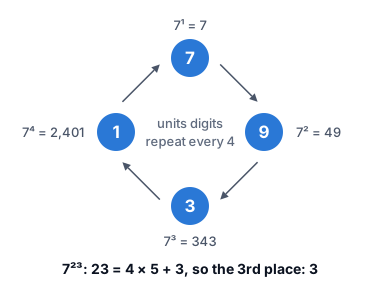
- Powers repeat in cycles. To build a cycle, multiply the last units digit by the base's units digit and keep only the last digit. For 7: 7; 7 × 7 = 49 → 9; 9 × 7 = 63 → 3; 3 × 7 = 21 → 1; 1 × 7 = 7, back to the start.
| Units digit of the base | Units digits of the 1st, 2nd, 3rd, 4th, … powers | Cycle length |
|---|---|---|
| 0, 1, 5, 6 | the same digit every time | 1 |
| 4 | 4, 6 | 2 |
| 9 | 9, 1 | 2 |
| 2 | 2, 4, 8, 6 | 4 |
| 3 | 3, 9, 7, 1 | 4 |
| 7 | 7, 9, 3, 1 | 4 |
| 8 | 8, 4, 2, 6 | 4 |
- Position in a cycle of length L: divide the exponent (or the position number) by L. A remainder of r means position r. A remainder of 0 means the last position.
Try it. What is the units digit of 3¹⁰?
Show the answer
- Cycle for 3: 3, 9, 7, 1 (length 4).
- 10 = 4 × 2 + 2, so the remainder is 2.
- Second position: 9. (Check: 3¹⁰ = 59,049.)
Units digit of a power
Keep only the units digit of the base and write out its cycle. Divide the exponent by the cycle length. The remainder tells you the position in the cycle.
Why it works. The units digit of a product depends only on the units digits of the factors. So each new power's units digit comes from the previous units digit times the base's units digit. With only 10 possible digits, the pattern must repeat, and for every base the cycle has length 1, 2 or 4.
How to spot it: "what is the units digit of 3745?"
Example. What is the units digit of 3745?
- Units digit of the base: 7. Cycle: 7, 9, 3, 1 (length 4).
- 45 = 4 × 11 + 1, so the remainder is 1.
- Remainder 1 is the first position: 7.
For a sum of powers, find each units digit the same way, then add. 3745 + 32 ends in 7 + 9 = 16, so its units digit is 6.
Trap: using the exponent's last digit. 317 and 327 both have exponents ending in 7, but 17 = 4 × 4 + 1 gives the first position (3), while 27 = 4 × 6 + 3 gives the third position (7).
Try it. What is the units digit of 830?
Show the answer
- Cycle for 8: 8, 4, 2, 6 (length 4).
- 30 = 4 × 7 + 2, so the remainder is 2.
- Second position: 4.
Edge cases.
- Digits 0, 1, 5 and 6 never change: every power of 6 ends in 6.
- 4 and 9 have cycles of length 2: 4, 6 and 9, 1.
- A remainder of 0 means the last place in the cycle, not the first. 7⁸ ends in 1.
- Exponent 0: any non-zero number to the power 0 is 1.
GRE-level example. What is the units digit of 1347 + 1747?
- 1347 ends like 347. The cycle of 3 is 3, 9, 7, 1. 47 = 4 × 11 + 3, so the 3rd place: 7.
- 1747 ends like 747. The cycle of 7 is 7, 9, 3, 1. The 3rd place: 3.
- Add the units digits: 7 + 3 = 10, so the units digit is 0.
On the GRE (Quantitative Comparison). Quantity A: the units digit of 7²³. Quantity B: the units digit of 3¹⁸. Powers of 7 end in 7, 9, 3, 1 and 23 leaves remainder 3 when divided by 4, so A is 3. Powers of 3 end in 3, 9, 7, 1 and 18 leaves remainder 2, so B is 9. Quantity B is greater. The on-screen calculator can't show 7²³ in full, so the cycle is the only practical route.
Check yourself. What is the units digit of 7²³?
Check your answer
23 = 4 × 5 + 3, so the 3rd place in 7, 9, 3, 1: 3.
Units digit of a product
Find the units digit of each factor (use the cycles for powers). Multiply those digits, and keep only the units digit at each step.
Why it works. The tens, hundreds and higher places of each factor contribute only multiples of 10 to the product. So only the units digits of the factors affect the product's units digit.
How to spot it: a product of large numbers or powers, and a question about its last digit.
Example. What is the units digit of 223 × 915?
- 223: the cycle is 2, 4, 8, 6. 23 = 4 × 5 + 3, remainder 3, so the third digit: 8.
- 915: the cycle is 9, 1 (length 2). 15 = 2 × 7 + 1, remainder 1, so the first digit: 9.
- Multiply: 8 × 9 = 72. The units digit is 2.
Trap: adding the units digits (8 + 9 = 17, giving 7) instead of multiplying them.
Edge cases.
- A factor ending in 0 makes the product end in 0.
- A factor ending in 5 times any even number ends in 0.
- Factorials: from 5! on, every factorial ends in 0 (it contains 2 × 5).
GRE-level example. What is the units digit of 1! + 2! + 3! + … + 50!?
- 5! = 120 and every larger factorial contains 5! as a factor, so they all end in 0.
- Only 1! + 2! + 3! + 4! = 1 + 2 + 6 + 24 = 33 matters.
- The units digit is 3.
On the GRE (Quantitative Comparison). Quantity A: the units digit of 7²³ + 3¹⁸. Quantity B: 2. The units digits are 3 and 9, and 3 + 9 = 12 ends in 2, so the quantities are equal.
Numeric Entry. "What is the units digit of 17⁵ × 23⁶?" 7⁵ ends in 7 (5 leaves remainder 1 when divided by 4) and 3⁶ ends in 9 (remainder 2), and 7 × 9 = 63, so type 3.
Check yourself. What is the units digit of 413 × 67 × 35?
Check your answer
413 ends in 4 (odd exponent), 67 ends in 6, and 35 ends in 3. Then 4 × 6 = 24 → 4, and 4 × 3 = 12 → 2.
Positions in a repeating cycle
Any repeating pattern works like a units-digit cycle. Find the cycle length, divide the position number by it, and look at the remainder. A remainder of 0 lands on the last item of the cycle.
Why it works. After each full cycle the pattern is back where it started, so full cycles change nothing. Only the leftover steps, the remainder, decide where you land.
How to spot it: a pattern that repeats ("red, green, blue, white, red, …") and a question about a far-off position.
Example. A light flashes red, green, blue, white, then repeats. What color is the 103rd flash?
- Cycle length: 4.
- 4 × 25 = 100, so 103 = 4 × 25 + 3. The remainder is 3.
- Third color: blue.
- Check: flash 100 has remainder 0, so it is the last color, white. Then 101 is red, 102 green and 103 blue. ✓
Units digits use the same counting. For 8103, the cycle 8, 4, 2, 6 and the remainder 3 give a units digit of 2.
Trap: numbering the first flash as 0. Then the 103rd flash becomes number 102, which gives remainder 2 and the wrong color, green.
Edge cases.
- A remainder of 0 lands on the last item of the cycle.
- A pattern that starts repeating later (for example, the first two items are special) needs those items set aside before you divide.
- Days of the week are a cycle of 7.
GRE-level example. Today is Tuesday. What day of the week will it be 1,000 days from now?
- Every 7 days the day of the week repeats.
- 1,000 = 7 × 142 + 6, so the remainder is 6.
- 6 days after Tuesday: Monday.
- Check: 994 days from now (a multiple of 7) is a Tuesday; 6 days later is Monday ✓.
On the GRE (Quantitative Comparison). n is a positive integer. Quantity A: the units digit of 4ⁿ. Quantity B: 5. Powers of 4 end in 4 (odd n) or 6 (even n), so one case is below 5 and one is above: the relationship cannot be determined. Change Quantity A to the units digit of 5ⁿ and it is always 5, so the quantities are equal.
On the GRE (select all). "The units digit of 3ⁿ is 7. Which of the following could be the value of n? 7, 11, 14, 19, 22." Powers of 3 end in 7 exactly when n leaves remainder 3 when divided by 4. Select 7, 11 and 19.
Check yourself. The letters A, B, C, D, E repeat in that order. What is the 2,026th letter?
Check your answer
2,026 = 5 × 405 + 1, so the 1st letter of the cycle: A.
How hard questions disguise it
For harder questions (L4–L5)
L4 versions ask for the units digit of a sum of powers (320 + 720), or of an expression with an unknown exponent, like 4n when n is odd. At L5, units digits combine with remainders: the units digit of N is the remainder when N is divided by 10, and "the remainder when 350 is divided by 5" depends only on the units digit of 350. Reduce everything to units digits early, and write out the cycle instead of trusting your memory.
Practice
Practice units-digit and cycle questions in timed sets on the units digits practice page.
Common traps
Assuming the units digit never changes
Only 0, 1, 5 and 6 keep their units digit under every power. For other digits, write out the first few powers to find the cycle.
Being off by one in the cycle
A remainder of 1 means the first position in the cycle, and a remainder of 0 means the last position, not the 0th power.
Using the exponent's units digit, or ignoring the exponent
The exponent matters only through its remainder when divided by the cycle length. 3¹⁷ and 3²⁷ have different units digits even though both exponents end in 7.
Treating a power as a product
7²³ means 23 factors of 7, not 7 × 23, and 2⁵ × 3⁴ can't be merged into one power. Find each power's units digit from its own cycle.
Adding when you should multiply, or the reverse
For a product, multiply the units digits; for a sum, add them. Then keep only the last digit.
Dropping one of the factors or terms
Every factor of a product, and every term of a sum, affects the units digit. List each one's units digit before combining.
Assuming every digit cycles through 4 values
2, 3, 7 and 8 cycle through 4 digits, 4 and 9 through 2, and 0, 1, 5 and 6 never change. Write out the cycle instead of assuming its length.
Reading the tens digit
7 × 8 = 56 has units digit 6, not 5. After multiplying the digits, keep only the last one.
Mixing up a remainder and a units digit
The units digit of k and the remainder of k divided by 4 are different numbers. Use the remainder to place a power in its cycle and the units digit when you add, and find the remainder from the last two digits, not the last one.
Placing a tower's exponent in the cycle wrong
In A^(B^C), the exponent of A is the whole number B^C, not C. Find the remainder of B^C divided by 4 from the cycle of B's powers, then place A in its own cycle.
Reusing n's remainder for a changed exponent
If n leaves remainder r when divided by 4, then n + j leaves the remainder of r + j, and pn leaves the remainder of p × r. Work out the new exponent's remainder before you use the cycle.
Units digit of a product of powers
Find each power's units digit from its cycle of 4, then multiply those digits and keep the last one.
Using a given units digit to place n
A given units digit tells you where n sits in the cycle. Use that position for every other power of n, and remember that a^(2n) = (a^n)², so square the digit.
Taking the wrong place in the cycle
7²³: 23 = 4 × 5 + 3, so take the 3rd entry of the cycle 7, 9, 3, 1, which is 3. A remainder of 0 means the 4th entry, not the 1st.
Combining the units digits wrongly
For 17⁵ × 23⁶, multiply the units digits 7 and 9 to get 63 and keep only the 3; don't add them, and don't keep 63.