GRE Quant lesson · Sequences
GRE sequences: nth term, arithmetic series, recursive and geometric
Sequences on GRE Quant: the nth term of an arithmetic sequence, sums of arithmetic series, recursive definitions, and geometric sequences, with examples.
The core idea
An arithmetic sequence adds the same difference each step, so term n is the first term plus (n − 1) differences, and the sum is the number of terms times the average of the first and last. A geometric sequence multiplies by the same ratio, and a recursive rule is simply applied one term at a time.
Core ideas
Words used here
- Sequence: a list of numbers in a fixed order. Each number is a term.
- an (read "a sub n"): the nth term. a1 is the first term, a2 the second, and so on.
- Arithmetic sequence: you add the same number each time, such as 3, 7, 11, 15 (add 4).
- Common difference (d): the number you add each time. In 3, 7, 11, 15, d = 4.
- Geometric sequence: you multiply by the same number each time, such as 2, 6, 18, 54 (times 3).
- Common ratio (r): the number you multiply by each time. In 2, 6, 18, 54, r = 3.
- Recursive rule: a rule that makes each term from the term (or terms) before it.
- Inclusive: "from 21 to 79, inclusive" means 21 and 79 are both counted.
- nth term of an arithmetic sequence: an = a1 + (n − 1)d. To reach term n from term 1 you take n − 1 steps, not n. (10 fence posts have only 9 gaps between them.)
- Number of terms from a to b in steps of d: (b − a) ÷ d + 1. The "+ 1" counts the first term.
- Sum of an arithmetic sequence = number of terms × (first + last) ÷ 2.
- nth term of a geometric sequence: an = a1 × rn−1. For example, r³ means r × r × r.
- Recursive rule: work out one term at a time, and watch for a pattern that repeats.
On the GRE
- The on-screen calculator speeds up sums like 50 × 51, but count the terms yourself: the + 1 is where mistakes happen.
- Quantitative Comparison: a sequence quantity ("the 12th term", "the sum of the even integers from 2 to 100") is a fixed number once the sequence is fixed. With an unknown first term, write the terms using a₁ and compare.
- Numeric Entry: a term that comes out as a fraction goes in the two boxes.
Try it. The sequence 5, 9, 13, 17, … continues the same way. What is its 20th term?
Show the answer
- Common difference: 9 − 5 = 4.
- From term 1 to term 20 there are 20 − 1 = 19 steps.
- 20th term: 5 + 19 × 4 = 5 + 76 = 81.
The nth term
In an arithmetic sequence you add the same number, the common difference d, at each step. Find d, then add (n − 1) of them to the first term. If you know two terms, d = (gap between the two terms) ÷ (number of steps between them).
Why it works. Every step adds the same d, so k steps add k × d. Term n is n − 1 steps after term 1, and term k is k − j steps after term j. Counting steps (gaps), not terms (posts), is the whole method.
How to spot it: "each term is d more than the one before", "what is the 30th term?".
Example. In an arithmetic sequence, the 1st term is 7 and the 15th term is 63. What is the 30th term?
- From term 1 to term 15 there are 15 − 1 = 14 steps.
- The gap is 63 − 7 = 56, so 14d = 56 and d = 56 ÷ 14 = 4.
- From term 1 to term 30 there are 29 steps: 7 + 29 × 4 = 7 + 116 = 123.
Trap: using 15 steps (d = 56/15) or 30 steps (7 + 30 × 4 = 127).
Edge cases.
- A negative d makes the terms fall. In 40, 37, 34, …, d = −3.
- Is a number in the sequence? 100 is in 7, 11, 15, … only if (100 − 7) ÷ 4 is a whole number of steps. It is 23.25, so 100 is not a term.
- "The first term greater than…" Solve the inequality, then round the number of steps up to a whole number.
GRE: Quantitative Comparison. Information: in an arithmetic sequence, the 3rd term is 11 and the 7th term is 27. Quantity A: the 12th term. Quantity B: 47.
- From term 3 to term 7 is 4 steps, so d = (27 − 11)/4 = 4, and the first term is 11 − 2(4) = 3.
- The 12th term is 3 + 11(4) = 47: (C).
GRE: select-all. Which of the following are terms of 7, 12, 17, …? 52 = 7 + 9 × 5 is a term (the 10th); 55 isn't, since 48/5 isn't whole; and 2 isn't, although it fits the pattern, because the sequence starts at 7.
GRE-level example. In an arithmetic sequence, the 4th term is 23 and the 11th term is 58. What is the first term greater than 200?
- From term 4 to term 11 there are 7 steps: 7d = 58 − 23 = 35, so d = 5.
- The 1st term is 3 steps before the 4th: 23 − 3 × 5 = 8.
- Term n is 8 + 5(n − 1). It is greater than 200 when 5(n − 1) > 192, so n − 1 > 38.4.
- The number of steps must be a whole number, so n − 1 = 39 and n = 40.
- The 40th term is 8 + 5 × 39 = 203. Check: the 39th term is 198, which is not greater than 200 ✓.
Check yourself. In 40, 37, 34, …, which term is the first negative one?
Check your answer
Term n is 40 − 3(n − 1). It is negative when 3(n − 1) > 40, so n − 1 > 13.3 and n − 1 = 14. The 15th term, 40 − 42 = −2, is the first negative one (the 14th is 1).
Sum of an arithmetic series
A series is the sum of the terms of a sequence. For an arithmetic sequence (same difference each step), count the terms, find the average of the first and last terms, and multiply.
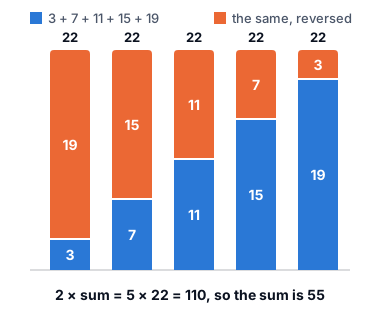
Why it works. Write the sum forward and backward, one above the other. Each column (first + last, second + second-to-last, …) has the same total. There are n columns, so the two rows together make n × (first + last). That is twice the sum.
How to spot it: "the sum of all multiples of k from… to…", "the sum of the odd integers between…".
Example. What is the sum of the odd integers from 21 to 79, inclusive?
- The odd integers go up by 2: 21, 23, 25, …, 79.
- Number of terms: (79 − 21) ÷ 2 + 1 = 58 ÷ 2 + 1 = 29 + 1 = 30.
- Average term: (21 + 79) ÷ 2 = 100 ÷ 2 = 50.
- Sum: 30 × 50 = 1,500.
Sum given as a formula. If S(n) is the sum of the first n terms, then the nth term is S(n) − S(n − 1). With S(n) = n² + 3n: S(10) = 100 + 30 = 130 and S(9) = 81 + 27 = 108, so the 10th term is 130 − 108 = 22.
Trap: counting 29 terms by forgetting the + 1.
Try it. What is the sum of the multiples of 4 from 8 to 60, inclusive?
Show the answer
- Number of terms: (60 − 8) ÷ 4 + 1 = 52 ÷ 4 + 1 = 13 + 1 = 14.
- Average term: (8 + 60) ÷ 2 = 68 ÷ 2 = 34.
- Sum: 14 × 34 = 476.
Edge cases.
- "Between" usually leaves out the ends. "Odd integers between 21 and 79" starts at 23 and ends at 77. "Inclusive" keeps them.
- Odd or even number of terms: the formula works either way. With an odd count, the middle term is the average.
- The average of an evenly spaced list is the average of its first and last terms, and it equals the median.
GRE: Quantitative Comparison. Quantity A: the sum of the even integers from 2 to 100, inclusive. Quantity B: the sum of the odd integers from 1 to 99, inclusive.
- Both lists have 50 terms. A = 50 × (2 + 100)/2 = 2,550 and B = 50 × (1 + 99)/2 = 2,500.
- Quantity A is greater: (A). Faster: pair 2 with 1, 4 with 3, and so on. Each even number is 1 more than its partner, 50 times.
GRE-level example. What is the sum of all integers between 100 and 300 that are divisible by 7?
- First multiple of 7 above 100: 7 × 15 = 105. Last one below 300: 7 × 42 = 294.
- Number of terms: 42 − 15 + 1 = 28 (or (294 − 105) ÷ 7 + 1 = 27 + 1 = 28).
- Average term: (105 + 294) ÷ 2 = 399 ÷ 2 = 199.5.
- Sum: 28 × 199.5 = 5,586.
The average doesn't have to be a whole number; the sum still is.
Check yourself. What is the sum of the first 50 positive even integers?
Check your answer
The terms are 2, 4, …, 100: 50 terms with average (2 + 100) ÷ 2 = 51. Sum: 50 × 51 = 2,550.
Recursive definitions
A recursive rule makes each term from the term (or terms) before it. Start from the given terms and apply the rule one step at a time. Write each value down. If the terms start to repeat, use the length of the repeat to jump ahead.
Why it works. A recursive rule only says how to get the next term from the ones you already have. There is no formula to jump with until you find one, so list the terms in order. A pattern (a repeat, or a formula you can test) is what lets you jump ahead.
How to spot it: an (the nth term) is defined using an−1 (the term before it), and maybe an−2 (two terms before).
Example. a1 = 2 and an = 3an−1 − 1 for n ≥ 2. What is a4?
- a2 = 3 × a1 − 1 = 3 × 2 − 1 = 5.
- a3 = 3 × a2 − 1 = 3 × 5 − 1 = 14.
- a4 = 3 × a3 − 1 = 3 × 14 − 1 = 41.
Repeating terms. Take a1 = 1, a2 = 3 and an = an−1 − an−2. The terms are 1, 3, 2, −1, −3, −2, 1, 3, … They repeat every 6 terms. To find the 100th term, divide: 100 = 6 × 16 + 4, remainder 4. So the 100th term equals the 4th term, −1.
Trap: applying the rule to the position n instead of the previous term (3 × 4 − 1 = 11).
Edge cases.
- Check where the rule starts. "For n ≥ 3" means the first two terms are given, not made by the rule.
- Working backward: undo the rule. If an = 2an−1 + 1 and a4 = 31, then a3 = (31 − 1) ÷ 2 = 15.
- A familiar sequence in disguise: an = an−1 + 5 is arithmetic, and an = 3an−1 is geometric.
GRE: Quantitative Comparison. Information: a₁ = 2 and aₙ = 3aₙ₋₁ − 2 for n ≥ 2. Quantity A: a₄. Quantity B: 27.
- a₂ = 3(2) − 2 = 4, a₃ = 3(4) − 2 = 10, a₄ = 3(10) − 2 = 28.
- Quantity A is greater: (A).
- If only "a₁ > 0" were given with aₙ = 2aₙ₋₁ − 1, then a₂ − a₁ = a₁ − 1, which is positive for a₁ = 2 and negative for a₁ = 1/2: comparing a₂ with a₁ would be (D).
GRE-level example. a1 = 3, and an = an−1 + 2n for n ≥ 2. What is a20?
- List a few terms: a2 = 3 + 4 = 7, a3 = 7 + 6 = 13, a4 = 13 + 8 = 21.
- Each term is 3 plus the added amounts: a20 = 3 + (4 + 6 + 8 + … + 40).
- That sum is evenly spaced: 19 terms (n = 2 to 20) with average (4 + 40) ÷ 2 = 22. So it is 19 × 22 = 418.
- a20 = 3 + 418 = 421.
- Check the pattern: the terms fit an = n² + n + 1 (1 + 1 + 1 = 3, 4 + 2 + 1 = 7, 9 + 3 + 1 = 13), and 400 + 20 + 1 = 421 ✓.
Check yourself. If an = 2an−1 + 1 and a4 = 31, what is a1?
Check your answer
Undo the rule three times: a3 = (31 − 1) ÷ 2 = 15, a2 = 7, a1 = 3. Check forward: 3, 7, 15, 31 ✓.
Geometric sequences
In a geometric sequence, each term is the previous term times the same number r, the common ratio. To find r from two terms, divide them: am ÷ ak = rm−k, because there are m − k steps between them.
Why it works. Each step multiplies by r, so k steps multiply by rk. Dividing a later term by an earlier one cancels the starting value and leaves r raised to the number of steps between them.
How to spot it: "each term is k times the previous term", doubling, halving.
Example. The 2nd term of a geometric sequence is 12 and the 5th term is 324. What is the 7th term?
- From term 2 to term 5 there are 3 steps, so 12 × r³ = 324.
- r³ = 324 ÷ 12 = 27. Since 3 × 3 × 3 = 27, r = 3.
- From term 5 to term 7 there are 2 more steps: 324 × 3 × 3 = 324 × 9 = 2,916.
Trap: treating the gap as arithmetic: (324 − 12) ÷ 3 = 104 per step is wrong, because the terms are multiplied, not added.
Try it. A geometric sequence starts at 5, and each term is twice the one before. What is the 6th term?
Show the answer
- From term 1 to term 6 there are 5 steps, so multiply by 2 five times: 25 = 32.
- 6th term: 5 × 32 = 160. (Check by listing: 5, 10, 20, 40, 80, 160.)
See it. An arithmetic sequence adds the same amount each step (a straight line). A geometric sequence multiplies by the same factor (a curve that bends upward). Here both start at 5; the geometric one doubles (+100% each step), so after 5 steps (the 6th term) it is 160. Change the rate and move the marker.
Linear (simple): adds 5 every step, the same amount each time. After 5: 5 × (1 + 1 × 5) = 30.
Exponential (compound): multiplies by 2 every step, so each step adds more than the last. After 5: 5 × 2⁵ = 160.
Gap after 5: 130. After 1 step both are 10; they split from the second step on.
Compound growth first reaches double the start after 1 step; linear growth needs 1.
Edge cases.
- A negative ratio alternates the signs: 3, −6, 12, −24, … (r = −2).
- An even number of steps hides the sign of r. If r² = 9, then r = 3 or r = −3, and both may fit the question.
- 0 < r < 1 makes the terms shrink toward 0 without reaching it. r = 1 gives a constant sequence.
GRE: Numeric Entry. In a geometric sequence the 2nd term is 6 and the 5th term is 162. What is the 7th term? Three steps multiply by r³ = 162/6 = 27, so r = 3. Two more steps: 162 × 3² = 1,458. Type 1458.
GRE-level example. In a geometric sequence of real numbers, the 3rd term is 18 and the 5th term is 162. What are the possible values of the 4th term?
- From term 3 to term 5 there are 2 steps: 18 × r² = 162, so r² = 9.
- So r = 3 or r = −3.
- The 4th term is 18 × r: 54 or −54.
- Check: 18, 54, 162 (r = 3) and 18, −54, 162 (r = −3) both work ✓.
Check yourself. A geometric sequence has first term 64 and ratio 1/2. Which term is 1/4?
Check your answer
64 × (1/2)n−1 = 1/4 means (1/2)n−1 = 1/256 = (1/2)⁸. So n − 1 = 8 and it is the 9th term. (64, 32, 16, 8, 4, 2, 1, 1/2, 1/4.)
How hard questions disguise it
For harder questions (L4–L5)
L4 versions describe a sequence in a story (seats in each row grow by 3) or ask for the sum of part of a sequence, such as terms 11 through 20. At L5, sequences connect to consecutive integers (consecutive multiples form an arithmetic sequence), to remainders (a recursive sequence that repeats every 6 terms), and to exponents (geometric terms are powers of r). Write the first few terms; the pattern usually appears quickly.
Practice
Practice sequence questions in timed sets on the sequences practice page.
Common traps
Counting n steps instead of n − 1
From term i to term m there are m − i steps; from term 1 to term n, n − 1. Picture fence posts: 10 posts have 9 gaps.
Miscounting the terms
The number of terms from a to b in steps of d is (b − a) ÷ d + 1: the gaps plus one. Add exactly one, and count only the numbers in the list, not every integer.
Starting from zero instead of the first term
The sequence starts at its first term, not at 0, so terms aren't proportional to their positions. Measure every step from the actual first term.
Stopping at the average or using the last term
Sum = number of terms × average term, and the average is (first + last) ÷ 2. The average alone, or count × last term, is a trap.
Treating a geometric sequence as arithmetic, or the reverse
'Each term is 4 greater' means add 4; 'each term is 4 times' means multiply. Check the gaps: equal gaps mean arithmetic, equal ratios mean geometric.
Mixing up a sum of terms with a single term
If S(n) is the sum of the first n terms, the nth term is S(n) − S(n − 1). Subtract the two sums exactly; neither sum is the term.
Miscounting the factors of r
Term n of a geometric sequence is a × r^(n − 1): r is multiplied in n − 1 times, and the first term appears once.
Applying a recursive rule wrong
Apply the rule exactly as written, in order, once per step, and write each term down. From a₁, three applications reach a₄.
Landing on the wrong place in a repeating sequence
Write terms until they return to the start to find the true cycle length. Then use the remainder of the term number divided by that length.
Answering a given or intermediate value
The common difference and the first term are steps toward the answer. Finish the calculation the question asks for.
Summing a sequence that repeats
Write out terms until they repeat. If each block sums to 0, the total is just the leftover terms after the full blocks: N = 6m + r leaves exactly r terms.
Misreading what a sequence fixes
Two terms fix an arithmetic sequence. From term 1 to term n is n − 1 steps. With an unknown first term, write the terms using a₁: the comparison may still be fixed.
Counting a number as a term when it isn't
A term is the first term plus a whole number of steps: subtract a₁ and check for a non-negative multiple of d.