GRE Quant lesson · Ratios
GRE ratios and proportions: parts, combined ratios, proportions
How to solve GRE ratio questions: split totals into parts, combine two ratios, handle a ratio that changes, and scale direct and inverse proportions.
The core idea
A ratio tells you how many equal parts each quantity gets, not how many items there are. Find the size of one part from a real number in the problem, then multiply; when ratios share a quantity, make that quantity's number match before combining them.
Core ideas
Words used here
- Ratio: a comparison of two or more amounts. "3 : 5" (say "3 to 5") means: for every 3 of the first thing, there are 5 of the second.
- Part: one equal share. The ratio 2 : 7 splits a whole into 2 + 7 = 9 equal parts.
- Part-to-part: a ratio of one share to another share, such as boys : girls.
- Part-to-whole: one share compared with the total, such as boys : whole class. It is often written as a fraction.
- Proportion: a statement that two ratios are equal, such as 2/3 = 8/12.
- Direct proportion: when one amount is multiplied by a number, the other is multiplied by the same number. y ÷ x always gives the same answer.
- Inverse proportion: when one amount is multiplied by a number, the other is divided by it. x × y always gives the same answer.
- Constant of proportionality: the number that stays the same: y ÷ x in a direct proportion (such as the price of 1 kg), or x × y in an inverse one (such as the total worker-days).
- Inverse ratio: the same ratio with the numbers in the opposite order. If two machines' speeds are 2 : 3, their times for the same job are in the inverse ratio 3 : 2.
- Least common multiple (LCM): the smallest number that two numbers both divide into. The LCM of 4 and 6 is 12.
- A ratio a : b splits a whole into a + b equal parts. One part = total ÷ (a + b).
- Part-to-part vs. part-to-whole: boys : girls = 2 : 3 means 2 + 3 = 5 parts in all, so boys are 2/5 of the class, not 2/3.
- Combining ratios: make the shared quantity the same number in both ratios (use the LCM), then read across.
- A changing ratio: write each amount as a number of parts of one unknown size n, such as 5n and 3n.
- Direct proportion: 3 kg of rice cost $12, so 1 kg costs 12 ÷ 3 = $4 (the constant). Then 5 kg cost 5 × 4 = $20.
- Inverse proportion: 4 workers take 6 days, so the job is 4 × 6 = 24 worker-days (the constant). Then 8 workers take 24 ÷ 8 = 3 days.
Try it. A bag has red and blue marbles in the ratio 3 : 5. There are 48 marbles. How many are blue?
Show the answer
- Parts: 3 + 5 = 8.
- One part: 48 ÷ 8 = 6 marbles.
- Blue: 5 × 6 = 30. Check: red = 3 × 6 = 18, and 18 + 30 = 48. ✓
Part to whole
A ratio such as 2 : 7 splits the whole into equal parts. Add the ratio numbers to get the number of parts. Divide the real total by that number to get the size of one part. Then multiply by the number of parts you need. The same one-part size also answers questions about any share, or about the difference between two shares.
Why it works. A ratio says how many equal-sized parts each quantity gets. Every part is the same size, so the whole is a + b parts, and dividing the total by a + b gives the size of one part.
How to spot it: a total and a ratio: "divided in the ratio…", "the ratio of A to B is… and there are N in all".
Example. A 54-liter drink is mixed from juice and water in the ratio 2 : 7. How many liters of juice does it contain?
- Parts: 2 + 7 = 9.
- One part: 54 ÷ 9 = 6 liters.
- Juice: 2 × 6 = 12 liters. (Water: 7 × 6 = 42 liters, and 12 + 42 = 54. ✓)
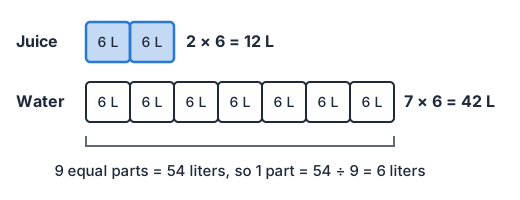
A difference works the same way. Muffins : scones = 5 : 3, and there are 12 more muffins than scones.
- Muffins are 5 parts and scones are 3 parts, so the difference is 5 − 3 = 2 parts.
- 2 parts = 12, so one part = 12 ÷ 2 = 6.
- Muffins: 5 × 6 = 30. (Scones: 3 × 6 = 18, and 30 − 18 = 12. ✓)
Trap: taking 2/7 of 54. The 2 : 7 compares juice with water (part to part), so juice is 2/9 of the drink, not 2/7.
Explore. The same drink with the ratio you choose. The whole stays 54 liters; the number of boxes changes, so the size of each box changes.
Juice : Water = 2 : 7, so the whole is 2 + 7 = 9 equal boxes.
Each box = 54 ÷ 9 = 6 liters.
Juice = 2 × 6 = 12 liters. Water = 7 × 6 = 42 liters.
Juice is 2/9 of the whole, not 2/7.
Edge cases.
- Whole items need a whole number of parts. If boys : girls = 4 : 5, the class size must be a multiple of 9.
- Ratios with fractions. 1/2 : 1/3 becomes 3 : 2 after multiplying both by 6.
- Three-part ratios work the same way: 2 : 3 : 7 is 12 parts in all.
GRE-level example. Red, green and blue pens are in the ratio 2 : 3 : 7. There are 20 more blue pens than red and green pens together. How many pens are there?
- Red and green together are 2 + 3 = 5 parts. Blue is 7 parts.
- The difference is 7 − 5 = 2 parts, and that is 20 pens. So one part is 10 pens.
- The whole is 2 + 3 + 7 = 12 parts: 12 × 10 = 120 pens.
- Check: 20 red, 30 green, 70 blue. 70 − 50 = 20 ✓.
Check yourself. Boys : girls = 4 : 5. Which could be the size of the class: 27, 30 or 32?
Check your answer
The class is 9 parts, so its size is a multiple of 9: 27 (12 boys and 15 girls).
Combining two ratios
Sometimes two ratios share a quantity. Rescale them (multiply every number in a ratio by the same number) so that the shared quantity has the same number in both. The least common multiple (LCM) of its two values is the easiest choice. Then you have one ratio with three terms.
Why it works. Multiplying every number in a ratio by the same amount doesn't change it (3 : 4 = 9 : 12). It only changes the size of one part. Rescaling makes the shared quantity the same number in both ratios, so the parts can be read across.
How to spot it: "the ratio of a to b is… and the ratio of b to c is…".
Example. At a shelter, cats : dogs = 3 : 4 and dogs : rabbits = 6 : 5. What is the ratio of cats to rabbits?
- Dogs are 4 in the first ratio and 6 in the second. Multiples of 4: 4, 8, 12. Multiples of 6: 6, 12. So the LCM is 12.
- Multiply the first ratio by 3: cats : dogs = 9 : 12.
- Multiply the second ratio by 2: dogs : rabbits = 12 : 10.
- Now dogs match: cats : dogs : rabbits = 9 : 12 : 10, so cats : rabbits = 9 : 10.
Trap: pairing the outer numbers directly (3 : 5). That ignores that "dogs" has a different number in each ratio.
Edge cases.
- A ratio never gives actual amounts. You need one real number (a total or one quantity) to find the rest.
- Chains of three or more ratios work the same way, one link at a time.
GRE-level example. If a : b = 2 : 3, b : c = 4 : 5 and c : d = 6 : 7, what is a : d?
- Match b: the LCM of 3 and 4 is 12. a : b = 8 : 12 and b : c = 12 : 15, so a : b : c = 8 : 12 : 15.
- Match c: the LCM of 15 and 6 is 30. Double the first chain: a : b : c = 16 : 24 : 30. Multiply c : d by 5: 30 : 35.
- So a : b : c : d = 16 : 24 : 30 : 35, and a : d = 16 : 35.
- Check with real numbers: a = 16, b = 24, c = 30, d = 35 gives 16 : 24 = 2 : 3 ✓, 24 : 30 = 4 : 5 ✓, 30 : 35 = 6 : 7 ✓.
Check yourself. x : y = 5 : 2 and y : z = 3 : 4. If z = 40, what is x?
Check your answer
Match y (LCM 6): x : y = 15 : 6 and y : z = 6 : 8, so x : y : z = 15 : 6 : 8. z = 40 means one part is 5, so x = 75.
A ratio that changes
Write the starting amounts as parts of one unknown size n, such as 5n and 3n. Apply the change to the right amount. Then set the new ratio equal to a fraction and solve for n. The amount that didn't change is often the quickest way in.
Why it works. The unknown n is the size of one part before the change. The change only adds to or takes from the amounts, so the new amounts can still be written with the same n. The new ratio then gives an equation with one unknown.
How to spot it: a starting ratio, then something is added or removed, then a new ratio.
Example. The ratio of boys to girls in a club is 5 : 3. After 8 girls join, the ratio becomes 5 : 4. How many boys are in the club?
- Before: boys = 5n and girls = 3n, where n is the size of one part.
- After: boys = 5n and girls = 3n + 8. So 5n / (3n + 8) = 5/4.
- Cross-multiply (multiply each top by the other bottom): 4 × 5n = 5 × (3n + 8).
- Multiply out: 20n = 15n + 40.
- Subtract 15n from both sides: 5n = 40.
- Divide both sides by 5: n = 8.
- Boys: 5 × 8 = 40. Check: girls were 3 × 8 = 24 and are now 24 + 8 = 32. 40 : 32 → divide both by 8 → 5 : 4. ✓
Faster way: the boys did not change, and they are 5 parts in both ratios. So the parts are the same size before and after. The girls went from 3 parts to 4 parts, so the 8 new girls are 1 part. Boys = 5 × 8 = 40.
Ages work the same way, except that both amounts change: in y years, add y to each age, never to the ratio numbers.
Trap: calling the 8 new girls "one part" without checking. That only works when the amount that did not change has the same number in both ratios. If 5 : 3 became 10 : 7, first rewrite 5 : 3 as 10 : 6. Then the 8 girls are 7 − 6 = 1 part, and boys = 10 × 8 = 80.
Edge cases.
- Removing works the same way. If a ratio is 7 : 3 and 20 of the first kind leave, making it 1 : 1, then 7n − 20 = 3n, so n = 5.
- Both amounts can change. Write both new amounts in terms of n.
- People come in whole numbers. If n isn't a whole number (or gives fractions of people), recheck the setup.
GRE-level example. A jar holds red and white marbles in the ratio 4 : 7. After 10 red marbles are added and 5 white marbles are taken out, the ratio is 3 : 4. How many marbles were in the jar at first?
- Before: red = 4n and white = 7n.
- After: (4n + 10) : (7n − 5) = 3 : 4.
- Cross-multiply: 4(4n + 10) = 3(7n − 5), so 16n + 40 = 21n − 15.
- Then 55 = 5n, so n = 11.
- At first: 4n + 7n = 11n = 121 marbles (44 red and 77 white).
- Check: after the change, 54 red and 72 white. 54 : 72 = 3 : 4 (divide both by 18) ✓.
Check yourself. Two kinds of tiles are in the ratio 7 : 3. After 20 tiles of the first kind are removed, the ratio is 1 : 1. How many tiles of the second kind are there?
Check your answer
7n − 20 = 3n, so n = 5. Second kind: 3 × 5 = 15. (First kind: 35, then 15.)
Direct and inverse proportion
In a direct proportion, both amounts grow together. Find the unit rate (such as the price of 1 pound, or miles per gallon) and multiply. That unit rate is the constant of proportionality.
Why it works. In a direct proportion, y = k × x, so the ratio y/x stays fixed: double x and y doubles. In an inverse proportion, x × y = k, so the product stays fixed: double x and y halves. Ask yourself which one stays fixed, the rate or the total.
In an inverse proportion, one amount grows while the other shrinks, and their product stays fixed. Find the total (such as worker-days) and divide.
How to spot it: "at the same rate", "how much will… cost", or "how long will it take more workers".
Example. Six painters can finish a job in 15 days. At the same rate, how many days would 9 painters take?
- More painters means fewer days, so this is an inverse proportion.
- Total work: 6 × 15 = 90 painter-days (one painter working for one day is 1 painter-day).
- With 9 painters: 90 ÷ 9 = 10 days.
Trap: scaling directly (15 × 9/6 = 22.5 days). That makes more painters slower.
Try it. (a) 4 kg of rice cost $10. What do 7 kg cost? (b) A trip takes 4 hours at 60 km/h. How long does it take at 80 km/h?
Show the answer
(a) Direct proportion. Price of 1 kg: 10 ÷ 4 = $2.50. Then 7 kg: 7 × 2.50 = $17.50.
(b) Inverse proportion: speed × time = distance stays the same. Distance: 60 × 4 = 240 km. Time at 80 km/h: 240 ÷ 80 = 3 hours.
Edge cases.
- Not every "more" is a proportion. A taxi fare of $3 plus $2 per mile is not directly proportional to distance: 10 miles cost $23, not twice the $13 for 5 miles.
- Several factors at once. With machines and hours per day, the fixed total is machine-hours.
- Squares. If y is inversely proportional to x², doubling x divides y by 4.
GRE-level example. 8 machines working 6 hours a day finish an order in 15 days. How many days would 10 machines working 8 hours a day take?
- Total work: 8 machines × 6 hours × 15 days = 720 machine-hours.
- The new setup does 10 × 8 = 80 machine-hours per day.
- Days: 720 ÷ 80 = 9 days.
- Check: more machines and longer days should mean fewer days, and 9 < 15 ✓.
Check yourself. y is directly proportional to x, and y = 21 when x = 6. What is y when x = 10?
Check your answer
k = 21 ÷ 6 = 3.5, so y = 3.5 × 10 = 35.
Ratio comparisons on the GRE
The GRE gives you an on-screen calculator, so messy arithmetic is never the obstacle; the faster route is still to reason first and calculate only what the comparison needs.
- Quantitative Comparison (QC). Ask whether the quantities are shares or counts.
- Shares compare from the ratios alone: if seniors to juniors is 3 to 5 in Club P and 2 to 3 in Club Q, juniors are 5/8 of P and 3/5 of Q, and 5/8 is greater.
- Counts need sizes. Without them, Club P with 8 members has 5 juniors and Club Q with 50 members has 30; with 80 and 5 members it is 50 against 3. The answer is (D).
- Everything as multiples of one t. When a ratio changes because only one part changed, write all the counts as multiples of one whole number t. Red : blue goes from 3 : 4 to 5 : 4 after some red marbles are added, so the jar had 3t red and 4t blue and 2t red were added. Counts compare for every t (4t blue is more than 2t added), but a count against a fixed number like 10 depends on t, unless a bound on the jar's size settles it.
- Select all (MA). "Which of the following could be the total?" With a ratio of 3 to 5, the total is 8t, so pick every multiple of 8 and no other choice: a multiple of 3 or of 5 alone isn't enough.
How hard questions disguise it
For harder questions (L4–L5)
At L4, the ratio is hidden in the wording ("for every 3 red marbles there are 5 blue"), or the total is given only through a change. At L5, ratios combine with other skills:
- Mixtures: the amounts of two solutions form a ratio.
- Averages: the group sizes in a weighted average are a ratio.
- Probability: a ratio of red to blue becomes a probability once you know the total.
Turn every ratio into parts with one unknown, and look for the one real number that sets the size of a part.
Practice
Drill parts, combined ratios and proportions in timed sets on the ratios practice page.
Common traps
Treating ratio numbers as actual counts
A ratio of 5:3 means 5 parts to 3 parts, and a part could be any size; a difference of 12 between them is 2 parts. Use a real total, a real difference or a real change to find one part before doing anything else.
Stopping at one part, the multiplier or the constant
The size of one part, the unit rate and the constant of proportionality are in-between steps. Multiply or divide once more to reach the quantity the question asks about.
Answering the count before or after the change
A changing-ratio question has a before and an after, and the answer choices include both. Note which moment and which quantity the question asks about.
Answering for the wrong part or the whole
Ratio questions produce every share, their total and their differences along the way. Circle the quantity the question asks for and check it before you answer.
Writing the ratio backward, or comparing the wrong pair
The order of the words is the order of the numbers: 'the ratio of a to c' puts a first. Check that both quantities in your ratio are the ones named.
Mixing part-to-part with part-to-whole
If almonds : walnuts = 2 : 3, almonds are 2/5 of the nuts, not 2/3. The whole is the sum of every term in the ratio, so don't leave a term out.
Scaling a proportion the wrong way
For direct proportion, three times as much of one means three times as much of the other. Find the unit rate first, or check the direction with a quick estimate.
Mixing up direct and inverse proportion
In an inverse proportion the product xy stays fixed, so when x doubles, y halves. Neither y itself nor the sum x + y stays the same.
Averaging groups without their ratio weights
When groups are in the ratio 2:3, their averages count 2 parts and 3 parts in the overall average. Weight each group by its own number of parts, and divide a group's total by its own size.
Ratio comparisons: GRE traps
A ratio gives shares, not counts: compare fractions straight from the ratios, but compare counts only when the totals (or a link between them) are known.