GRE Quant lesson · Probability
GRE probability: complements, without replacement, and/or rules
How to solve GRE probability questions: at least one via the complement, draws without replacement, and/or rules, and probability with combinations.
The core idea
Probability is favorable outcomes over possible outcomes, counted the same way on top and bottom. Multiply for 'and' (adjusting the pool when items aren't replaced), add for 'or' only after removing any overlap, and use the complement whenever you see 'at least one'.
Core ideas
Words used here
- Outcome: one possible result, such as rolling a 4.
- Event: the result you are asking about, such as "rolling an even number".
- Favorable outcomes: the outcomes that make the event happen.
- Equally likely: every outcome has the same chance, like each face of a fair die.
- P(A): the probability of event A. It is always between 0 (impossible) and 1 (certain).
- Complement: the opposite event. The complement of "at least one" is "none".
- Independent events: one event doesn't change the chance of the other, like two coin tosses.
- Without replacement: an item you draw is not put back, so the next draw has fewer items.
- Odds: favorable compared with unfavorable, such as 1 : 3. This is not a probability (that would be 1/4).
- C(n, k): the number of ways to choose k items from n when order doesn't matter.
- Basic formula: P(event) = favorable outcomes ÷ all possible outcomes, when every outcome is equally likely. A die shows an even number in 3 of 6 ways, so P = 3/6 = 1/2.
- Complement: P(not A) = 1 − P(A). So P(at least one) = 1 − P(none).
- "And" for independent events: P(A and B) = P(A) × P(B). Without replacement, update the counts after each draw.
- "Or": P(A or B) = P(A) + P(B) − P(A and B). Subtract the overlap so it isn't counted twice.
- With combinations: P = (number of favorable groups) ÷ (number of all possible groups).
On the GRE.
- Calculator: the on-screen calculator turns 1 − 0.8 × 0.8 × 0.8 into 0.488 in seconds, but setting up the right product (and the complement) is where the points are.
- Quantitative Comparison: probability QCs often pit two events that look different but have equal chances (red then blue against blue then red), or an exact probability against a tempting shortcut (n × p for "at least one"). Compare the structures before computing.
- Numeric Entry: a probability typed in two boxes as a fraction doesn't need to be reduced: 30/56 earns the same credit as 15/28.
Try it. A fair coin is tossed 3 times. What is the probability of at least one head?
Show the answer
- The opposite of "at least one head" is "no heads", which means tails, tails, tails.
- P(tails on one toss) = 1/2, so P(3 tails) = 1/2 × 1/2 × 1/2 = 1/8.
- P(at least one head) = 1 − 1/8 = 7/8.
At least one: use the complement
"At least one" covers many cases (exactly one, exactly two, …). Its complement (opposite), "none", is a single case. So find P(none) and subtract it from 1. For independent trials (each one doesn't affect the others), P(none) = P(fail once) multiplied by itself once for each trial.
Why it works. "None" and "at least one" never happen together, and one of them always happens. So their probabilities add up to 1, and P(at least one) = 1 − P(none).
How to spot it: "at least one", "one or more", "not all fail".
Example. On each of 3 days, the chance of rain is 1/3, and the days don't affect each other. What is the probability that it rains on at least one day?
- P(no rain on one day) = 1 − 1/3 = 2/3.
- P(no rain on all 3 days) = 2/3 × 2/3 × 2/3 = (2 × 2 × 2) ÷ (3 × 3 × 3) = 8/27.
- P(rain on at least one day) = 1 − 8/27 = 27/27 − 8/27 = 19/27.
Trap: 3 × 1/3 = 1 says rain is certain, which is clearly wrong. Adding the days counts the days with rain on two or three days more than once.
Edge cases.
- Draws without replacement: P(none) is found draw by draw, with the counts going down.
- "At least two" has the complement "none or exactly one".
- More tries help, but never to certainty. With 4 rolls of a die, P(at least one 6) = 1 − (5/6)⁴ ≈ 0.52.
GRE-level example. Each of 4 machines breaks down on a given day with probability 0.1, independently of the others. What is the probability that at least one breaks down, but not all four?
- P(none break down) = 0.9⁴ = 0.6561.
- P(all four break down) = 0.1⁴ = 0.0001.
- Everything else is "at least one, but not all": 1 − 0.6561 − 0.0001 = 0.3438.
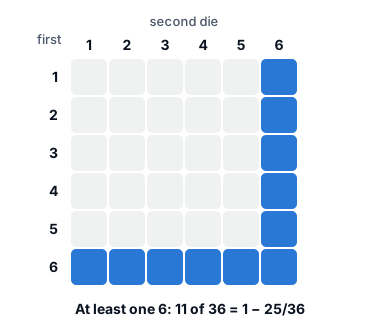
Check yourself. Two dice are rolled. What is the probability of at least one 6?
Check your answer
1 − (5/6)² = 1 − 25/36 = 11/36, the highlighted cells in the grid.
Without replacement
"Without replacement" means an item you draw is not put back. Multiply the probabilities draw by draw, and make the pool smaller after each draw. You get the same answer with combinations: favorable pairs ÷ all pairs.
Why it works. After the first draw the box really has one item fewer, and one fewer of that kind. The second probability must be counted from the box as it is then, not as it was.
How to spot it: "drawn at random without replacement", "two different people are chosen", "at the same time".
Example. A box of 20 bulbs contains 5 broken ones. Two bulbs are chosen at random. What is the probability that both work?
- Working bulbs: 20 − 5 = 15. First bulb works: 15/20.
- Now 19 bulbs are left, and 14 of them work. Second bulb works: 14/19.
- Multiply: 15/20 × 14/19 = (15 × 14) ÷ (20 × 19) = 210/380.
- Simplify (divide top and bottom by 10): 21/38.
Trap: (15/20)² = 9/16. This treats the draws as if the first bulb went back into the box.
Try it. A drawer has 4 red socks and 2 blue socks. You take 2 socks without looking. What is the probability that both are red?
Show the answer
- First sock red: 4/6.
- Second sock red (3 red left out of 5 socks): 3/5.
- Multiply: 4/6 × 3/5 = 12/30 = 2/5.
- Check with combinations: red pairs C(4, 2) = 6, all pairs C(6, 2) = 15, and 6/15 = 2/5. ✓
Explore. The sock drawer as a tree: 4 red and 2 blue, two draws. Multiply along a path, add the paths you want. Turn on "put the first one back" to see which branches change.
4 red and 2 blue: 6 in all. Draw two, without putting the first one back.
After one red is taken, 5 are left and only 3 of them are red.
Both red: 2/3 × 3/5 = 2/5 (0.4). Both blue: 1/3 × 1/5 = 1/15 (≈ 0.067).
One of each (either order): 4/15 + 4/15 = 8/15 (≈ 0.533).
At least one red = 1 − P(both blue) = 1 − 1/15 = 14/15 (≈ 0.933). The four ends add to 1.
Edge cases.
- "One of each" has two orders, red then blue and blue then red. Add both paths.
- The second draw alone is as likely to be red as the first: 4/6, even without replacement (nobody saw the first sock).
- A huge pool makes the two methods nearly equal; small pools make them differ a lot.
GRE-level example. A bag has 5 red and 3 green apples. Three are taken at random without replacement. What is the probability that exactly one is green?
- Count groups: favorable = C(3, 1) × C(5, 2) = 3 × 10 = 30. All groups = C(8, 3) = 56.
- P = 30/56 = 15/28.
- Check draw by draw: green, red, red has probability 3/8 × 5/7 × 4/6 = 60/336. The green apple can come first, second or third, and each order has the same probability, so 3 × 60/336 = 180/336 = 15/28 ✓.
Check yourself. In the sock drawer (4 red, 2 blue), what is the probability of getting one red and one blue sock?
Check your answer
4/6 × 2/5 + 2/6 × 4/5 = 8/30 + 8/30 = 16/30 = 8/15. (Check: 2/5 for both red + 1/15 for both blue + 8/15 = 1 ✓.)
With or without replacement: independent vs. dependent draws
Putting the first item back makes the two draws independent: the second draw sees the same bag. Keeping it out makes them dependent: the second draw's fractions depend on what came out first. Which matters for a QC is usually the structure, not the arithmetic.
Why it works. With replacement, P(both red) = (r/n) × (r/n). Without it, P(both red) = (r/n) × ((r − 1)/(n − 1)), and (r − 1)/(n − 1) is less than r/n whenever some marbles aren't red. Removing a red marble makes red rarer for the second draw.
How to spot it: two draws from one bag in a QC, with "put back" in one quantity and "not put back" in the other, or "first … and second …" in different orders.
Example. A bag has 5 red and 3 blue marbles; two are drawn one after the other without replacement. Quantity A: P(first red, second blue). Quantity B: P(first blue, second red).
- A: (5/8) × (3/7) = 15/56.
- B: (3/8) × (5/7) = 15/56.
- The same factors in a different order: the quantities are equal (C), for any numbers of red and blue marbles.
The second draw on its own. Without replacement, the chance that the second marble is red is still r/n: (5/8)(4/7) + (3/8)(5/7) = 20/56 + 15/56 = 35/56 = 5/8. Before anything is seen, every marble is equally likely to be the one drawn second.
Trap: thinking "not put back" lowers every later chance. It lowers the chance of a second red only once you know the first was red.
Edge cases.
- Both red with vs. without replacement: with replacement is always greater (more red left for the second draw).
- Both red vs. both blue without replacement: compare r(r − 1) with b(b − 1); if the counts aren't given, the answer can be (D).
- A huge bag makes the two cases nearly equal, but on a QC "nearly" still decides it.
GRE-level example. A bag holds only red and blue marbles, at least 2 of each, with more red than blue. Two are drawn without replacement. Quantity A: P(both red). Quantity B: P(first red, second blue).
- Both share the first factor r/n, so compare (r − 1)/(n − 1) with b/(n − 1): compare r − 1 with b.
- With more red than blue, r − 1 ≥ b, and r − 1 = b exactly when there is just one more red than blue.
- With 3 red and 2 blue the quantities are equal (2 and 2); with 4 red and 2 blue, A is greater. So the answer is (D).
Check yourself. A bag has 4 red and 6 blue marbles. Is P(both red) greater if the first marble is put back or if it isn't?
Check your answer
Put back: (4/10)² = 16/100 = 0.16. Not put back: (4/10)(3/9) = 12/90 ≈ 0.133. Putting it back gives the greater chance.
And/or rules
For "A or B", add the two probabilities and subtract the overlap, P(A and B), once. For "exactly one", take "A but not B" plus "B but not A". For groups of people with two traits, count as in a two-set Venn diagram, then divide by the total.
Why it works. Adding P(A) and P(B) counts the outcomes where both happen twice, just like the overlap in a Venn diagram; subtracting it once fixes that. Multiplying for "and" works for independent events because B happens the same share of the time whether or not A happened.
How to spot it: "A or B", "exactly one of", "neither", two things that can happen together.
Example. Events A and B are independent (one doesn't affect the other), with P(A) = 0.5 and P(B) = 0.4. Find P(A or B) and P(exactly one).
- Both: P(A and B) = 0.5 × 0.4 = 0.2.
- Or: P(A or B) = 0.5 + 0.4 − 0.2 = 0.7.
- Exactly one = (A or B) minus both: 0.7 − 0.2 = 0.5.
- Check: P(A, not B) = 0.5 × (1 − 0.4) = 0.5 × 0.6 = 0.3. P(B, not A) = (1 − 0.5) × 0.4 = 0.2. And 0.3 + 0.2 = 0.5. ✓
Trap: answering 0.5 + 0.4 = 0.9 for "or". This counts the 0.2 where both happen twice.
Edge cases.
- Events that can't happen together (mutually exclusive) have P(A and B) = 0, so P(A or B) = P(A) + P(B).
- Independent is not the same as mutually exclusive. Independent events with non-zero chances can certainly happen together.
- Dependent events: P(A and B) = P(A) × P(B, given that A happened).
GRE-level example. P(A) = 0.6, P(B) = 0.5, and the probability that neither happens is 0.1. What is P(A and B), and are A and B independent?
- P(A or B) = 1 − P(neither) = 0.9.
- P(A and B) = P(A) + P(B) − P(A or B) = 0.6 + 0.5 − 0.9 = 0.2.
- If they were independent, P(A and B) would be 0.6 × 0.5 = 0.3. It is 0.2, so they are not independent.
Check yourself. A card is drawn from cards numbered 1 to 20. What is the probability that its number is a multiple of 3 or a multiple of 4?
Check your answer
Multiples of 3: 6. Multiples of 4: 5. Both (12): 1. So (6 + 5 − 1)/20 = 10/20 = 1/2.
Probability with combinations
When a group is chosen at random, count the favorable groups and all possible groups with combinations. C(n, k) is the number of ways to choose k items from n when order doesn't matter. A favorable group is often built in pieces: choose the required members from one category, fill the other spots from the rest, then multiply.
Why it works. Every group of 3 marbles is equally likely to be drawn. So the probability is simply the share of all groups that are favorable, and combinations count both.
How to spot it: "a committee of k is chosen at random", "what is the probability that exactly…".
Example. Three marbles are drawn at random from 4 red and 6 blue marbles. What is the probability that exactly 2 are red?
- Exactly 2 red means 2 red and 1 blue.
- Ways to choose 2 red from 4: C(4, 2) = (4 × 3) ÷ 2 = 6. Ways to choose 1 blue from 6: C(6, 1) = 6.
- Favorable groups: 6 × 6 = 36.
- All groups of 3 from 10 marbles: C(10, 3) = (10 × 9 × 8) ÷ (3 × 2 × 1) = 720 ÷ 6 = 120.
- P = 36/120 = 3/10 (divide top and bottom by 12).
Dice and coins work the same way, but count ordered outcomes. Two dice give 6 × 6 = 36 equally likely results. A coin tossed 4 times gives 2 × 2 × 2 × 2 = 16 sequences. Exactly 2 heads means choosing which 2 of the 4 tosses are heads: C(4, 2) = 6 sequences. So P = 6/16 = 3/8.
Trap: counting only C(4, 2) and forgetting that the third marble must be blue.
Edge cases.
- Count the same way on top and bottom: both ordered or both unordered.
- A particular person on a random team: C(n − 1, k − 1)/C(n, k) = k/n.
- "At least" with groups: use the complement, or add the cases.
GRE-level example. A committee of 3 is chosen at random from 5 men and 4 women. What is the probability that it has more women than men?
- More women means 3 women, or 2 women and 1 man.
- 3 women: C(4, 3) = 4. 2 women and 1 man: C(4, 2) × 5 = 6 × 5 = 30. Favorable: 34.
- All committees: C(9, 3) = 84.
- P = 34/84 = 17/42.
Check yourself. A team of 3 is chosen at random from 9 people. What is the probability that Ana is on it?
Check your answer
C(8, 2)/C(9, 3) = 28/84 = 1/3 (that is, 3 of the 9 places).
How hard questions disguise it
For harder questions (L4–L5)
At L4, the complement hides behind wording like "not both blue" or "at least one red pen". At L5, probability combines with counting (the favorable count needs a restriction or a block), with overlapping sets (find "exactly one activity" from a Venn diagram, then divide), and with ratios (a ratio of red to blue fixes the probabilities before you know the counts). First decide whether order matters and whether items are replaced. Then count the top and the bottom of the fraction the same way.
Practice
Train these patterns with timed sets on the probability practice page.
Common traps
Adding or averaging probabilities of overlapping events
P(A or B) = P(A) + P(B) only when A and B can't both happen; otherwise subtract P(A and B). And 'both' is never more likely than either event alone, so averaging can't give it.
Taking the complement of the wrong event
The opposite of 'at least one' is 'none', not 'all'. And P(none) or P(the event) is a step, not the answer, when the question asks for the complement: subtract it from 1.
Adding the single chances for 'at least one'
A 0.3 chance each day for 3 days is not 0.9: adding counts the days with rain on two or three days more than once. Use 1 − (0.7)^3 = 0.657.
Treating dependent draws as independent
Without replacement, the second draw comes from a smaller pool, and you can multiply P(A) × P(B) only for independent events. Reduce both the favorable count and the total after each draw.
Counting only one draw, one person or one outcome
If the event needs several things to happen, or can happen in several ways, the probability must count all of them. Exactly 2 heads in 4 tosses happens in C(4,2) = 6 sequences, not one.
Answering a neighboring event
'Exactly one', 'at least one', 'both', 'either' and 'neither' are different events with different answers. List the cases that count before you compute.
Counting only part of the favorable group
A committee with exactly 2 women also needs its other seats filled with men, and 'not blue' includes every other color. Count every piece of the favorable outcome, and don't divide by an order factor your count never included.
Treating unequal outcomes as equally likely
Two dice give 11 possible sums, but a sum of 7 is far more likely than a sum of 2. Count the 36 equally likely ordered outcomes (or individual marbles, not colors) before dividing.