GRE Quant lesson · Mixtures
GRE mixture problems: concentrations, alligation and dilution
Mixture problems on GRE Quant: mixing two concentrations, the alligation shortcut, remove-and-replace, and evaporation or dilution, with worked examples.
The core idea
Track the pure substance: in any mixture, amount of substance = volume × concentration, and those amounts add. A mixture's concentration is a weighted average of the ingredients, so the volumes are in the inverse ratio of each ingredient's distance from the target.
Core ideas
Words used here
- Mixture or solution: a liquid made of a substance (such as acid, salt or juice) and water.
- Substance: the pure ingredient you track, such as the acid itself, without the water.
- Concentration: the percent of the mixture that is the substance. A 20% acid solution has 20 liters of acid in every 100 liters.
- Volume: how much liquid there is, for example in liters.
- Weighted average: an average where larger amounts count more.
- Alligation: a shortcut that finds the ratio of two ingredients from their distances to the target on a number line.
- Inverse ratio: a ratio with its numbers swapped. The inverse of 3 : 5 is 5 : 3.
- Dilute: add water. Evaporate: water dries up and leaves; the substance stays.
- Amount of substance = volume × concentration. 30 liters of a 40% acid solution contain 30 × 0.40 = 12 liters of acid.
- Substance amounts add when you mix. Concentrations do not add.
- Concentration of a mix = total substance ÷ total volume. It is a weighted average, so it always lies between the two ingredients' concentrations.
- Alligation: volume of A : volume of B = (B − target) : (target − A). Each ingredient's amount matches the other ingredient's distance from the target.
- Remove and replace: if you pour out a fraction f of the mixture and refill with water, the substance is multiplied by (1 − f) each time.
- Evaporation removes only water. The substance stays the same.
Try it. You mix 20 liters of 15% salt water with 30 liters of 5% salt water. What is the salt concentration of the mix?
Show the answer
- Salt in the first: 20 × 0.15 = 3 liters. Salt in the second: 30 × 0.05 = 1.5 liters.
- Total salt: 3 + 1.5 = 4.5 liters. Total volume: 20 + 30 = 50 liters.
- Concentration: 4.5 ÷ 50 = 0.09 = 9%. Check: 9% is between 5% and 15%, and closer to 5% because there is more of the 5% water. ✓
Mixing two concentrations
Write one equation for the pure substance (the acid, salt or juice itself): substance in A + substance in B = substance in the mix. Each amount is volume × concentration (the percent that is substance). Then solve for the unknown volume.
Why it works. Volumes add and the pure substance adds, but percents don't. So track the one thing that is kept when you mix, the pure substance, and write that it balances: what goes in equals what is in the mix.
How to spot it: "how many liters of an x% solution must be added to… to get a y% solution".
Example. How many liters of a 10% acid solution must be mixed with 30 liters of a 40% acid solution to make a 20% solution?
- Call the unknown volume x. Acid in it: 0.10x. Acid in the 30 liters: 0.40 × 30 = 12. The mix has x + 30 liters, so its acid is 0.20(x + 30).
- Equation: 0.10x + 12 = 0.20(x + 30).
- Multiply out the right side: 0.20x + 6. So 0.10x + 12 = 0.20x + 6.
- Subtract 0.10x from both sides: 12 = 0.10x + 6. Subtract 6: 6 = 0.10x.
- x = 6 ÷ 0.10 = 60 liters.
- Check: acid = 0.10 × 60 + 12 = 6 + 12 = 18 liters in 60 + 30 = 90 liters. 18 ÷ 90 = 0.2 = 20%. ✓
Trap: answering 90, the final volume.
See it. The example on a number line: the 10% and 40% solutions are 10 and 20 points from the 20% target. The amounts go in the reverse ratio, 20 : 10 = 2 : 1, so the 90-liter mix holds 60 liters of the weak solution and 30 of the strong one. Move the target to see the split change.
Weak 10% is 10 below the mix at 20%; strong 40% is 20 above it.
Amounts go in the reverse ratio of the distances: weak : strong = 20 : 10 = 2 : 1.
Why: the gains and losses balance. 2 × 10 = 1 × 20 = 20.
In 90 units of mix: weak = 2/3 × 90 = 60, strong = 30.
Edge cases.
- Pure substance is 100%, and water is 0%. Adding pure acid means adding at concentration 1.00; adding water means adding at 0.
- The target must lie between the two strengths. You can't make a 50% solution from 10% and 40% solutions.
- Answer what is asked: the amount added (60 liters) or the final volume (90 liters).
GRE-level example. How many liters of pure acid must be added to 40 liters of a 15% acid solution to make a 32% solution?
- Acid now: 0.15 × 40 = 6 liters. Add x liters of pure acid (100% acid).
- Acid after: 6 + x. Volume after: 40 + x. So 6 + x = 0.32(40 + x).
- Multiply out: 6 + x = 12.8 + 0.32x.
- Collect: 0.68x = 6.8, so x = 10 liters.
- Check: 16 liters of acid in 50 liters is 16 ÷ 50 = 32% ✓.
Check yourself. You mix 10 liters of a 30% solution with 15 liters of a 50% solution. What is the concentration of the mix?
Check your answer
Substance: 3 + 7.5 = 10.5 liters in 25 liters. 10.5 ÷ 25 = 42%. It is closer to 50% because there is more of the 50% solution ✓.
The alligation shortcut
Alligation is a shortcut for the ratio of two ingredients. Put the two ingredients and the target on a number line. Each ingredient's share equals the distance from the other ingredient to the target. This is an inverse ratio of the distances.
Why it works. The blend balances like a seesaw. Each pound of cheap coffee is $1.50 below the blend price; each pound of expensive coffee is $2.50 above it. For the total value to come out right, the shortfalls and the extras must cancel: (pounds of cheap) × 1.50 = (pounds of expensive) × 2.50. That is exactly cheap : expensive = 2.50 : 1.50.
How to spot it: two ingredients (prices, concentrations, scores) and a target average, with a ratio or amount asked.
Example. Coffee at $6 per pound is mixed with coffee at $10 per pound to make a blend worth $7.50 per pound. In what ratio are they mixed?
- Distances to the target: cheap 7.50 − 6 = 1.50; expensive 10 − 7.50 = 2.50.
- Swap them: cheap : expensive = 2.50 : 1.50.
- Multiply both by 2 to get whole numbers: 5 : 3. So the ratio is 5 : 3.
- Check: 5 pounds at $6 = $30, and 3 pounds at $10 = $30. Total $60 for 8 pounds, and 60 ÷ 8 = $7.50. ✓
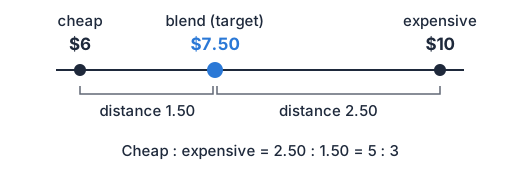
Why swap? The blend price is closer to the cheap coffee, so the blend must contain more cheap coffee.
Trap: writing 3 : 5. That puts more of the expensive coffee into a blend priced near the cheap one.
Explore. Move the blend price between $6 and $10. The distances, the ratio and the split of a 40-pound batch update together.
Cheap $6 is 1.5 below the mix at $7.50; expensive $10 is 2.5 above it.
Amounts go in the reverse ratio of the distances: cheap : expensive = 2.5 : 1.5 = 5 : 3.
Why: the gains and losses balance. 5 × 1.5 = 3 × 2.5 = 7.5.
In 40 units of mix: cheap = 5/8 × 40 = 25, expensive = 15.
Edge cases.
- It works for any weighted average: prices, test scores, interest rates, and speeds over equal times (not equal distances).
- The target must be strictly between the two values. At an end, the mix is all one ingredient.
- Three ingredients need more information, such as the ratio of two of them.
GRE-level example. A class's average score is 78. The boys average 72 and the girls average 82. There are 30 students. How many are girls?
- Distances to the class average: boys 78 − 72 = 6, girls 82 − 78 = 4.
- Swap them: boys : girls = 4 : 6 = 2 : 3.
- 30 students in 5 parts: one part is 6, so girls = 3 × 6 = 18.
- Check: 12 × 72 + 18 × 82 = 864 + 1,476 = 2,340, and 2,340 ÷ 30 = 78 ✓.
Check yourself. How many kilograms of $4 nuts must be mixed with 6 kg of $9 nuts to make a mix worth $6 per kilogram?
Check your answer
Distances: $4 is 2 below $6, and $9 is 3 above. So cheap : expensive = 3 : 2. With 6 kg of expensive nuts (2 parts), one part is 3 kg, so 9 kg of the $4 nuts. Check: 36 + 54 = 90, and 90 ÷ 15 = 6 ✓.
Remove and replace
When you pour out part of a mixture, you pour out substance and water in the same proportion as the mixture. So each time a fraction f of the mixture is removed and replaced with water, the substance left is multiplied by (1 − f).
Why it works. Pouring from a well-mixed tank takes every ingredient in its current proportion. After the first refill the tank is 3/4 juice, so the next 10 liters poured out are 3/4 juice too. Each step keeps the same fraction of what is there, which is why the factors multiply.
How to spot it: "some of the mixture is drained and replaced with water", repeated steps.
Example. A 40-liter tank is full of pure juice. Ten liters are removed and replaced with water. Then this is done once more. How much juice is left?
- Each time, 10 of the 40 liters are removed: 10/40 = 1/4 of everything, including 1/4 of the juice. So each step keeps 1 − 1/4 = 3/4 of the juice.
- After step 1: 40 × 3/4 = 30 liters of juice (and 10 liters of water).
- After step 2: 30 × 3/4 = 22.5 liters of juice.
In one line: 40 × (3/4)² = 40 × 9/16 = 22.5.
Trap: subtracting 10 liters twice (20 liters left). The second 10 liters removed are only 3/4 juice: 7.5 liters of juice and 2.5 liters of water. So 30 − 7.5 = 22.5.
Edge cases.
- Refilling with something other than water. Track the ingredient that is only removed, never added. If you refill with pure alcohol, track the water.
- The fraction uses the whole tank: 10 liters out of 40 is 1/4, whatever the mix inside.
- The substance never reaches 0. Each step keeps a fraction of what is left.
GRE-level example. A 60-liter container is full of a 50% alcohol solution. 15 liters are removed and replaced with pure alcohol. What is the new concentration?
- Alcohol is added, so track the water. Water at first: 0.5 × 60 = 30 liters.
- Removing 15 of 60 liters takes 1/4 of everything, so 3/4 of the water stays: 30 × 3/4 = 22.5 liters.
- The refill is pure alcohol, so it adds no water. Water: 22.5 of 60 liters.
- Alcohol: 60 − 22.5 = 37.5 liters, so the concentration is 37.5 ÷ 60 = 62.5%.
Check yourself. A 20-liter tank of pure milk has 4 liters replaced by water, three times in a row. How much milk is left?
Check your answer
Each step keeps 1 − 4/20 = 4/5 of the milk: 20 × (4/5)³ = 20 × 64/125 = 10.24 liters.
Evaporation and dilution
When water evaporates (dries up) or is added (dilution), the amount of substance stays the same. Only the volume changes. Find the substance first. Then divide it by the new concentration to get the new volume.
Why it works. Evaporation and dilution change only the water. The substance is the anchor: find it first, and the new concentration then fixes the new volume (substance ÷ concentration).
How to spot it: "water evaporates", "how much water must be added to dilute".
Example. 50 liters of a solution that is 12% salt is left to evaporate until it is 20% salt. How much water evaporates?
- Salt: 0.12 × 50 = 6 liters. This doesn't change.
- New volume: the 6 liters must be 20% of it, so 0.20 × V = 6 and V = 6 ÷ 0.20 = 30 liters.
- Water evaporated: 50 − 30 = 20 liters.
Trap: answering 30 (the new volume), or reducing the salt along with the water.
Try it. You have 12 liters of a 25% sugar syrup. How much water must you add to make it 10% sugar?
Show the answer
- Sugar: 0.25 × 12 = 3 liters. It doesn't change.
- New volume: 3 ÷ 0.10 = 30 liters.
- Water to add: 30 − 12 = 18 liters.
Edge cases.
- Doubling the concentration halves the volume. From 12% to 24%, half of the solution remains.
- The percent of water can be the given one. "90% water" means 10% solids, and the solids stay the same when water dries off.
- A concentration can't pass 100%. No amount of evaporation turns 12% salt water into more than pure salt.
GRE-level example. Fresh grapes are 90% water by weight; dried grapes are 20% water. How many kilograms of fresh grapes are needed to make 5 kg of dried grapes?
- The solid part doesn't dry off. Dried grapes are 80% solids: 0.8 × 5 = 4 kg of solids.
- In fresh grapes those 4 kg are only 10% of the weight: 0.10 × W = 4.
- W = 4 ÷ 0.10 = 40 kg.
- Check: 40 kg of fresh grapes hold 4 kg of solids and 36 kg of water. Drying off 35 kg leaves 5 kg, with 1 kg (20%) water ✓.
Check yourself. 200 g of a 5% salt solution is heated until it is 8% salt. How much water evaporates?
Check your answer
Salt: 10 g. New total: 10 ÷ 0.08 = 125 g. Water evaporated: 200 − 125 = 75 g.
Mixture comparisons on the GRE
The GRE gives you an on-screen calculator, so messy arithmetic is never the obstacle; the faster route is still to reason first and calculate only what the comparison needs.
- Quantitative Comparison (QC). The plain average of two concentrations is the classic Quantity B. The mixture equals it only when the volumes are equal; otherwise it leans toward the larger volume.
- Example. 3 liters of a 20% salt solution are mixed with 1 liter of a 60% salt solution. Quantity A: the percent of salt in the mixture. Quantity B: 40%.
- Salt: 0.6 + 0.6 = 1.2 liters in 4 liters, so the mixture is 30%. The answer is (B).
- Without a total. Alligation fixes the ratio of the volumes, so "the volume of the 85% solution" against "the volume of the 45% solution" is decided. Against a number of liters it isn't, unless the total is given: that's (D).
- Replacing twice. Draining a fraction f and refilling with water twice keeps (1 − f)² of the solute, which is more than the 1 − 2f kept by one draining of twice as much.
- Numeric Entry (NE). A volume can be a fraction. Then the question gives two boxes, numerator and denominator, and the fraction doesn't need to be reduced; with one box, type a decimal.
How hard questions disguise it
For harder questions (L4–L5)
L4 versions mix three ingredients, or give a ratio and ask for a volume. At L5, mixtures are weighted averages in disguise: a class average from two sections, an average price from two products, or an average speed weighted by time all use the same distance-ratio logic. Ask what is being averaged and what the weights are.
Practice
Practice mixture questions in timed sets on the mixtures practice page.
Common traps
Averaging concentrations without weighting
Mixing 10% and 40% gives 25% only with equal volumes, and concentrations never add or subtract. Weight each concentration by its own volume; the result always lies between the two.
Flipping the alligation ratio
The ingredient closer to the target is used in larger amounts. Each amount matches the OTHER ingredient's distance from the target, and the prices themselves don't set the ratio.
Measuring the wrong distance
Distances are measured from each ingredient to the target, not between the two ingredients. Write all three numbers on a line before subtracting.
Answering a different amount than asked
Mixture problems produce the final volume, the substance, the water and the amount added. Reread the last line, and subtract the starting amount if you solved for a total.
Treating a percent as an amount
p% of V liters is (p/100) × V liters. Keep liters and percentage points separate, and convert each percent once, carefully.
Forgetting the removed part carries substance with it
Pouring out mixture removes substance in the mixture's concentration, and replacing it keeps the volume the same. Each remove-and-replace step multiplies the substance by the fraction kept; count the steps.
Holding the wrong thing fixed
When water is added or evaporates, the substance stays fixed and the volume changes. Find the substance, then divide it by the target concentration to get the new total.
Leaving water out of a mixture's volume
Acid in = acid out. Water adds volume but no acid, so it appears only in the final total. Collect the unknown on one side: (p − r) × A = r × (other volume) − acid already present.
Mixture comparisons: GRE traps
A mixture's percent is a weighted average that leans toward the larger volume; the alligation ratio compares volumes without a total, but liters need the total.