SAT Math lesson · Words to equations
SAT word problems: writing equations and expressions for a situation
How to translate SAT word problems into equations and expressions: 'more than' and 'times as many' relationships, expressions for a charge or a plan, equations that compare two situations, two-item purchases, how many of each item, and age problems.
The core idea
SAT translation questions usually ask which equation or expression represents a situation. Name what each letter stands for, build each part of the story separately (a one-time amount, an amount per unit, the units that are actually charged), and read phrases like 'c more than k times x' in order: kx + c. Test a choice with a small number to check it matches the story.
Core ideas
Words used here
- Variable: a letter, such as x, that stands for a number you don't know yet.
- Expression: numbers and letters joined by +, −, × or ÷, such as 3x + 5. It has no "=" sign.
- Equation: two expressions with "=" between them, such as 3x + 5 = 20.
- "k times as many as A": k × A, written kA.
- "c more than": add c. "c less than" or "c fewer than": subtract c.
- Evenly spaced: numbers with the same gap between neighbors, such as 5, 8, 11, 14 (gap 3). This is also called an arithmetic sequence.
- Whole number: 0, 1, 2, 3 and so on, with no fractions. Counts of people and items must be whole numbers.
- Pick one variable for the amount that the other amounts are described from.
- Translate phrase by phrase: "is" → =, "of" → ×, "more than" → +, "less than" → subtract from the thing named after it. So "5 less than x" is x − 5.
- "k times as many as A" is kA. "c more than k times A" is kA + c: multiply first, then add.
- Ages: in y years, every person's age goes up by y. y years ago, every age was y less.
- Solving: undo the last step first. In 3B + 4 = x, B was multiplied by 3 and then 4 was added. So first subtract 4 from both sides (3B = x − 4), then divide both sides by 3: B = (x − 4)/3.
- Answer the question asked. Your variable may be a different amount.
Try it. (a) Sam has 7 more than twice as many stamps as Kim. Kim has 15. How many does Sam have? (b) Ten less than 4 times a number is 30. What is the number?
Show the answer
(a) "Twice as many as Kim" is 2 × 15 = 30. "7 more than" that is 30 + 7 = 37.
(b) Let the number be x. "4 times a number" is 4x, and "ten less than" it is 4x − 10. So 4x − 10 = 30. Add 10 to both sides: 4x = 40. Divide by 4: x = 10. Check: 4 × 10 − 10 = 30. ✓
Age problems
Write each person's age now using one variable. Then, for the other point in time, add or subtract the same number of years for everyone. Write the relationship given for that time as an equation.
Why it works. Time passes equally for everyone, so every age changes by the same number of years. That means the difference between two ages never changes, while their ratio does.
How to spot it: "is now… years old", "in y years", "z years ago".
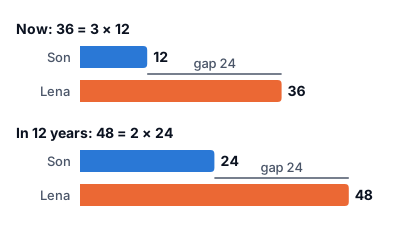
Example. Lena is 3 times as old as her son. In 12 years, she will be twice as old as he is. How old is the son now?
| Now | In 12 years | |
|---|---|---|
| Son | s | s + 12 |
| Lena | 3s | 3s + 12 |
- In 12 years, Lena's age is twice her son's: 3s + 12 = 2(s + 12).
- Multiply out the right side: 3s + 12 = 2s + 24.
- Subtract 2s from both sides: s + 12 = 24.
- Subtract 12 from both sides: s = 12.
- Check: now the son is 12 and Lena is 36 (3 × 12). In 12 years they are 24 and 48, and 48 = 2 × 24. ✓
Evenly spaced ages. Four children were born 3 years apart, and their ages add up to 38. How old are they?
- Average age: 38 ÷ 4 = 9.5.
- For evenly spaced numbers, the average is exactly halfway between the two middle numbers. The two middle ages are 3 years apart, so each is 3 ÷ 2 = 1.5 years from the average: 9.5 − 1.5 = 8 and 9.5 + 1.5 = 11.
- Step out by 3 years on each side: 8 − 3 = 5 and 11 + 3 = 14. The ages are 5, 8, 11 and 14.
- Check: 5 + 8 + 11 + 14 = 38. ✓
With algebra instead: call the youngest x. Then x + (x + 3) + (x + 6) + (x + 9) = 38, so 4x + 18 = 38, 4x = 20 and x = 5.
Trap: writing 3s + 12 = 2s. That adds 12 years to Lena but not to her son.
Edge cases.
- Differences stay fixed; ratios don't. Lena is 3 times her son's age now but only 2 times in 12 years.
- "Years ago" can't go below 0. If an answer makes someone's past age negative, it is wrong.
- "When A was as old as B is now" means (A − B) years ago.
Harder example. Five years ago, Priya was 3 times as old as Omar. In 10 years, Priya will be 1.5 times as old as Omar. How old is Priya now?
- Use their ages five years ago: Omar o and Priya 3o.
- "In 10 years" is 15 years after that point: Omar o + 15 and Priya 3o + 15.
- Equation: 3o + 15 = 1.5(o + 15) = 1.5o + 22.5.
- Subtract 1.5o and 15: 1.5o = 7.5, so o = 5.
- Five years ago Priya was 15, so she is now 20 (and Omar is 10).
- Check: in 10 years they are 30 and 20, and 30 = 1.5 × 20 ✓.
Check yourself. Ana is 28 and Ben is 8. In how many years will Ana be exactly twice as old as Ben?
Check your answer
28 + y = 2(8 + y), so 28 + y = 16 + 2y and y = 12. Check: they will be 40 and 20. The gap is always 20, so Ana is twice Ben's age when Ben is 20.
Two-item purchases
Use one variable for one item. Write the other item's amount using the link given in the question. Then write the total cost as an equation.
Why it works. The link between the counts ("twice as many") turns two unknowns into one. Then the total cost gives one equation with one unknown.
How to spot it: two items with known prices and a link between their quantities.
Example. Jay buys twice as many apples as pears. Apples cost $0.50 each and pears cost $0.80 each. He spends $9.00. How many apples does he buy?
- Pears: p. Apples: 2p.
- Cost of apples: 0.50 × 2p = 1.00p. Cost of pears: 0.80p.
- Total: 1.00p + 0.80p = 1.80p, so 1.80p = 9.00.
- p = 9.00 ÷ 1.80 = 90 ÷ 18 = 5 pears, so apples = 2 × 5 = 10.
- Check: 10 × $0.50 = $5.00 and 5 × $0.80 = $4.00. $5.00 + $4.00 = $9.00. ✓
When the counts are not linked, whole numbers do the work. Adult tickets cost $8 and child tickets cost $5, and a group pays exactly $61. How many people can be in the group?
- With a adults and c children: 8a + 5c = 61.
- The children's part, 5c, is a multiple of 5. So 61 − 8a must be a multiple of 5: it must end in 0 or 5.
- Try a = 0, 1, 2, … until 8a is more than 61. The values of 61 − 8a are 61, 53, 45, 37, 29, 21, 13, 5.
- Only two work. a = 2 gives 5c = 45, so c = 9 (11 people). a = 7 gives 5c = 5, so c = 1 (8 people).
- So the group has 11 or 8 people, and the largest possible group is 11.
Trap: answering 5, the number of pears.
Edge cases.
- Whole numbers can stand in for a second equation. Counts must be whole, which can leave only a few possible answers (as in the ticket example).
- "At least one of each" rules out answers with a count of 0.
- Use one unit. Work in cents if the prices mix dollars and cents.
SAT-level example. Pens cost $3 and notebooks cost $7. Lee spends exactly $100 and buys at least one of each. What is the greatest number of items she could buy?
- With p pens and n notebooks: 3p + 7n = 100.
- Pens are cheaper, so more items means as few notebooks as possible.
- Try n = 1: 3p = 93, so p = 31. This works, and n can't be smaller (at least one notebook).
- Greatest number of items: 31 + 1 = 32.
- Check: 31 × 3 + 1 × 7 = 93 + 7 = 100 ✓.
Check yourself. With the same prices and the same $100, what is the least number of items she could buy?
Check your answer
Now use as many notebooks as possible. 100 − 7n must be a positive multiple of 3. n = 13 gives 100 − 91 = 9, so p = 3 (n = 14 leaves 2, which doesn't work). Least: 13 + 3 = 16 items.
"More than" and "times as many"
Translate in order. "c more than k times A" is kA + c, and "c fewer than k times A" is kA − c. Then use the total to solve.
Why it works. The sentence builds the expression in a fixed order: "c more than k times A" first takes k times A, then adds c. Testing your expression with a small number catches order mistakes before they cost you.
How to spot it: "more than", "fewer than", "times as many as".
Example. Mia has 4 fewer than 3 times as many cards as Raj. Together they have 52 cards. How many does Mia have?
- Raj: R. Mia: 3R − 4.
- Together: R + (3R − 4) = 52, so 4R − 4 = 52.
- Add 4 to both sides: 4R = 56. Divide by 4: R = 14.
- Mia: 3 × 14 − 4 = 42 − 4 = 38. Check: 14 + 38 = 52. ✓
Trap: writing 3(R − 4), which subtracts the 4 before multiplying. Test your expression with a small number: if Raj had 10 cards, Mia should have 3 × 10 − 4 = 26, but 3 × (10 − 4) = 18.
Edge cases.
- "Less than" reverses the order. "5 less than x" is x − 5, not 5 − x.
- Percent wording: "x is 20% more than y" is x = 1.2y.
- "A exceeds B by 7" means A = B + 7.
SAT-level example. Box B holds 6 more than twice as many balls as box A. Box C holds 3 fewer than box B. The three boxes hold 79 balls in all. How many balls are in box C?
- Box A: a. Box B: 2a + 6. Box C: (2a + 6) − 3 = 2a + 3.
- Total: a + (2a + 6) + (2a + 3) = 5a + 9 = 79.
- So 5a = 70 and a = 14.
- Box C: 2(14) + 3 = 31.
- Check: 14 + 34 + 31 = 79 ✓.
Which equation represents it? The SAT often stops at the equation. "A florist has r roses and t tulips. The number of roses is 12 more than twice the number of tulips." The sentence is about roses, so r is alone: r = 2t + 12. The traps: t = 2r + 12 (relationship reversed), r = 2(t + 12) (12 added before doubling), r = 12t + 2 (numbers swapped). With "less than": "4 less than 3 times b" is 3b − 4, never 4 − 3b.
Check yourself. Two numbers add to 40. One of them is 4 less than 3 times the other. What is the larger number?
Check your answer
x + (3x − 4) = 40, so 4x = 44 and x = 11. The other is 3(11) − 4 = 29. The larger is 29.
How many of each
Two kinds of items, a total count and a total value: first pretend every item is the cheaper or smaller kind. The value that is missing must come from the other kind. Each swap to the other kind adds the difference between the two.
Why it works. Starting from "all chickens" gets the number of heads right. Swapping one chicken for one goat keeps the heads the same and adds exactly 2 legs. So the number of swaps (goats) is the missing legs ÷ 2.
How to spot it: two kinds of items, a total number of items and a total of something else (cost, legs, points).
Example. A farm has chickens and goats: 40 heads and 112 legs. How many goats are there?
- If all 40 animals were chickens (2 legs each): 40 × 2 = 80 legs.
- Missing legs: 112 − 80 = 32.
- Each goat has 4 − 2 = 2 more legs than a chicken.
- Goats: 32 ÷ 2 = 16. Chickens: 40 − 16 = 24.
- Check: 16 × 4 + 24 × 2 = 64 + 48 = 112. ✓
With algebra: g goats and 40 − g chickens give 4g + 2(40 − g) = 112. So 4g + 80 − 2g = 112, then 2g = 32 and g = 16.
Trap: dividing the 32 extra legs by 4 instead of by the difference of 2.
Try it. A jar holds 25 coins, all 5-cent and 10-cent coins, worth $1.90 in total. How many 10-cent coins are there?
Show the answer
- Work in cents: $1.90 = 190 cents.
- If all 25 were 5-cent coins: 25 × 5 = 125 cents.
- Missing: 190 − 125 = 65 cents. Each 10-cent coin adds 10 − 5 = 5 cents.
- 10-cent coins: 65 ÷ 5 = 13. Check: 13 × 10 + 12 × 5 = 130 + 60 = 190. ✓
Edge cases.
- Impossible data. 40 heads and 113 legs: the missing 33 legs isn't a multiple of 2, so no answer exists.
- A negative count means the totals don't fit, or you started from the wrong kind.
- Penalties work too. If a wrong answer loses points, the "difference" is the right-answer points plus the penalty.
SAT-level example. A test has 40 questions. A right answer earns 3 points and a wrong answer loses 1 point. Sam answered every question and scored 88. How many did he get wrong?
- If all 40 were right: 40 × 3 = 120 points.
- Missing: 120 − 88 = 32 points.
- Changing one right answer to a wrong one costs 3 + 1 = 4 points (the 3 he loses plus the 1 taken away).
- Wrong answers: 32 ÷ 4 = 8.
- Check: 32 right and 8 wrong give 96 − 8 = 88 ✓.
Check yourself. A shop has 30 bikes and trikes with 74 wheels in all. How many trikes are there?
Check your answer
All bikes would have 60 wheels. The extra 14 wheels come from trikes, 1 extra wheel each: 14 trikes (and 16 bikes). Check: 32 + 42 = 74 ✓.
Expressions and equations for a situation
Build the expression in pieces that match the story: what is paid (or counted) once, what is paid per unit, and how many units that per-unit amount applies to. For "when will they be equal" questions, write one expression for each side and set them equal.
Why it works. Each phrase of the story becomes one term. A one-time charge is a constant. A charge "for each additional hour" applies to every hour except the first, so it multiplies h − 1, not h. "Beyond 5 gigabytes" applies to g − 5 gigabytes. Two amounts that change over time are equal when their expressions are equal.
How to spot it: "Which expression represents the total charge for h hours?", "Which equation can be solved to find w, the number of weeks when they will have the same amount?"
Example. A parking garage charges $12 for the first hour and $4.50 for each additional hour. Which expression gives the charge, in dollars, for h hours (h a positive whole number)?
- The first hour: 12.
- The other h − 1 hours: 4.5 each, so 4.5(h − 1).
- In all: 12 + 4.5(h − 1).
- Test h = 1: 12 + 0 = 12 ✓. Test h = 3: 12 + 9 = 21, and the story gives 12 + 4.50 + 4.50 = 21 ✓.
Trap: 12 + 4.5h charges the first hour twice (test h = 1: it gives 16.50, not 12).
Example (equation). Ana has $120 and adds $25 each week; Ben has $300 and adds $10 each week. Which equation finds w, the number of weeks until they have the same amount?
- After w weeks: Ana has 120 + 25w, Ben has 300 + 10w.
- Equal amounts: 120 + 25w = 300 + 10w. (Solving: 15w = 180, w = 12.)
Trap: 120 + 10w = 300 + 25w attaches each weekly amount to the wrong person; 120w + 25 = 300w + 10 multiplies the starting amounts by w.
Check yourself. A phone plan costs $35 a month, including 5 gigabytes. Each gigabyte beyond 5 costs $8. Which expression gives the monthly cost for g gigabytes, where g > 5?
Check your answer
35 + 8(g − 5). Only the gigabytes beyond 5 cost extra. Test g = 7: 35 + 16 = 51, which matches 35 plus two extra gigabytes at $8.
Translation questions on the SAT
- Four choices of equations or expressions. Many SAT questions stop at "which equation represents this situation?" Test a choice with a small, easy number from the story before you trust it.
- Typed answers (SPR). When you solve, the answer is usually a whole number. Check it in the story (does the total come out exactly?) and type it without units or commas.
- Graphing calculator. For "when will they be equal" questions, graph both sides (y = 120 + 25x and y = 300 + 10x) and read the intersection; the x-coordinate is the answer.
- Whole-number solutions. With 3p + 5n = 46 and at least one of each, there are three answers (12 and 2, 7 and 5, 2 and 8). The SAT then asks for one specific case, such as the greatest number of pens: read the condition, then test.
How hard questions disguise it
For harder questions (L4–L5)
L4 versions link three people or amounts in a chain ("A has twice as many as B, and B has 6 more than C"), or ask for a combination, such as the sum of two ages in 5 years. Harder questions ask for an expression with a threshold ("each additional hour", "beyond 5 gigabytes"), lead into inequalities ("what is the greatest number of $7 items she can buy?"), or into systems of equations (two equations, one for the count and one for the money). Define one variable, write everything in terms of it, and check your final number against every sentence.
For two-ticket totals like 8a + 5c = 61, the answers repeat in a pattern: 5 more adults and 8 fewer children keep the total the same (5 × $8 = 8 × $5 = $40). So from (2 adults, 9 children) the next answer is (7, 1).
Practice
Practice translating word problems in timed sets on the word problems practice page.
Common traps
Aging only one person
In y years, everyone is y years older. Add y to every person's age before writing the 'twice as old' equation.
Mixing up now, then and later
Age problems have more than one point in time. Make a small table with rows for people and columns for past, now and future, move between columns by adding or subtracting years, and check which column the question asks about.
Answering for the wrong person, kind or total
After solving for your variable, check whether it is the quantity asked for. Often you solve for one person or one kind and must then compute the other, or the total.
Mistranslating 'more than' and 'times as many'
'5 more than 3 times A' is 3A + 5: multiply first, then add once, and describe the right person in terms of the other. Test your expression with a small number for A.
Writing '5 less than x' as 5 − x
'5 less than x' means start at x and take 5 away: x − 5. The order of the words is the reverse of the order in the expression.
Undoing the equation in the wrong order
To get B alone in 3B + 4 = x, first subtract 4 from both sides: 3B = x − 4. Then divide both sides by 3: B = (x − 4)/3. Undo the last operation first.
Miscounting the gaps between evenly spaced ages
n children born d years apart have n − 1 gaps, so the oldest is (n − 1)d years older than the youngest. Their average is the middle age, not the oldest.
Assuming every item is the larger kind
Start by assuming every item is the smaller kind; each larger item adds only the difference. Divide the shortfall by that difference, not by the larger item's full size.
Ignoring a whole-number or 'at least one' condition
Counts of people and tickets must be whole numbers that meet every condition. Test the allowed values one by one, and check whether the question wants the largest or the smallest group.
Assuming the two kinds are split evenly
Nothing says there are equally many of each kind. Use the second total, such as the number of guests or the cost, to find the split.
Reversing the relationship or misplacing the numbers
'The number of roses is 12 more than twice the number of tulips' is r = 2t + 12: the subject of the sentence is alone on one side, the multiplier goes with the other count, and the 12 is added once at the end.
Charging the wrong units
If the first hour costs $c and each additional hour $d, h hours cost c + d(h − 1): only h − 1 hours are 'additional'. Test h = 1: the expression must give c.
Whole-number solutions and 'more than' phrases
With whole-number counts, one equation in two unknowns can have a few solutions; list them all before deciding a comparison, and read 'c more than m times' as m × count + c.