SAT Math lesson · Inequalities
SAT inequalities: inequalities in context, systems of inequalities, and sign rules
Linear inequalities for SAT Math: writing an inequality for a budget or a limit, the greatest or least whole number that works, points in the solution of a system of inequalities, flipping when multiplying by a negative, combining ranges, and quadratic sign charts.
The core idea
Inequalities solve like equations with one extra rule: multiplying or dividing by a negative number flips the sign. On the SAT most inequality questions are stories: 'at most' is ≤, 'at least' is ≥, and a count of items is a whole number, so round in the direction the question allows. A point solves a system of inequalities only when it makes every inequality true.
Core ideas
Words used here
- Inequality: a statement that one side is smaller or larger: < (less than), ≤ (less than or equal to), > (greater than), ≥ (greater than or equal to).
- Strict inequality: < or >. The two sides can't be equal, so the boundary value is not included.
- Boundary (or endpoint): the value where the two sides are equal. It is the end of a range.
- Compound inequality: an inequality with three parts, such as −4 < 2x + 6 ≤ 10.
- Flip: reverse the direction of the sign, so < becomes > and ≤ becomes ≥.
- Quadratic: an expression with x² in it, such as x² − x − 12.
- Root: a value of x that makes an expression equal to 0.
- Integer: a whole number, such as −3, 0 or 8.
- Counterexample: one value that makes a statement false.
- Adding or subtracting the same number on both sides keeps the direction of the sign.
- Multiplying or dividing both sides by a positive number keeps the direction. By a negative number, flip the sign. Why: 2 < 5 is true. Multiply both sides by −1 and you get −2 and −5. Now −2 is the larger number, so −2 > −5.
- Compound inequalities: do each step to all three parts.
- Largest or smallest value of an expression: try the ends of each range. For a product, try every pair of ends.
- Quadratics: factor, find the roots, and test the sign in each region around them.
On the SAT
- Stories: most inequality questions describe a limit or a goal ("a van can carry at most 2,000 pounds") and ask which inequality fits, or for the greatest or least whole number that works.
- Typed answers (SPR): a count is typed as a whole number, so round the way the question allows: down for "greatest", up for "least".
- Graphing calculator: Desmos shades the region of an inequality such as y > 2x − 3. For a system, enter both inequalities and look for the overlap; then confirm by substituting the point.
Try it. Solve 4x − 7 ≥ 9.
Show the answer
- Add 7 to both sides: 4x ≥ 16.
- Divide both sides by 4 (a positive number, so no flip): x ≥ 4.
- Check: x = 4 gives 16 − 7 = 9, and 9 ≥ 9 ✓.
Solving a linear inequality
Get the variable alone, as you would in an equation. In a compound inequality (three parts), do every step to all three parts.
Why it works. Adding or subtracting the same number slides both sides the same distance along the number line, so their order can't change. Dividing by a positive number shrinks or stretches the line without turning it around, so the order is kept as well.
How to spot it: a linear expression (no x²) with <, ≤, > or ≥, often with "how many integers".
Example. How many integers satisfy −4 < 2x + 6 ≤ 10?
- Subtract 6 from all three parts: −10 < 2x ≤ 4.
- Divide all three parts by 2: −5 < x ≤ 2.
- The < means −5 is not included. The ≤ means 2 is included.
- Integers: −4, −3, −2, −1, 0, 1, 2. Count: last − first + 1 = 2 − (−4) + 1 = 7.
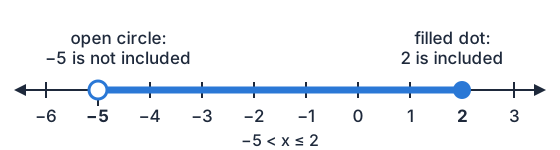
On a number line, an open circle marks an endpoint that is not included (< or >). A filled dot marks an endpoint that is included (≤ or ≥).
Trap: including −5, which the strict < leaves out.
Try it on the number line. Move the two ends and choose whether each one is included. The readout counts the integers in the range.
−5 < x ≤ 2.
So −5 < x ≤ 2. Open dot at −5, filled dot at 2.
Integers in it: −4, −3, −2, −1, 0, 1, 2, which is 2 − (−4) + 1 = 7 integers.
Edge cases.
- Ends that aren't integers. −2.5 < x ≤ 3.5 contains the integers −2 to 3. Find the first and last integers inside the range before you use last − first + 1: 3 − (−2) + 1 = 6.
- An empty range. 5 < x < 5 contains no numbers at all.
- "And" vs. "or". "x > 2 and x < 7" is one range, 2 < x < 7. "x < 2 or x > 7" is two separate pieces.
SAT-level example. How many integers n satisfy both 3n − 5 < 2n + 4 and 7 − 2n ≤ 3n + 22?
- First inequality: subtract 2n from both sides and add 5: n < 9.
- Second inequality: add 2n to both sides and subtract 22: 7 − 22 ≤ 5n, so −15 ≤ 5n and n ≥ −3.
- Both together: −3 ≤ n < 9. So −3 is included and 9 is not.
- The integers are −3 to 8: 8 − (−3) + 1 = 12.
- Check the ends: n = −3 gives 7 + 6 = 13 ≤ −9 + 22 = 13 ✓. n = 9 gives 22 < 22, which is false ✓.
Check yourself. How many integers x satisfy −7 ≤ 3 − 2x < 5?
Check your answer
Subtract 3 from all three parts: −10 ≤ −2x < 2. Divide all three parts by −2 and flip both signs: 5 ≥ x > −1, which is −1 < x ≤ 5. The integers are 0 to 5: 6.
Inequalities in context
Write the total as (one-time amount) + (amount per item) × (count). Then compare it with the limit: "at most", "no more than" and "can't exceed" give ≤; "at least" and "no fewer than" give ≥. For a count, solve and round to a whole number in the direction that keeps the inequality true.
Why it works. The total grows by the same amount for each item, so it is a linear expression in the count. A limit says the total can reach the boundary but not pass it, which is exactly what ≤ (or ≥) means. Rounding the wrong way would put the total past the limit (or short of the goal).
How to spot it: "at most", "at least", "a budget of", "a maximum load", "the greatest number of", "the least number of".
Example. An elevator can carry at most 1,500 pounds. A cart weighing 180 pounds is on it, and each box weighs 42 pounds. Which inequality represents the numbers of boxes b that can be loaded with the cart?
- Total weight: 180 + 42b (the cart once, 42 pounds for each box).
- "At most 1,500" means the total can equal 1,500 but not exceed it: 180 + 42b ≤ 1,500.
Trap: 42 + 180b ≤ 1,500 multiplies the wrong number by b, and 180 + 42b < 1,500 leaves out a total of exactly 1,500, which "at most" allows.
SAT-level example (typed answer). Dana has $250 to spend on a helmet that costs $38.75 and some bike lights that cost $16.50 each. What is the greatest number of lights she can buy?
- 38.75 + 16.5n ≤ 250, so 16.5n ≤ 211.25 and n ≤ 211.25 ÷ 16.5 ≈ 12.8.
- n must be a whole number, and 13 lights would cost too much, so the greatest is 12. Type 12.
For "least" questions round up: to earn at least $600 at $45 a sale with a $140 base, 140 + 45n ≥ 600 gives n ≥ 10.2, so the least is 11 (10 sales fall short).
Check yourself. A club has $85 and sells raffle tickets for $6 each. It needs at least $400. What is the least number of tickets it must sell?
Check your answer
85 + 6t ≥ 400, so 6t ≥ 315 and t ≥ 52.5. Round up: 53 (52 tickets give 85 + 312 = 397, just short).
Systems of inequalities in two variables
A point (x, y) is a solution of a system of inequalities when it makes every inequality true. In the xy-plane, the solutions of each inequality are a half-plane (one side of its boundary line); the system's solutions are where the half-planes overlap.
Why it works. Each inequality cuts the plane along its boundary line: points on one side make it true, points on the other side make it false. A solution of the system must lie on the "true" side of every line at once, so only the overlap counts. With < or >, the boundary line itself is not included (it is drawn dashed).
How to spot it: two inequalities in x and y, then "which point (x, y) is a solution", or "(a, b) lies in the solution region; what is the greatest possible value of b?"
Example. Which point is a solution of y > 2x − 3 and x + 2y ≤ 8: (0, 0), (4, 1), (2, 1) or (−2, 6)?
- (0, 0): 0 > −3 ✓, 0 ≤ 8 ✓. A solution.
- (4, 1): 1 > 5? ✗. (2, 1): 1 > 1? ✗: it's on the dashed boundary of a strict inequality. (−2, 6): 6 > −7 ✓ but −2 + 12 = 10 ≤ 8? ✗.
Trap: stopping after one inequality. (−2, 6) passes the first test and fails the second.
Edge case. Solving x − 2y < 6 for y means dividing by −2, which flips the sign: y > (1/2)x − 3. Keep the original form and substitute when you only need to test points.
SAT-level example (typed answer). For the system y ≤ 3x + 2 and y ≤ −2x + 17, the point (a, b) is in the solution region. What is the greatest possible value of b?
- y is capped by a rising line and a falling line. To the left of their crossing the rising line is lower; to the right the falling line is lower. So y is greatest where they meet.
- 3x + 2 = −2x + 17 gives 5x = 15, x = 3, and y = 3(3) + 2 = 11.
- On Desmos, graph both inequalities: the top corner of the overlap is (3, 11).
Check yourself. For y ≥ x − 1 and y ≥ −x + 7, what is the least possible y in the solution region?
Check your answer
Both are lower bounds, one rising and one falling, so the least y is where they meet: x − 1 = −x + 7 gives x = 4 and y = 3.
Flipping when multiplying by a negative
When you multiply or divide both sides by a negative number, flip the sign: < becomes >, and > becomes <. Check with a test value.
Why it works. Multiplying by −1 mirrors every number across 0. A number that was to the right of another ends up to its left, so the order reverses. Multiplying by any negative number is that mirror plus a stretch, so it reverses the order too.
How to spot it: a negative coefficient (the number in front of the variable, like −3 in −3x), or an expression divided by a negative number.
Example. Solve 5 − 3x > 17.
- Subtract 5 from both sides: −3x > 12.
- Divide both sides by −3. The number becomes 12 ÷ (−3) = −4, and the sign flips from > to <: x < −4.
- Check x = −5, which should work: 5 − 3(−5) = 5 + 15 = 20, and 20 > 17 ✓.
Trap: keeping the sign and writing x > −4.
Try it. Solve 3 − 2x ≤ 11.
Show the answer
- Subtract 3 from both sides: −2x ≤ 8.
- Divide both sides by −2 and flip ≤ to ≥: x ≥ 8 ÷ (−2), so x ≥ −4.
- Check x = 0: 3 ≤ 11 ✓. Check x = −5, which should fail: 3 + 10 = 13, and 13 ≤ 11 is false ✓.
Edge cases.
- Never multiply by a variable whose sign you don't know. To solve 6/x > 2, you can't simply write 6 > 2x. If x > 0, you get 6 > 2x, so x < 3. If x < 0, you must flip: 6 < 2x, so x > 3, which contradicts x < 0. So the answer is 0 < x < 3.
- Compound inequalities flip both signs. −6 < −2x < 4 becomes 3 > x > −2.
- Reciprocals flip too. If a and b are both positive and a < b, then 1/a > 1/b (2 < 4, but 1/2 > 1/4).
SAT-level example. If (4 − x)/(−3) ≥ 2, what is the least possible value of x?
- Multiply both sides by −3. It's negative, so ≥ becomes ≤: 4 − x ≤ −6.
- Subtract 4 from both sides: −x ≤ −10.
- Multiply by −1 and flip again: x ≥ 10.
- The least possible value is 10.
- Check: x = 10 gives (−6)/(−3) = 2, and 2 ≥ 2 ✓. x = 9 gives (−5)/(−3) = 5/3, which is less than 2 ✓ (9 fails, as it should).
Check yourself. Solve −x/2 + 1 > 4.
Check your answer
Subtract 1: −x/2 > 3. Multiply by −2 and flip: x < −6. Check x = −8: 4 + 1 = 5 > 4 ✓.
Combining ranges for a maximum or minimum
Push each variable to the end of its range that helps. For a sum or a difference, that's one choice per variable. For a product, test all four pairs of endpoints, because two negative numbers multiply to a positive one.
Why it works. a − b grows when a grows or when b shrinks, so the greatest difference uses the largest a and the smallest b. For a product, which end helps depends on the signs: a large negative times a large negative is a large positive. For a fixed b, a × b changes steadily as a moves, so its largest and smallest values sit at the ends of a's range. The same is true for b. That's why the four endpoint pairs can't miss the extremes.
How to spot it: "if a ≤ x ≤ b and c ≤ y ≤ d, what is the greatest (or least) value of…".
Example. If −2 ≤ a ≤ 3 and −5 ≤ b ≤ 1, what are the least and greatest values of ab?
- Multiply each pair of endpoints: (−2)(−5) = 10, (−2)(1) = −2, (3)(−5) = −15, (3)(1) = 3.
- Least: −15. Greatest: 10.
For a difference with the same ranges, the greatest a − b uses the largest a and the smallest b: 3 − (−5) = 3 + 5 = 8.
Trap: multiplying the two maximums (3 × 1 = 3) and calling it the greatest.
Edge cases.
- A square isn't steady. If −3 ≤ a ≤ 2, then a² runs from 0 (at a = 0, inside the range) up to 9 (at a = −3). The least value is not at an end.
- Strict ends. With −2 < a < 3, the value 3 is never reached, so "the greatest possible value of a" doesn't exist. SAT questions then use ≤, or ask about integers.
- Integers only. If a and b must be integers, use the largest and smallest integers inside each range.
SAT-level example. If −3 ≤ x ≤ 2 and 1 ≤ y ≤ 4, what is the greatest possible value of x² − y?
- To make x² − y large, make x² as large as possible and y as small as possible.
- x² is largest at the end farthest from 0: x = −3 gives 9. (x = 2 gives only 4.)
- The smallest y is 1.
- Greatest value: 9 − 1 = 8.
The trap answer 3 uses the largest x, 2: 2² − 1 = 3.
Check yourself. If 2 ≤ a ≤ 5 and −4 ≤ b ≤ −1, what is the least possible value of a/b?
Check your answer
Try the four pairs: 2/(−4) = −0.5, 2/(−1) = −2, 5/(−4) = −1.25, 5/(−1) = −5. The least is −5: the largest a over the b closest to 0.
Quadratic sign chart
Move everything to one side so the other side is 0. Factor the quadratic (the expression with x²) and find its roots (the x-values that make it 0). The roots split the number line into regions; test one value in each. When the number in front of x² is positive, the expression is positive outside the roots and negative between them.
Why it works. A product can change sign only where one of its factors passes through 0. So between two roots the sign of (x − 4)(x + 3) can't change, and one test value gives the sign of the whole region. For large x both factors are positive; each root you pass going left flips one factor, so the signs alternate: +, −, +.
How to spot it: x² terms in an inequality.
Example. Solve x² − x − 12 > 0.
- Factor: find two numbers that multiply to −12 and add to −1. They are −4 and 3. So (x − 4)(x + 3) > 0.
- Roots: x − 4 = 0 gives x = 4, and x + 3 = 0 gives x = −3.
- Test one value in each region:
| Region | x < −3 | −3 < x < 4 | x > 4 |
|---|---|---|---|
| Test value | −4 | 0 | 5 |
| (x − 4)(x + 3) | (−8)(−1) = 8 | (−4)(3) = −12 | (1)(8) = 8 |
| Positive? | yes | no | yes |
- Answer: x < −3 or x > 4.
For a single square, x² ≤ 30: 5² = 25 works, but 6² = 36 is too big. Negatives work too, because (−5)² = 25. So every integer from −5 to 5 works: eleven integers, including 0.
Trap: solving only x − 4 > 0 and missing x < −3.
See it. The graph of y = x² − x − 12 is above the x-axis (positive) outside the roots −3 and 4, and below it (negative) between them. Change a, b and c to see the regions move; with a negative, the pattern turns upside down.
y = x² − x − 12. It opens up (a > 0). Vertex (1/2, −49/4), on the line x = 1/2.
Discriminant b² − 4ac = 49.
Roots x = −3 and x = 4. Sum = −b/a = 1, product = c/a = −12.
y < 0 between the roots (−3 < x < 4), and y > 0 outside them.
Edge cases.
- A double root. (x − 2)² > 0 is true for every x except 2. (x − 2)² < 0 is never true. (x − 2)² ≤ 0 is true only at x = 2.
- No real roots. x² + 4 > 0 is true for every x, because x² ≥ 0.
- A negative x² coefficient. For −x² + x + 12 > 0, multiply by −1 and flip: x² − x − 12 < 0, so −3 < x < 4.
- Don't divide by a factor. Dividing (x − 4)(x + 3) > 0 by (x − 4) assumes you know its sign. You don't.
SAT-level example. How many integers n satisfy both (n + 5)(n − 3) ≤ 0 and n² > 4?
- (n + 5)(n − 3) ≤ 0: the roots are −5 and 3, and the product is negative between them. With ≤, the roots count too: −5 ≤ n ≤ 3.
- n² > 4: the numbers farther than 2 from 0, so n < −2 or n > 2.
- Both at once: −5 ≤ n < −2, or 2 < n ≤ 3.
- The integers are −5, −4, −3 and 3: 4.
- Check n = −2: (3)(−5) = −15 ≤ 0 ✓, but (−2)² = 4 is not greater than 4 ✓ (−2 is out).
Check yourself. Solve x² < 4x.
Check your answer
Move 4x: x² − 4x < 0, so x(x − 4) < 0. The product is negative between the roots: 0 < x < 4. Dividing both sides by x would give x < 4, which wrongly includes negative numbers (x = −1 gives 1 < −4, false).
Must be true for a range
Test each statement with numbers from the range, including values near the ends. A counterexample is one value that makes a statement false. One counterexample shows that a statement is not always true, so you can cross it out. A statement that passes your tests still needs a reason that works for every value in the range.
Why it works. One counterexample is enough to prove "not always true". But passing a few tests proves nothing: a "must be true" statement needs a reason that covers every value in the range. For powers and reciprocals, the reason is almost always the sign of x and whether x is bigger or smaller than 1 in size. This table holds for every x in each region:
| Region | Example | Order, smallest to largest |
|---|---|---|
| x > 1 | x = 2 | 1/x < x < x² < x³ (1/2, 2, 4, 8) |
| 0 < x < 1 | x = 1/2 | x³ < x² < x < 1/x (1/8, 1/4, 1/2, 2) |
| −1 < x < 0 | x = −1/2 | 1/x < x < x³ < x² (−2, −1/2, −1/8, 1/4) |
| x < −1 | x = −2 | x³ < x < 1/x < x² (−8, −2, −1/2, 4) |
How to spot it: "if −1 < x < 0, which of the following must be true?" On the SAT the statements are the answer choices: decide each one on its own. The examples below label the statements I, II and III to keep track of them.
Example. If −1 < x < 0, which must be true? I. x² < x. II. x³ > x. III. 1/x < −1.
- Test x = −1/2: x² = 1/4, x³ = −1/8, and 1/x = −2.
- I: is 1/4 < −1/2? No, a positive number is never less than a negative one. I is false.
- II: is −1/8 > −1/2? Yes. Reason: x³ = x × x², and x² is between 0 and 1, so x³ is closer to 0 than x. For negative numbers, closer to 0 means larger.
- III: is −2 < −1? Yes. Reason: x is between −1 and 0, so 1/x is negative with a size above 1 (for example, 1/(−0.1) = −10).
- Answer: II and III.
Trap: testing only positive values, where the rules for powers work the other way.
Try it. If 0 < x < 1, which must be true? I. x² < x. II. √x < x. III. 1/x > 1.
Show the answer
- Test x = 1/4: x² = 1/16, √x = 1/2, 1/x = 4.
- I: 1/16 < 1/4 ✓. Reason: x² = x × x, and multiplying by a number less than 1 makes x smaller.
- II: 1/2 < 1/4? No. This counterexample shows II is not always true.
- III: 4 > 1 ✓. Reason: dividing 1 by a number less than 1 gives more than 1.
- Answer: I and III.
Edge cases.
- Test the ends when they are included. If −1 ≤ x ≤ 0, try x = 0 (then 1/x doesn't exist) and x = −1 (then x³ = x, so x³ < x fails).
- "Could be true" is the opposite task. One example where the statement works is enough.
SAT-level example. If x < −1, which must be true? I. x³ < x II. 1/x > x III. x² > −x
- Test x = −2: x³ = −8, 1/x = −1/2, x² = 4, −x = 2. All three statements hold. Now find a reason for each.
- I: x³ = x × x², and x² > 1. Multiplying the negative number x by more than 1 moves it further left. So x³ < x always ✓.
- II: 1/x is between −1 and 0, while x is below −1. So 1/x > x always ✓.
- III: −x = |x|, which is bigger than 1. A number bigger than 1 is smaller than its square, so x² = |x|² > |x| = −x always ✓.
- Answer: I, II and III.
Check yourself. If 0 < x < 1, put x, x², √x and 1/x in order from smallest to largest.
Check your answer
x² < x < √x < 1/x. With x = 1/4: 1/16 < 1/4 < 1/2 < 4. Squaring a number between 0 and 1 makes it smaller; taking its square root makes it bigger, but still below 1.
How hard questions disguise it
For harder questions (L4–L5)
L4 versions hide the inequality in a story ("no more than", "a minimum of"), give a system whose second inequality has a negative y-coefficient (solving it for y flips the sign), or put a point exactly on a strict boundary. At L5, a system asks for the greatest or least possible value of a coordinate, which sits where two boundary lines meet, or an inequality combines with absolute value (|x − 2| < 5 is a range). Test boundary values before you trust your first idea.
Practice
Practice inequality patterns in timed sets on the inequalities practice page.
Common traps
Pairing a maximum with a maximum
To make x − y large, x must be large and y small; for a product, two large negatives can beat two positives. Test every endpoint pair when signs can differ.
Answering the reverse difference or slipping a sign
x − y and y − x have opposite signs, subtracting a negative endpoint adds, and a negative times a negative is positive. Write the target expression with the numbers in parentheses.
Including a boundary that a strict inequality excludes
At a boundary the two sides are equal, which fails < and >. Strict inequalities exclude the boundary values, and 'positive' excludes 0.
Dropping a boundary that ≤ or ≥ includes
≤ and ≥ include the values that make the two sides equal. Test each endpoint before you count.
Counting the wrong region
An upward-opening quadratic is negative only between its roots, and when two conditions apply, only their overlap counts. Test one value in each region instead of guessing.
Reading x² > 4 as x > 2 only
Squares hide the sign: x² > 4 also holds for x < −2, and x² ≤ 9 includes −3 through 3. Count both sides of zero.
Forgetting to flip, or flipping the numbers too
Dividing by a negative flips the inequality sign, not the sign of the number you get. Do the arithmetic carefully, then reverse only the symbol.
Stopping before the variable is alone, or answering a different question
Get the variable completely alone, and keep everything on the right side. Then reread the question: it may want the sum of the solutions, not how many there are.
Multiplying by a variable of unknown sign
If you don't know whether x is positive, you can't multiply both sides by x without risking a flip. Move everything to one side and analyze signs instead.
Removing only half of a band around zero
x² > c fails for every x from −√c to √c, on both sides of zero. List the window from the first condition, ends included, then remove that whole band.
Pointing the inequality the wrong way in a story
'At most', 'no more than' and 'within a budget' mean ≤; 'at least' and 'no fewer than' mean ≥. The one-time amount is added once; the per-item amount multiplies the count.
Checking only one inequality of a system
A solution of a system makes every inequality true. Test each answer point in both, and remember that a point on the line of a strict inequality (< or >) is not a solution.
Forgetting to flip, or misjudging an endpoint
Dividing by −3 reverses every sign in the inequality. A strict sign leaves its endpoint out; ≤ or ≥ keeps it in.
Pairing the wrong extremes, or reading a quadratic's sign wrong
The smallest x − y uses the smallest x and the largest y. (x − r)(x − s) < 0 between the roots and > 0 on both sides outside them. A value must satisfy every condition given.