GMAT Quant lesson · Percents
GMAT percents: percent change, reverse percents, successive changes
How to handle GMAT percent questions: percent of, percent change, successive changes, reverse percents and percentage points, with worked examples and traps.
The core idea
Every percent is a fraction of some base, and most percent errors come from using the wrong base. Turn each change into a multiplier, multiply multipliers for changes in a row, and divide by a multiplier to undo one.
Core ideas
Words used here
- Percent (%): "per hundred". 30% means 30 out of every 100, so 30% = 30/100 = 0.30.
- Base, or whole: the number a percent is taken of. In "35% of 260", the base is 260.
- Original value: the starting value, before any change.
- Percent change: how much a value changed, written as a percent of the original value.
- Multiplier: the number you multiply by to make a change. A 30% increase has the multiplier 1.30.
- Net change: the overall change after several changes.
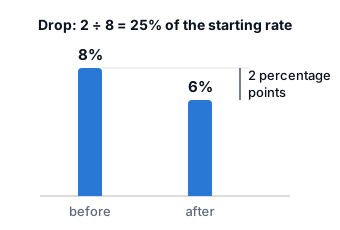
- Percentage point: the plain difference between two percents. From 8% to 6% is a drop of 2 percentage points.
- Percent means per hundred: p% = p/100. To find 10% of a number, move the decimal point one place left (10% of 260 = 26.0). To find 1%, move it two places left (1% of 260 = 2.60).
- Part = percent × whole. "A is what percent of B" is A ÷ B × 100. The number right after "of" is the whole.
- Percent change = (new − original) ÷ original × 100. Always divide by the starting value.
- Changes are multipliers. The original value is 100%.
- A 30% increase: 100% + 30% = 130% = 1.30. So you multiply by 1.30.
- A 30% decrease: 100% − 30% = 70% = 0.70. So you multiply by 0.70.
- In general, a p% increase multiplies by (1 + p/100), and a p% decrease multiplies by (1 − p/100).
- Changes in a row multiply. They never simply add.
- To undo a change, divide by its multiplier.
Try it. A jacket costs $60, and the price rises 15%. What is the new price?
Show the answer
- Multiplier: 100% + 15% = 115% = 1.15.
- New price: 60 × 1.15 = $69.
- Check with easy pieces: 10% of 60 is 6, 5% is half of that, 3. So 15% is 6 + 3 = 9, and 60 + 9 = 69. ✓
Percent of a number
To find a percent of a number, multiply by p/100. Or build the percent from easy pieces: 10%, 5% and 1%. To find what percent one number is of another, divide the part by the whole and multiply by 100. The word right after "of" names the whole.
Why it works. "Percent" means "per hundred", so p% of a number is p hundredths of it: (p/100) × the number. Building a percent from 10%, 5% and 1% works because percents of the same number add: 35% of 260 = 30% of 260 + 5% of 260.
How to spot it: "What is p% of…", "A is what percent of B", or a share of a group.
Example. What is 35% of 260?
- 10% of 260: move the decimal point one place left, so 26.
- 30% is 3 × 10%: 3 × 26 = 78.
- 5% is half of 10%: 26 ÷ 2 = 13.
- 35% = 30% + 5% = 78 + 13 = 91.
Check: 0.35 × 260 = 91. ✓
Trap: in "18 is what percent of 72", the 72 comes after "of", so it goes on the bottom: 18 ÷ 72 = 1/4 = 0.25 = 25%. Dividing 72 ÷ 18 = 4 gives 400%, which is wrong.
Edge cases.
- Percents above 100% are fine. 150% of 40 = 1.5 × 40 = 60.
- A percent of a percent multiplies: 20% of 30% = 0.2 × 0.3 = 0.06 = 6%.
- x% of y = y% of x. 8% of 25 is hard; 25% of 8 = 2 is easy, and they are equal.
GMAT-level example. If 30% of x equals 45% of y, then x is what percent of y?
- Write it as an equation: 0.30x = 0.45y.
- Divide both sides by 0.30: x = (0.45 ÷ 0.30)y = 1.5y.
- 1.5 = 150%, so x is 150% of y.
- Check with y = 100: 45% of 100 = 45, and x = 150 gives 30% of 150 = 45 ✓.
Check yourself. What is 8% of 25?
Check your answer
Swap them: 25% of 8 = 2.
Percent change
First subtract to find the change. Then divide by the original value (the starting value) and multiply by 100. A negative result is a decrease. Note: new ÷ original gives the new value as a percent of the old one. That is a level, not a change.
Why it works. A percent change compares the change with the place you started from, so the starting value is the base. The same $6 change is a bigger share of $42 than of $48, which is why the two directions give different percents.
How to spot it: "by what percent did it increase/decrease", "from X to Y".
Example. A subscription price drops from $48 to $42. What is the percent change?
- Change = new − original = 42 − 48 = −6. The minus sign means the price went down.
- Divide by the original price, 48. First look at 6 ÷ 48: divide the top and the bottom by 6, so 6/48 = 1/8. And 1/8 = 0.125. So −6 ÷ 48 = −0.125.
- Multiply by 100: −0.125 × 100 = −12.5. The price had a 12.5% decrease.
Trap: dividing by the new price: 6 ÷ 42 = 1/7 ≈ 0.143, about 14.3%. This is a common wrong answer choice.
Try it. A town grows from 250 people to 290 people. What is the percent change?
Show the answer
- Change: 290 − 250 = 40.
- Divide by the original: 40 ÷ 250 = 4/25 = 16/100 = 0.16.
- 0.16 × 100 = 16, so a 16% increase.
Edge cases.
- Up and back are different percents. 40 → 50 is a 25% increase, but 50 → 40 is a 20% decrease.
- A decrease can't pass 100% while the value stays positive; an increase can be any size (from 10 to 35 is +250%).
- A change from 0 has no percent: you can't divide by 0.
GMAT-level example. A company's revenue rose from $2.0 million to $2.4 million, and its profit rose from 12% of revenue to 15% of revenue. By what percent did its profit rise?
- Profit before: 12% of 2.0 million = $0.24 million.
- Profit after: 15% of 2.4 million = $0.36 million.
- Change: 0.36 − 0.24 = 0.12 million, on a base of 0.24 million.
- 0.12 ÷ 0.24 = 0.5, so profit rose 50%.
The trap answers are 3% (the change in percentage points) and 25% (12% to 15% as a percent change, ignoring the revenue growth).
Check yourself. What is the percent change from 40 to 50, and from 50 back to 40?
Check your answer
10 ÷ 40 = 25% increase; 10 ÷ 50 = 20% decrease.
Successive changes
"Successive" changes are changes that happen one after another. Write each change as a multiplier (the number you multiply by) and multiply them. The product is the final value as a fraction of the start. Subtract 1 (that is, 100%) to get the net change. The order of the changes doesn't affect the result.
Why it works. The second change is a percent of the new value, which already includes the first change. Multipliers take care of that for you: × 1.3 and then × 0.7 applies the 30% loss to the 130.
How to spot it: two or more changes in a row: "then", "the following year", "after that".
Example. A stock rises 30% and then falls 30%. What is the net change?
- Rise of 30%: 100% + 30% = 130% = 1.30.
- Fall of 30%: 100% − 30% = 70% = 0.70.
- Multiply: 1.30 × 0.70. Think 13 × 7 = 91, then place the decimal point: 0.91.
- 0.91 = 91% of the starting value. 100% − 91% = 9%, so a 9% net decrease.
Check with a starting price of $100: up 30% gives $130. Then 30% of 130 is 39, and 130 − 39 = $91. ✓
Trap: +30% − 30% = 0 is wrong. The 30% loss is taken from 130, a bigger number than the starting 100.
Explore. The stock example as bars. Move either change: the net multiplier is always the product of the two, and +x% then −x% always ends below the start.
Start: 100.
Change 1: +30% means × 1.3, so 100 × 1.3 = 130.
Change 2: −30% means × 0.7, so 130 × 0.7 = 91. This change is taken of 130, not of 100.
Net: × 1.3 × 0.7 = × 0.91, a net change of −9% (adding the percents would say 0%).
Undo: 91 ÷ 0.91 = 100.
Edge cases.
- The order doesn't matter: 1.3 × 0.7 = 0.7 × 1.3.
- +x% then −x% always loses x²/100 percent: +30% then −30% loses 9%.
- Three or more changes: multiply all the multipliers.
GMAT-level example. A town's population rose 10% in the first year, fell 10% in the second year and rose 20% in the third. What was the net percent change over the three years?
- Multipliers: 1.1, 0.9 and 1.2.
- Multiply: 1.1 × 0.9 = 0.99, and 0.99 × 1.2 = 1.188.
- 1.188 is 118.8% of the start: a net increase of 18.8%.
- Check with 1,000 people: 1,100, then 990, then 1,188 ✓. (Adding the percents gives 20%, which is wrong.)
Check yourself. A price rises 20% and then falls 25%. What is the net change?
Check your answer
1.2 × 0.75 = 0.9, a 10% decrease.
Reverse percent
Sometimes you know the value after a change and need the value before it. Write original × multiplier = final, then divide. For several changes, multiply the multipliers first, then divide once. Never take the same percent off the final value.
Why it works. The percent was taken of the original value, which you don't know yet, so you can't take it of the final value. The change was "× multiplier", and dividing by the same multiplier undoes it exactly.
How to spot it: the question gives the value after the change and asks for the value before it.
Example. After a 35% decrease, a town used 520,000 gallons of water. How much did it use before?
- Multiplier for a 35% decrease: 100% − 35% = 65% = 0.65.
- Original × 0.65 = 520,000.
- Divide both sides by 0.65. Since 0.65 = 65/100, dividing by 0.65 is the same as multiplying by 100/65: 520,000 × 100 ÷ 65 = 52,000,000 ÷ 65 = 800,000 gallons.
- Check: 35% of 800,000 = 280,000, and 800,000 − 280,000 = 520,000. ✓
Trap: adding 35% of 520,000 back gives 520,000 + 182,000 = 702,000. That takes the percent of the wrong base (the final value, not the original).
Try it. After a 20% raise, a salary is $54,000. What was it before the raise?
Show the answer
- Multiplier: 100% + 20% = 120% = 1.20.
- Original × 1.20 = 54,000, so original = 54,000 ÷ 1.2 = 540,000 ÷ 12 = $45,000.
- Check: 45,000 × 1.2 = 54,000. ✓ (Taking 20% off 54,000 gives 43,200, which is wrong.)
Explore. The salary from the Try it above: $45,000 raised 20%. The "Undo" line divides by the multiplier and lands back on $45,000; taking 20% off $54,000 doesn't.
Start: $45,000.
Change 1: +20% means × 1.2, so $45,000 × 1.2 = $54,000.
Undo: $54,000 ÷ 1.2 = $45,000. Taking 20% off $54,000 instead gives $43,200, which is wrong.
Edge cases.
- Several changes: divide by the product of all the multipliers.
- Discount then tax is two changes: the price you pay is the original × 0.8 × 1.08 (for 20% off and 8% tax).
- Read "of" carefully. "The new price is 20% more than the old" makes the old price the base.
GMAT-level example. After a 25% discount and then 8% sales tax on the discounted price, a customer paid $162. What was the price before the discount?
- Multipliers: 0.75 (discount) and 1.08 (tax). Together: 0.75 × 1.08 = 0.81.
- Original × 0.81 = 162.
- Original = 162 ÷ 0.81 = 16,200 ÷ 81 = $200.
- Check: 200 × 0.75 = 150, and 150 × 1.08 = 162 ✓.
Check yourself. After a 40% decrease, a value is 72. What was it before?
Check your answer
72 ÷ 0.6 = 120. (Adding 40% of 72 gives 100.8, which is wrong.)
Percentage points vs. percent
Some quantities are already percents, like an interest rate or a share of voters. When such a rate changes, the plain difference is the change in percentage points. The percent change divides that difference by the original rate.
Why it works. Percentage points measure the gap between two percents on the same scale, like the gap between two numbers. Percent change measures that gap as a share of the starting percent, so it depends on how big the starting rate was.
How to spot it: a rate, share or interest rate that moves from one percent to another.
Example. Unemployment falls from 8% to 6%. Describe the change both ways.
- Difference: 8 − 6 = 2, so a fall of 2 percentage points.
- Percent change: 2 ÷ 8 = 1/4 = 0.25, so a 25% decrease.
Trap: answering "2%" when the question asks by what percent the rate fell.
Edge cases.
- Small rates give big percent changes. From 1% to 2% is only 1 percentage point, but a 100% increase.
- "Increased by 10%" on a rate multiplies it: a 30% rate becomes 33%, not 40%.
GMAT-level example. A bank raised its savings rate from 2.5% to 3.5% a year. By how many percentage points did the rate rise, and by what percent did the yearly interest on a fixed balance rise?
- Points: 3.5 − 2.5 = 1 percentage point.
- On a fixed balance, the interest is proportional to the rate, so it changes by the same percent as the rate: 1 ÷ 2.5 = 0.4 = 40%.
- Check with $1,000: interest goes from $25 to $35, and 10 ÷ 25 = 40% ✓.
Check yourself. A 30% approval rate increases by 10%. What is the new rate?
Check your answer
30% × 1.1 = 33% (an increase of 3 percentage points).
How hard questions disguise it
For harder questions (L4–L5)
At L4 and L5, percents appear inside other skills.
- An averages question gives everyone the same raise. The total and the mean both grow by the same multiplier, so work with totals.
- Profit questions put a markup and then a discount on a price. These are successive changes.
- Interest and growth questions use one multiplier many times.
- Chart questions ask for the percent change between two bars, so you must pick the right base.
- Hard versions give percents of different groups ("40% of the sales staff and 10% of everyone else") and ask for a share of the combined group. Pick 100 or 1,000 as the total, and turn every percent into a count before you divide.
Practice
Work through timed percent questions, each with its key idea and trap notes, on the percents practice page.
Common traps
Taking the percent of the wrong base
A percent change is measured from the starting value, and 'A is what percent of B' puts B underneath. Before you divide, say which value the percent is of.
Adding, averaging or netting percents of different bases
+20% then −20% seems to cancel, but the second change applies to a different base: 1.2 × 0.8 = 0.96, a 4% net loss. Percents of percents multiply too, so never add, average or net them.
Undoing a change the wrong way
To get back to the original, divide by every multiplier that was applied, starting from the last. Adding the percents back, or dividing by the share that was removed instead of the share kept, uses the wrong base.
Dropping, reversing or misreading one of the changes
Long questions can contain several changes. List every change in order with its direction and multiplier before you calculate, so you don't lose or reverse one.
Answering a different quantity than the one asked
'What percent of the start' asks for a level (like 96%); 'by what percent did it change' asks for a change (like −4%). The answer choices often include every in-between value, so reread the last line before you choose.
Treating a percent as a plain number
A rise from 4% to 5% is 1 percentage point but a 25% increase, and a 20% increase is neither 20 dollars nor 20 items. Keep points, percents and amounts apart.
Misplacing the decimal point
p% means p/100. Convert once, carefully: 30% of 40% is 0.3 × 0.4 = 0.12 = 12%, and a decimal answer becomes a percent only after you multiply by 100.
Answering what's left instead of the part
If 30% is taken, 70% remains, and the answer choices often include both numbers. Check whether the question asks for the part taken or the part left.
Using the wrong group as the base
'What percent of the remote workers are in sales' divides by remote workers, not by salespeople or by everyone. Convert percents to counts first, then divide by the group named after 'of'.
Mishandling totals when someone leaves
When an average changes and people leave, work with totals: adjust the total, subtract what left, and divide by the new count.