GMAT Quant lesson · Profit & cost
GMAT profit, markup and discount: percent profit and break-even
Profit questions on GMAT Quant: markup then discount, profit as a percent of cost, break-even volume, and how price and quantity changes move revenue.
The core idea
Profit = revenue − cost, and profit percent is measured on cost unless the question says otherwise. Markups and discounts are successive percent changes on different bases, so multiply their factors; revenue = price × quantity, so percent changes in price and quantity multiply too.
Core ideas
Words used here
- Cost: what the seller pays for an item.
- Selling price: what the buyer pays.
- Revenue: all the money from sales: price × number sold.
- Profit: revenue − cost. A negative profit is a loss.
- Markup: an increase from the cost to the marked price, given as a percent of the cost.
- Marked price (or list price): the price on the label, before any discount.
- Discount: a cut from the marked price, given as a percent of the marked price.
- Multiplier (or factor): the number you multiply by to make a percent change. A 50% markup: 100% + 50% = 150% = 1.5. A 20% discount: 100% − 20% = 80% = 0.8.
- Fixed costs: costs that stay the same however many items you make, such as rent.
- Variable cost: the cost of making each single item.
- Break even: sell just enough that profit is 0 (revenue = all costs).
- Profit = revenue − cost. Revenue = price × quantity.
- Profit percent = profit ÷ cost × 100, unless the question names another base.
- Markup is a percent of the cost. Discount is a percent of the marked price. Turn each into a multiplier and multiply.
- Break-even quantity = fixed costs ÷ (price − variable cost per unit).
- Revenue change: multiply the price multiplier by the quantity multiplier, then subtract 1 (that is, 100%).
Try it. A shop buys a shirt for $40 and sells it for $50. What is the profit as a percent of cost?
Show the answer
- Profit: 50 − 40 = $10.
- Divide by the cost: 10 ÷ 40 = 1/4 = 0.25 = 25%.
- (Dividing by the price instead, 10 ÷ 50 = 20%, uses the wrong base.)
Markup, then discount
A markup raises the cost to a marked price; a discount then cuts the marked price. Apply the markup multiplier (the number you multiply by) to the cost. Then apply the discount multiplier to the marked price. Subtract the cost to get the profit.
Why it works. The discount is a percent of the marked price ($120), not of the cost ($80). Writing both changes as multipliers puts each one on the right base for you: 80 × 1.5 × 0.8 = 96.
How to spot it: "marked up x% above cost, then sold at y% off".
Example. A store buys a lamp for $80, marks it up 50%, and sells it at 20% off the marked price. What is its profit?
- Markup multiplier: 100% + 50% = 150% = 1.5. Marked price: 80 × 1.5 = $120.
- Discount multiplier: 100% − 20% = 80% = 0.8. Sale price: 120 × 0.8 = $96.
- Profit: 96 − 80 = $16.
Two discounts in a row multiply the same way. 20% off and then 10% off: 0.8 × 0.9 = 0.72. The buyer pays 72% of the price, so the total discount is 100% − 72% = 28%, not 30%.
Trap: netting +50% and −20% to +30%. That gives 80 × 1.3 = $104 and a profit of $24, which is wrong.
Explore. The lamp example as bars: cost, marked price, sale price. Change the markup and the discount, and watch the net change. Equal-looking pairs, such as +25% then −25%, always end below the start.
Start: $80.
Change 1: +50% means × 1.5, so $80 × 1.5 = $120.
Change 2: −20% means × 0.8, so $120 × 0.8 = $96. This change is taken of $120, not of $80.
Net: × 1.5 × 0.8 = × 1.2, a net change of +20% (adding the percents would say +30%).
Undo: $96 ÷ 1.2 = $80.
Edge cases.
- The order doesn't change the final price (80 × 0.8 × 1.5 = 96 too), but it does change the price in between.
- A markup and an equal discount always lose money. +25% then −25%: 1.25 × 0.75 = 0.9375, a 6.25% loss.
- Working backward to the markup. To keep a profit after a discount, divide the target multiplier by the discount multiplier.
GMAT-level example. A retailer wants a 26% profit on cost after taking 10% off the marked price. By what percent above cost must the item be marked?
- Let the cost be C. The selling price must be 1.26C.
- The selling price is 90% of the marked price M: 0.9M = 1.26C.
- Divide by 0.9: M = 1.26C ÷ 0.9 = 1.4C.
- So the item must be marked 40% above cost.
- Check with C = $100: marked $140, 10% off gives $126, a 26% profit ✓.
Adding the percents (26% + 10% = 36%) is the trap: 1.36 × 0.9 = 1.224, only a 22.4% profit.
Check yourself. An item costs $60, is marked up 40%, then sold at 25% off. What is the profit?
Check your answer
Marked price: 60 × 1.4 = $84. Sale price: 84 × 0.75 = $63. Profit: 63 − 60 = $3 (5% of cost).
Profit as a percent of cost
Find the profit (selling price − cost). Then divide by the cost and multiply by 100.
Why it works. "Profit percent" asks how much the money spent grew. The money spent is the cost, so the cost is the base. A question that wants another base (such as the selling price) says so.
How to spot it: "profit is what percent of the cost", "percent profit".
Example. A dealer buys a bike for $250 and sells it for $320. What is the profit as a percent of cost?
- Profit: 320 − 250 = $70.
- Divide by the cost: 70 ÷ 250 = 7/25 = 28/100 = 0.28.
- 0.28 × 100 = 28%.
Working backward, divide. If a price of $150 includes a 25% profit on cost, then cost × 1.25 = 150. So cost = 150 ÷ 1.25 = $120. Check: 120 × 1.25 = 150. ✓ (Taking 25% off $150 gives $112.50, which is wrong.)
Trap: 70 ÷ 320 ≈ 21.9%. That divides by the selling price, not the cost.
Edge cases.
- A loss is a negative profit. Selling a $250 bike for $200 is a loss of 50 ÷ 250 = 20% of cost.
- Markup on cost is not margin on price. A 25% profit on cost is 25 ÷ 125 = 20% of the selling price.
- Same selling price, opposite percents. The cost bases differ, so the gain and the loss don't cancel (see the example).
GMAT-level example. A dealer sells two cars for $12,000 each. On one he makes a 20% profit on cost; on the other he loses 20% of cost. What is his overall profit or loss?
- Car 1: cost × 1.2 = 12,000, so its cost was 12,000 ÷ 1.2 = $10,000.
- Car 2: cost × 0.8 = 12,000, so its cost was 12,000 ÷ 0.8 = $15,000.
- Total cost: $25,000. Total revenue: $24,000.
- Overall: a loss of $1,000, which is 1,000 ÷ 25,000 = 4% of cost.
- The loss happens because the 20% loss is taken from the bigger cost.
Check yourself. A price of $84 gives a 40% profit on cost. What is the profit in dollars?
Check your answer
Cost = 84 ÷ 1.4 = $60, so the profit is 84 − 60 = $24. (40% of $84 is $33.60, which uses the wrong base.)
Break-even
Each unit sold brings in its price but costs its variable cost (the cost of making one unit). The difference, price − variable cost, goes toward paying the fixed costs (costs that don't change, such as rent). To break even (profit = 0), divide the fixed costs by that difference.
Why it works. With nothing sold, profit is −(fixed costs). Each unit sold adds price − variable cost to profit (its "contribution"). So profit climbs by the same amount per unit, and it reaches 0 after fixed costs ÷ contribution units.
How to spot it: "fixed costs", "cost per unit", "how many must be sold to break even (or to make a profit of…)".
Example. A bakery has fixed costs of $4,500 a month. Each cake sells for $25 and costs $16 to make. How many cakes must it sell to break even?
- Each cake contributes 25 − 16 = $9 toward the fixed costs.
- Cakes needed: 4,500 ÷ 9 = 500 cakes.
- Check: revenue = 500 × 25 = $12,500. Costs = 4,500 + 500 × 16 = 4,500 + 8,000 = $12,500. Profit = 0. ✓
Trap: 4,500 ÷ 25 = 180. That ignores the cost of making each cake.
Try it. A workshop has fixed costs of $1,200. Each chair sells for $15 and costs $7 to make. How many chairs must it sell to make a profit of $800?
Show the answer
- Each chair contributes 15 − 7 = $8.
- It must cover the fixed costs and the profit: 1,200 + 800 = $2,000.
- Chairs: 2,000 ÷ 8 = 250.
- Check: revenue 250 × 15 = $3,750; costs 1,200 + 250 × 7 = 1,200 + 1,750 = $2,950; profit 3,750 − 2,950 = $800. ✓
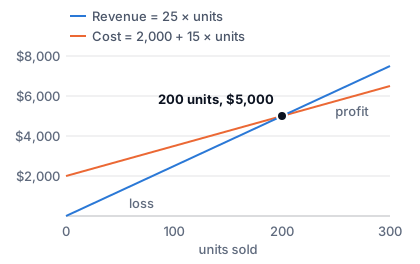
See it. Here fixed costs are $2,000, each unit costs $15 to make and sells for $25. The cost line starts at $2,000 and rises $15 per unit; the revenue line starts at $0 and rises $25 per unit. They cross at 2,000 ÷ (25 − 15) = 200 units, the break-even point.
Edge cases.
- Round up. If 4,500 ÷ 8 = 562.5, you need 563 units: at 562 there is still a small loss.
- Price at or below the variable cost means each unit adds nothing or loses money, so there is no break-even point.
- A target profit is added to the fixed costs, as in the Try it above.
GMAT-level example. A company's fixed costs are $36,000 a month. It sells each unit for $50, and each unit costs $32 to make. If it raises the price to $54, how many fewer units must it sell each month to break even?
- At $50, each unit contributes 50 − 32 = $18. Break-even: 36,000 ÷ 18 = 2,000 units.
- At $54, each unit contributes 54 − 32 = $22. 36,000 ÷ 22 = 1,636.36…, so it must sell 1,637 units. (1,636 × 22 = $35,992, still short of $36,000.)
- Fewer units: 2,000 − 1,637 = 363.
Check yourself. In the chart above, how many units must be sold for a profit of $1,500?
Check your answer
Contribution per unit: 25 − 15 = $10. Needed: (2,000 + 1,500) ÷ 10 = 350 units. Check: 350 × 25 = 8,750 and 2,000 + 350 × 15 = 7,250, a difference of 1,500 ✓.
Price and quantity changes
Revenue = price × quantity. So a percent change in the price and a percent change in the quantity multiply. Use multipliers, or pick 100 for both.
Why it works. Revenue is a product, so its multiplier is the product of the two multipliers: (1.2 × price) × (0.9 × quantity) = 1.08 × (price × quantity).
How to spot it: "the price rose x% and the number sold fell y%; what happened to revenue".
Example. A theater raises ticket prices by 20%, and attendance falls by 10%. By what percent does revenue change?
- Price multiplier: 100% + 20% = 1.20. Attendance multiplier: 100% − 10% = 0.90.
- Revenue multiplier: 1.20 × 0.90 = 1.08.
- 1.08 = 108% of the old revenue, so revenue rises 8%.
- Check with numbers: a $10 ticket and 100 people give $1,000. After: a $12 ticket and 90 people give $1,080. That is 8% more. ✓
Trap: 20% − 10% = 10%. That adds percents that apply to different bases.
For harder questions (L4–L5): when the number sold depends on the price
Write profit = (price − cost of one unit) × quantity. A shop sells 100 − 5x hats when the price is x dollars, and each hat costs $4. Profit = (x − 4)(100 − 5x).
- Profit is 0 when x − 4 = 0 (x = 4) or when 100 − 5x = 0 (x = 20).
- The largest profit is halfway between: (4 + 20) ÷ 2 = 12. At x = 12: (12 − 4)(100 − 60) = 8 × 40 = $320.
Edge cases.
- Equal and opposite changes lose. Price +10%, quantity −10%: 1.1 × 0.9 = 0.99, a 1% drop.
- Keeping revenue the same. If the price rises 25%, the quantity must be multiplied by 1 ÷ 1.25 = 0.8: a 20% drop, not 25%.
- Revenue is not profit. If the question asks about profit, the cost of each unit matters too.
GMAT-level example. A café raises the price of a coffee by 25%. By what percent must the number of coffees sold change for revenue to rise by 10%?
- Revenue multiplier = price multiplier × quantity multiplier, so 1.10 = 1.25 × q.
- q = 1.10 ÷ 1.25 = 0.88.
- 0.88 is 12% less than 1, so sales can fall by 12%.
- Check with numbers: $4 × 100 cups = $400. After: $5 × 88 cups = $440, which is 10% more ✓.
Check yourself. The price rises 10% and the number sold falls 10%. What happens to revenue?
Check your answer
1.1 × 0.9 = 0.99, so revenue falls by 1%.
How hard questions disguise it
For harder questions (L4–L5)
L4 versions work backward ("after a 20% discount the store still made a 20% profit; what was the markup?") or give profit as a percent of the selling price. At L5, profit combines with linear equations (two products with different profits per item and a total profit) and with optimization (the largest discount that still avoids a loss). Write cost, price and profit on separate lines, and label the base of each percent.
Practice
Practice profit, markup and discount questions in timed sets on the profit practice page.
Common traps
Using the selling price as the base instead of the cost
Profit percent is profit ÷ cost unless the question names the selling price. A profit that is 20% of the price is 25% of the cost, because the cost is the smaller base.
Adding, averaging or netting successive percents
A markup, a discount and a tax each apply to a different base, so their factors multiply: 1.5 × 0.8 = 1.2, and 0.8 × 0.9 = 0.72. Never add or average the percents.
Undoing or applying a percent in the wrong direction
To find the cost behind a price with a 25% profit, divide by 1.25; taking 25% off the price uses the wrong base. Undo every layer, tax included, by dividing by its factor.
Answering a price or a level instead of the profit or change
Cost, price, discount, profit and their percents all appear along the way. Reread the last line: profit is price − cost, and a percent change is the new level minus 100%.
Mixing up percents, decimals, dollars and counts
A 15% profit on $80 is $12, not $15, and 0.28 of cost is 28%. Keep percents, dollar amounts and item counts in their own units.
Leaving costs out of break-even
Each unit contributes price − variable cost. Units needed = (fixed costs + target profit) ÷ that contribution, and the answer is a number of units, not dollars.
Ignoring one side of price × quantity
Revenue depends on both price and quantity, and profit also subtracts the cost of each unit. When quantity falls as price rises, write profit as (price − cost) × quantity and find where it is largest.
Stopping before the unknown is alone
When the equation reaches a form like 0.2c = $1.50, one step is left: divide both sides by the coefficient to get c.