GRE Quant lesson · Fractions & decimals
GRE fractions and decimals: compare, simplify, convert, remainders
Fractions and decimals for GRE Quant: comparing fractions, complex fractions, terminating decimals, converting decimals, and fractions of the remainder.
The core idea
A fraction is a division, and every fraction rule follows from that. Add only over a common denominator, divide by a fraction by multiplying by its reciprocal (the fraction turned upside down), and always ask what whole a fraction is taken of, because 'of the remainder' changes the base.
Core ideas
Words used here
- Fraction: a/b means a divided by b. The top number is the numerator; the bottom number is the denominator.
- Common denominator: the same bottom number for two or more fractions.
- Reduce (or write in lowest terms): divide the top and the bottom by the same number until they share no factor. 6/8 = 3/4.
- Reciprocal: the fraction turned upside down. The reciprocal of 2/3 is 3/2, and the reciprocal of 5 is 1/5.
- Cross-multiply: multiply the top of each fraction by the bottom of the other one.
- Prime: a whole number above 1 whose only factors are 1 and itself: 2, 3, 5, 7, 11, …
- Terminating decimal: a decimal that ends, like 0.25. A repeating decimal goes on forever, like 0.333…
- Complex fraction: a fraction with fractions in its top or bottom.
A fraction is a division: 3/4 = 3 ÷ 4 = 0.75.
Add or subtract over a common denominator. For 1/4 + 2/3:
- Choose a number that both 4 and 3 divide: 12.
- Rewrite each fraction with 12 on the bottom: 1/4 = 3/12 (top and bottom × 3) and 2/3 = 8/12 (top and bottom × 4).
- Add the tops and keep the bottom: 3/12 + 8/12 = 11/12.
The general rule does the same steps with letters: a/b + c/d = (ad + bc)/(bd). Check: (1 × 3 + 2 × 4)/(4 × 3) = (3 + 8)/12 = 11/12. ✓
Multiply straight across: 2/3 × 4/5 = (2 × 4)/(3 × 5) = 8/15.
Divide by a fraction by multiplying by its reciprocal: 3/4 ÷ 1/2 = 3/4 × 2/1 = 6/4 = 3/2.
Compare fractions by cross-multiplying, or with a benchmark (a simple fraction such as 1/2).
Terminating decimals: a reduced fraction terminates exactly when its denominator has no prime factors other than 2 and 5.
"Of the remainder": multiply the fractions that remain, (1 − a)(1 − b).
Try it. Work out 2/5 + 1/6 and 2/3 ÷ 4/9.
Show the answer
- 2/5 + 1/6: both 5 and 6 divide 30. 2/5 = 12/30 and 1/6 = 5/30, so the sum is 12/30 + 5/30 = 17/30.
- 2/3 ÷ 4/9 = 2/3 × 9/4 = 18/12. Divide top and bottom by 6: 3/2.
Comparing fractions
To compare a/b and c/d (all positive), cross-multiply: work out a × d and c × b. The fraction whose top is in the larger product is the larger fraction. This is the same as writing both fractions over the common denominator b × d. For several fractions, first compare each one with a benchmark such as 1/2 (5/9 is more than 1/2, because 5 is more than half of 9).
Why it works. Cross-multiplying is the same as writing both fractions over the common denominator b × d and comparing the tops. Once the pieces are the same size, more pieces means a bigger fraction.
How to spot it: "which is greater?", or fractions with different denominators.
Example. Which is larger, 11/15 or 8/11?
- Top of the first × bottom of the second: 11 × 11 = 121.
- Top of the second × bottom of the first: 8 × 15 = 120.
- 121 > 120, so 11/15 is larger. (Over the common denominator 15 × 11 = 165, they are 121/165 and 120/165.)
Counting between two fractions. How many integers n make 1/3 < n/24 < 3/4 true?
- Write both bounds with 24 on the bottom: 1/3 = 8/24 (top and bottom × 8) and 3/4 = 18/24 (top and bottom × 6).
- Now 8/24 < n/24 < 18/24, so 8 < n < 18.
- The signs are strict (<, not ≤), so 8 and 18 are not allowed: n = 9, 10, …, 17.
- Count: 17 − 9 + 1 = 9 integers.
Trap: judging by the denominators alone. A bigger denominator doesn't make a fraction smaller if its numerator is bigger too.
Edge cases.
- Negative fractions reverse the order: 11/15 > 8/11, so −11/15 < −8/11.
- Cross-multiplying assumes positive denominators. With a negative bottom, rewrite the fraction first.
- Adding the same positive amount to top and bottom moves a fraction toward 1: 3/5 < 4/6 < 5/7.
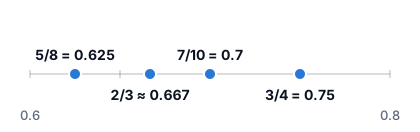
GRE-level example. Which is greatest: 5/8, 7/11, 9/14 or 11/17?
- Each fraction is just below 1. Compare the gaps to 1 instead: 3/8, 4/11, 5/14 and 6/17.
- Turn each gap into a decimal: 0.375, about 0.364, about 0.357 and about 0.353.
- The smallest gap belongs to the largest fraction: 11/17.
- Check: 11/17 ≈ 0.647, 9/14 ≈ 0.643, 7/11 ≈ 0.636, 5/8 = 0.625 ✓.
On the GRE (Quantitative Comparison). Quantity A: 0.43. Quantity B: 3/7. Since 3/7 = 0.428571…, Quantity A is greater, by about 0.0014. Rounding 3/7 to 0.43 makes them look equal, so carry enough digits (or cross-multiply: 0.43 × 7 = 3.01 > 3).
On the GRE (Quantitative Comparison). With letters: if 0 < a < b and c > 0, compare a/b with (a + c)/(b + c). The difference is (a + c)/(b + c) − a/b = c(b − a)/(b(b + c)), which is positive, so Quantity B is greater: 1/2 < 2/3. If a > b > 0, the order flips; if you only know a, b and c are positive, the answer cannot be determined.
Check yourself. How many integers n satisfy 2/5 < n/30 < 5/6?
Check your answer
Over 30: 12/30 < n/30 < 25/30, so 12 < n < 25. The integers 13 to 24: 12.
Simplifying complex fractions
A complex fraction has fractions in its top or bottom. Simplify the top and the bottom separately, each over a common denominator. Then divide, by multiplying by the reciprocal (the flipped fraction) of the bottom.
Why it works. Dividing by a fraction asks how many of that fraction fit in the top. Multiplying by the reciprocal answers that question: ÷ (5/6) means "how many 5/6 fit?", which is × 6/5.
How to spot it: a fraction whose numerator or denominator contains fractions.
Example. Simplify (2/3 − 1/4) ÷ (5/6).
- Top: both 3 and 4 divide 12. 2/3 = 8/12 and 1/4 = 3/12, so 8/12 − 3/12 = 5/12.
- Dividing by 5/6 is multiplying by its reciprocal, 6/5: 5/12 × 6/5 = (5 × 6)/(12 × 5) = 30/60.
- Reduce: 30/60 = 1/2.
Trap: multiplying by 5/6 instead of 6/5. That gives 5/12 × 5/6 = 25/72.
Edge cases.
- Nested fractions: work from the deepest level outward (see the example).
- With letters, note the values that make any denominator 0; they stay excluded.
- Don't cancel across a + or −. (2/3 − 1/4)/(5/6) has no common factor to cancel until the top is one fraction.
GRE-level example. Simplify 1 + 1/(1 + 1/(1 + 1/2)).
- Deepest level: 1 + 1/2 = 3/2.
- Next: 1/(3/2) = 2/3, so 1 + 2/3 = 5/3.
- Next: 1/(5/3) = 3/5.
- Outside: 1 + 3/5 = 8/5.
Check yourself. Simplify (1/2 + 1/3) ÷ (1/2 − 1/3).
Check your answer
Top: 5/6. Bottom: 1/6. (5/6) ÷ (1/6) = 5.
Terminating decimals
Prime-factor notation. Split a number into prime factors until only primes are left: 24 = 2 × 12 = 2 × 2 × 6 = 2 × 2 × 2 × 3. Three 2s multiplied together are written 2³ (say "2 to the third"). So 24 = 2³ × 3.
The test. Reduce the fraction first. Then write the denominator in prime factors. If only 2s and 5s are left, the decimal terminates. Any other prime makes it repeat. Why 2 and 5? Decimals count tenths, hundredths and thousandths, and 10 = 2 × 5. A denominator made only of 2s and 5s can be scaled up to 10, 100, 1,000 and so on.
How to spot it: "which of the following has a terminating decimal?", "how many nonzero digits?"
Example. Which of 7/24, 9/40 and 21/60 terminate?
- 7/24 is already reduced. 24 = 2³ × 3. The 3 makes it repeat (7/24 = 0.291666…).
- 9/40 is already reduced. 40 = 2³ × 5: only 2s and 5s, so it terminates. Multiply top and bottom by 25: 225/1,000 = 0.225.
- 21/60: reduce first. 21 = 3 × 7 and 60 = 3 × 20, so divide top and bottom by 3: 7/20. 20 = 2² × 5, so it terminates: 7/20 = 35/100 = 0.35.
- Answer: 9/40 and 21/60.
Trap: rejecting 21/60 because 60 has a factor of 3, before reducing.
Edge cases.
- Reduce first: the numerator matters only through the factors it cancels (21/60 above).
- The number of decimal places of a reduced fraction a/(2ᵐ × 5ⁿ) is the larger of m and n. 9/40 = 9/(2³ × 5) has 3 places: 0.225.
- Whole numbers are terminating decimals too (denominator 1).
GRE-level example. For how many positive integers n less than 30 does 1/n have a terminating decimal?
- 1/n is already reduced, so n must be of the form 2ᵃ × 5ᵇ.
- List them under 30: 1, 2, 4, 8, 16 (powers of 2); 5, 10, 20 (5 times those); 25.
- Count: 9.
- Check one that fails: 1/12 = 0.08333…, because 12 has a factor of 3 ✓.
On the GRE (select all). "Which of the following fractions are equal to terminating decimals? 9/12, 7/30, 11/40, 14/35, 5/18." Reduce first: 9/12 = 3/4 and 14/35 = 2/5 terminate, 11/40 terminates (40 = 2³ × 5), while 7/30 and 5/18 keep a factor of 3. Select 9/12, 11/40 and 14/35, and nothing else.
Numeric Entry. "For how many integers k from 1 to 100 is k/84 a terminating decimal?" 84 = 2² × 3 × 7, so k must cancel the 3 × 7 = 21: k = 21, 42, 63 or 84. Type 4.
Check yourself. How many decimal places does 7/160 have?
Check your answer
160 = 2⁵ × 5, so 5 places: 7/160 = 0.04375.
Converting decimals and fractions
Decimal to fraction: count the decimal places. Put the digits over 1 followed by that many zeros, then reduce. Fraction to decimal: divide, or scale the bottom to 10, 100 or 1,000 (3/25 = 12/100 = 0.12).
Why it works. Place value: 0.375 means 375 thousandths, which is exactly 375/1,000. Reducing only cancels common factors, so the value doesn't change.
Learn the common ones: 1/8 = 0.125, 3/8 = 0.375, 1/6 ≈ 0.1667, 1/12 ≈ 0.0833.
How to spot it: a decimal and a fraction in the same question, or answer choices written in the other form.
Example. Write 0.375 as a fraction in lowest terms.
- 0.375 has 3 decimal places, so it is 375/1,000.
- 375 = 3 × 125 and 1,000 = 8 × 125. Divide top and bottom by 125: 3/8.
Trap: stopping at 75/200 (dividing only by 5). 75 and 200 still share the factor 25.
Try it. Write 0.45 as a fraction in lowest terms.
Show the answer
- 0.45 has 2 decimal places: 45/100.
- Both divide by 5: 9/20. 9 and 20 share no factor, so the answer is 9/20.
Edge cases.
- Repeating decimals: a block of k repeating digits is that block over k nines. 0.333… = 3/9 = 1/3, and 0.272727… = 27/99 = 3/11.
- Trailing zeros don't matter: 0.50 = 0.5 = 1/2.
- Mixed decimals: 2.375 = 2 + 3/8 = 19/8.
GRE-level example. Write 0.4545… + 0.1666… as a single fraction.
- 0.4545… repeats "45": 45/99 = 5/11.
- 0.1666… is 1/6 (1 ÷ 6 = 0.1666…).
- Add over 66: 5/11 = 30/66 and 1/6 = 11/66, so the sum is 41/66.
- Check with decimals: 0.4545 + 0.1667 ≈ 0.6212, and 41 ÷ 66 ≈ 0.6212 ✓.
Check yourself. Write 0.272727… as a fraction in lowest terms.
Check your answer
27/99 = 3/11.
Fraction of the remainder
Track what is left after each step. A fraction taken "of the remainder" applies to the amount left after the step before, not to the whole. So the fractions that remain multiply.
Why it works. Each step takes a fraction of what is there at that moment, so each step leaves a fraction of what was there. Leftovers of leftovers multiply: 2/3 × 1/4 = 1/6.
How to spot it: "of the remaining", "of what was left", "then".
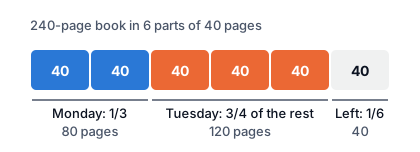
Example. A reader finishes 1/3 of a book on Monday and 3/4 of the remaining pages on Tuesday. 40 pages are left. How long is the book?
- After Monday: 1 − 1/3 = 2/3 of the book is left.
- On Tuesday she reads 3/4 of that, so 1 − 3/4 = 1/4 of it is still unread.
- Unread: 1/4 × 2/3 = 2/12 = 1/6 of the book.
- 1/6 of the book is 40 pages, so the book has 40 × 6 = 240 pages.
- Check: Monday 240 ÷ 3 = 80 pages read, 160 left. Tuesday 3/4 × 160 = 120 read, 160 − 120 = 40 left. ✓
Trap: adding 1/3 + 3/4. That treats both fractions as shares of the whole book.
Try it. A worker spends 1/4 of her pay on rent and 2/3 of the rest on food. What fraction of her pay is left?
Show the answer
- After rent: 1 − 1/4 = 3/4 of the pay is left.
- Food takes 2/3 of that, so 1 − 2/3 = 1/3 of it stays.
- Left: 1/3 × 3/4 = 3/12 = 1/4 of her pay. (Check with a pay of 120: rent 30 leaves 90, food 60 leaves 30, and 30/120 = 1/4.)
Edge cases.
- "Of the original" vs. "of the remainder". If Tuesday's 3/4 were of the whole book, the fractions would add and the reader would have read more than the whole book (1/3 + 3/4 > 1).
- Order matters when only some steps are "of the remainder".
GRE-level example. A tank loses 1/5 of its water on day 1, then 1/4 of what is left on day 2, then 1/3 of what is left on day 3. 24 liters remain. How much water was there at first?
- Fraction left after each day: 4/5, then 3/4, then 2/3.
- Left after three days: 4/5 × 3/4 × 2/3 = 24/60 = 2/5 of the start.
- 2/5 of the start is 24 liters, so the start is 24 × 5/2 = 60 liters.
- Check: 60 → 48 → 36 → 24 ✓.
On the GRE (Quantitative Comparison). A tank is full. 1/4 of the water is drained, then 1/3 of what remains is drained. Quantity A: the fraction of the original water still in the tank. Quantity B: 5/12. What's left is 3/4 × 2/3 = 1/2, and 1/2 > 5/12, so Quantity A is greater. Subtracting 1/4 + 1/3 = 7/12 from the whole gives 5/12 and the wrong answer that the quantities are equal.
Check yourself. Half of a class leaves, then 1/3 of the rest leave. 12 students remain. How many were in the class?
Check your answer
Left: 1/2 × 2/3 = 1/3 of the class. So the class had 12 × 3 = 36 students.
From a change in fraction to the whole
When a known amount moves something from one fraction of the whole to another, that amount equals the difference of the two fractions. Divide the amount by that difference to get the whole.
Why it works. Both fractions are of the same whole (the tank), so they can be subtracted directly. The 15 liters filled exactly the gap between them.
How to spot it: "is 1/4 full … after adding … it is 2/3 full", "had used 1/5 of … after another … has used 1/2".
Example. A tank is 1/6 full. After 15 liters are added, it is 1/2 full. What is the capacity?
- The 15 liters moved the tank from 1/6 full to 1/2 full.
- Difference: 1/2 − 1/6 = 3/6 − 1/6 = 2/6 = 1/3 of the tank.
- So 1/3 of the capacity is 15 liters, and the capacity is 15 ÷ 1/3 = 15 × 3 = 45 liters.
- Check: 1/6 of 45 is 7.5 L; 7.5 + 15 = 22.5 L, which is 1/2 of 45. ✓
Trap: dividing 15 by the final fraction (15 ÷ 1/2 = 30). The 15 liters filled only the gap between the two fractions, not the whole 1/2.
Try it. A box is 2/5 full of books. After 18 more books are put in, it is 7/10 full. How many books does the full box hold?
Show the answer
- Difference: 7/10 − 2/5 = 7/10 − 4/10 = 3/10 of the box.
- 3/10 of the box is 18 books, so the box holds 18 ÷ 3/10 = 18 × 10/3 = 60 books.
Edge cases.
- Taking out works the same way. A tank goes from 3/4 full to 1/3 full when 25 liters are drained: the gap 3/4 − 1/3 = 5/12 is 25 liters, so the tank holds 60 liters.
- Fractions of different wholes don't subtract. "1/3 of the juice is poured out" is a fraction of the juice, not of the jug. Turn it into a fraction of the jug first (see the example).
GRE-level example. A jug is 3/5 full of juice. Then 1/3 of the juice is poured out, and 120 ml of juice is added. Now the jug is 2/3 full. What is the jug's capacity?
- Pouring out 1/3 of the juice leaves 2/3 of it: 2/3 × 3/5 = 2/5 of the jug.
- Adding 120 ml takes the jug from 2/5 full to 2/3 full: a gap of 2/3 − 2/5 = 10/15 − 6/15 = 4/15 of the jug.
- 4/15 of the jug is 120 ml, so the jug holds 120 × 15/4 = 450 ml.
- Check: 3/5 of 450 = 270 ml; pour out 90 to get 180; add 120 to get 300, which is 2/3 of 450 ✓.
Check yourself. A pool is 40% full. After 1,800 liters are added, it is 85% full. What is its capacity?
Check your answer
85% − 40% = 45% of the pool is 1,800 liters, so the capacity is 1,800 ÷ 0.45 = 4,000 liters.
How hard questions disguise it
For harder questions (L4–L5)
L4 versions chain three or more "of the remainder" steps, or give the leftover amount and ask for the whole, which is a reverse fraction problem. At L5, fractions blend into ratios (a fraction of a group is a part-to-whole ratio) and into percents (successive percent changes are just successive fractions). Choose the least common multiple (LCM) of the denominators as the total: the smallest number that every denominator divides. Then every step gives a whole number.
Practice
Practice fraction and decimal patterns in timed sets on the fractions practice page.
Common traps
Taking a fraction of the wrong base
1/3 of what's left is smaller than 1/3 of the whole, and fractions of different groups can't be added or averaged directly. Find the amount each fraction is taken of, then combine actual amounts.
Adding two fractions wrongly
1/a + 1/b is (a + b)/(ab), not 2/(a + b) or 1/(a + b). Rewrite over a common denominator every time.
Dividing by a fraction the wrong way
Dividing by 1/4 means multiplying by 4, so the result gets bigger. Flip the divisor, then multiply.
Stopping after the first step
Multi-step fraction stories need every step applied. Count the steps in the story and make sure each one changed your number.
Undoing the steps wrong
To find the starting amount, undo each step by dividing by the fraction that remained after it, starting from the last step. Adding the fractions back uses the wrong base.
Counting values between two fractions wrong
Scale both bounds to the same denominator, then count the integers strictly between them. Values equal to a bound are excluded by strict inequalities.
Misplacing digits when converting a decimal
A decimal with k places is its digits over 1 followed by k zeros; 0.375 = 375/1,000. Check the size: a proper fraction must convert to a decimal below 1.
Flipping the fraction or answering the complement
A decimal below 1 has the smaller number on top, and 1 − x is the missing part, not x. Compare your fraction's size with the decimal before you choose.
Testing a decimal before reducing the fraction
21/60 looks like it won't terminate because of the 3 in 60, but it reduces to 7/20, which does. Always reduce before checking the denominator.
Dividing by one fraction instead of the gap
The amount added fills only the gap between the two fractions. Divide it by (new fraction − old fraction), not by either fraction alone.
Changing only one part of a fraction
Whatever you do to the denominator, do to the numerator too: 3/4 = 75/100 because both parts are multiplied by 25. And 3/8 is 3 × 1/8, so multiply by the numerator after you find the decimal for 1/8.
Counting fractions that terminate
Factor the denominator. The 2s and 5s never stop a decimal from ending; the numerator only has to cancel the other part. Count multiples of that part, and count them exactly.
Comparing fractions by their parts
Neither the tops nor the bottoms decide 5/9 against 6/11; cross-multiply: 5 × 11 = 55 > 54 = 6 × 9, so 5/9 is larger. And 3/7 = 0.4285…, slightly less than 0.43, not equal to it.
Thinking that adding to the top and bottom changes nothing
Adding the same positive number to the top and bottom pulls a fraction toward 1: 1/2 < 2/3 < 3/4, but 3/2 > 4/3 > 5/4.
Taking the second fraction of the whole
Drain 1/4, then 1/3 of what remains: 3/4 × 2/3 = 1/2 is left, not 1 − 1/4 − 1/3 = 5/12.
Judging a decimal by the unreduced denominator
9/12 reduces to 3/4 = 0.75, which terminates even though 12 has a factor of 3. Reduce first, then check for primes other than 2 and 5.