GMAT Quant lesson · Picking numbers
GMAT picking numbers and backsolving: when and how to use them
How to pick numbers and backsolve on GMAT Quant: pick 100 for percents, the LCM for fractions, start with the middle choice, and test variable choices.
The core idea
When a question is abstract, make it concrete: replace unknown amounts with convenient numbers, or test the answer choices in the stem. Choose numbers that keep the arithmetic clean (100 for percents, the LCM for fractions) and that don't make several choices tie.
Core ideas
Words used here
- Picking numbers: replacing an unknown amount (or a letter) with a simple number you choose, then working with that number.
- Backsolving: taking each answer choice and checking whether it fits the question.
- Stem: the text of the question.
- Answer choices: the five options you choose from.
- Variable: a letter, such as x or c, that stands for a number.
- Denominator: the bottom number of a fraction. In 3/4, it is 4.
- Least common multiple (LCM): the smallest number that each of the given numbers divides into exactly. For 4 and 6: the multiples of 4 are 4, 8, 12, …; the multiples of 6 are 6, 12, …; so the LCM is 12.
- Base of a percent: the amount the percent is taken of.
- Pick numbers when the question has no real numbers: percents of an unknown amount, fractions of an unknown total, or letters in the answer choices.
- Pick 100 for percent questions. Pick the LCM of the denominators for fraction questions, so every fraction becomes a whole number.
- Backsolve when the choices are numbers and the stem is easy to check: put a choice into the stem and see if it fits.
- Start with the middle choice. Number choices are usually listed from smallest to largest, so one test tells you whether to go up or down.
- When you pick numbers, test every choice. Cross out every choice that fails.
Try it. A price rises 20% and then falls 10%. What is the overall percent change?
Show the answer
- Pick a starting price of 100.
- Rise 20%: 20% of 100 is 20, so the price becomes 100 + 20 = 120.
- Fall 10%: 10% of 120 is 12, so the price becomes 120 − 12 = 108.
- From 100 to 108 is a change of 8 out of 100: an 8% increase.
Pick 100 for percents
Picking numbers means replacing an unknown amount with a simple number you choose. When a percent question never gives a real starting value, call it 100. Then every percent becomes a plain number, and the final answer reads directly as a percent.
Why it works. A percent answer doesn't depend on the starting size: double the start, and every later amount doubles too, so the percent change stays the same. That makes any convenient start safe, and 100 makes percents read directly.
How to spot it: percents with no starting amount, such as "by what percent did the total change?"
Example. A company's workforce grows 25% and its average salary falls 12%. By what percent does its total payroll change?
- Start: 100 workers, each earning 100. Payroll = 100 × 100 = 10,000.
- Workers after: 25% of 100 is 25, so 100 + 25 = 125.
- Salary after: 12% of 100 is 12, so 100 − 12 = 88.
- Payroll after: 125 × 88 = 11,000.
- Change: 11,000 − 10,000 = 1,000, and 1,000 ÷ 10,000 = 0.10 = a 10% increase.
Chains of percents. If x is 40% of y and y is 25% of z, pick z = 100. Then y = 25% of 100 = 25, and x = 40% of 25 = 10. So x is 10% of z.
Trap: 25% − 12% = 13%. This combines two percents that are taken of different amounts.
Edge cases.
- When the answer is an amount, not a percent, a picked start only works if you scale back to the real numbers.
- Pick numbers that avoid fractions of people: use 100 or 1,000 when the percents need it.
- Two different unknowns can each be 100, as with the workers and the salary above.
GMAT-level example. A stock's price falls 20% and then rises x%. It ends 8% above its starting price. What is x?
- Start at 100. After the fall: 80.
- It ends 8% above the start: 108.
- The rise is 108 − 80 = 28 on a base of 80: 28 ÷ 80 = 0.35, so x = 35.
- Check: 0.8 × 1.35 = 1.08 ✓.
Check yourself. x is 150% of y, and y is 40% of z. What percent of z is x?
Check your answer
z = 100, y = 40, x = 1.5 × 40 = 60. So x is 60% of z.
Pick the LCM for fractions
The least common multiple (LCM) of some numbers is the smallest number they all divide into exactly. When a question gives fractions of an unknown total, use the LCM of the denominators (bottom numbers) as a trial total. Work through the story with whole numbers, then scale up to match the real amount.
Why it works. The LCM makes every fraction in the story a whole number of units, so you never work with fractions of pages. The real numbers are the same story at a different scale, so one real amount fixes the size of a unit.
How to spot it: several fractions of the same unknown whole, and then one real number.
Example. Ana spends 1/4 of her savings on a laptop and 1/6 on a phone, leaving $1,400. How much were her savings?
- The LCM of 4 and 6 is 12, so pretend her savings are 12 units.
- Laptop: 1/4 of 12 = 3 units. Phone: 1/6 of 12 = 2 units. Left: 12 − 3 − 2 = 7 units.
- 7 units = $1,400, so 1 unit = 1,400 ÷ 7 = $200.
- Savings: 12 × $200 = $2,400.
- Check: 1/4 of 2,400 = 600 and 1/6 of 2,400 = 400, and 2,400 − 600 − 400 = 1,400. ✓
Trap: treating $1,400 as the money spent (1/4 + 1/6 of the savings) instead of the money left.
Try it. Ben reads 1/3 of a book on Monday and 2/5 of it on Tuesday. He has 48 pages left. How many pages does the book have?
Show the answer
- The LCM of 3 and 5 is 15, so use 15 units.
- Monday: 1/3 of 15 = 5 units. Tuesday: 2/5 of 15 = 6 units. Left: 15 − 5 − 6 = 4 units.
- 4 units = 48 pages, so 1 unit = 12 pages.
- Book: 15 × 12 = 180 pages.
Edge cases.
- Fractions of the remainder need a trial total that still divides evenly after each step. For "1/3, then 1/4 of the rest", 12 works: 4 used, then 2 of the remaining 8.
- Fractions of fractions, such as "1/2 of the water is used" from a tank that is 1/3 full, need the LCM of all the denominators involved (see the example).
GMAT-level example. A tank is 1/3 full. Half of the water in it is used, and then 30 liters are added. Now the tank is 3/8 full. What is its capacity?
- Denominators 3, 2 and 8: use 24 units for the full tank.
- 1/3 full = 8 units. Half is used, leaving 4 units.
- 3/8 full = 9 units, so the 30 liters added are 9 − 4 = 5 units. One unit is 6 liters.
- Capacity: 24 × 6 = 144 liters.
- Check: 48 liters, then 24, then 54, and 54 ÷ 144 = 3/8 ✓.
Check yourself. Kim spends 1/4 of her money on rent and 1/3 of the rest on food. She has $300 left. How much did she have?
Check your answer
Use 12 units. Rent: 3, leaving 9. Food: 1/3 of 9 = 3, leaving 6. 6 units = $300, so 12 units = $600.
Backsolve: start with the middle choice
Backsolving means putting an answer choice into the stem (the question) to see if it fits. Start with the middle choice. If it is too big or too small, the result tells you which way to move, so you rarely need more than two tests.
Why it works. Answer choices are listed in order. Testing the middle one either gives the answer or shows whether the answer is bigger or smaller, which removes half of the remaining choices at once.
How to spot it: number choices, and a stem that is quick to check but awkward to solve.
Example. When a number is increased by 15 and the result is doubled, the outcome is 3 times the number. Choices: 18, 22, 26, 30, 34.
- Test the middle choice, 26: 2 × (26 + 15) = 2 × 41 = 82, but 3 × 26 = 78. They don't match.
- Which way? The left side, 2 × (n + 15), grows by 2 when n grows by 1. The right side, 3n, grows by 3. So a bigger n helps the right side catch up. Try a larger choice.
- Test 30: 2 × (30 + 15) = 2 × 45 = 90, and 3 × 30 = 90. It fits: 30.
Trap: moving the wrong way after the first test. Check which side grows faster.
Edge cases.
- Decide the direction from the result, not from a feeling: is the tested value's result too big or too small?
- The question may ask for a different quantity from the one you test. Translate the choice before you check it.
- Some stems are faster with algebra. Backsolving is best when checking a value is quick.
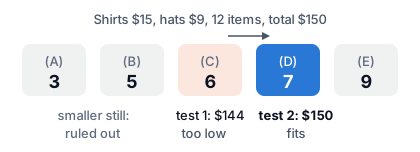
GMAT-level example. Shirts cost $15 and hats cost $9. Raj buys 12 items for $150. How many shirts does he buy? (A) 3 (B) 5 (C) 6 (D) 7 (E) 9
- Test the middle choice, 6 shirts: 6 × 15 + 6 × 9 = 90 + 54 = 144. That is $6 short.
- Each shirt in place of a hat adds $6, so he needs one more shirt.
- Test 7: 7 × 15 + 5 × 9 = 105 + 45 = 150 ✓. Answer: (D) 7.
Check yourself. Which choice solves n² − 5n = 84: 7, 10, 12, 14 or 16?
Check your answer
Test the middle, 12: 144 − 60 = 84 ✓. The answer is 12.
Variables in the answer choices
When the answer choices contain variables (letters), pick simple, different values for the letters. Work out the answer with those numbers. Then put the same values into every choice, and keep only the choices that give the same answer.
Why it works. If two expressions are equal for every value of the letters, they are equal for the values you picked. So any choice that gives a different number from the target is wrong.
How to spot it: the choices are expressions with letters, such as 100d/c or 60mp/s.
Example. Pens cost c cents each. How many pens can be bought with d dollars? Choices include 100d/c, dc/100 and 100c/d.
- Pick c = 20 and d = 3.
- $3 = 300 cents, and 300 ÷ 20 = 15 pens. The target is 15.
- 100d/c = (100 × 3) ÷ 20 = 300 ÷ 20 = 15. ✓
- dc/100 = (3 × 20) ÷ 100 = 0.6. ✗ And 100c/d = 2,000 ÷ 3 ≈ 667. ✗
- Answer: 100d/c.
Trap: forgetting that $1 = 100 cents.
Try it. A car travels m miles in h hours at a steady speed. How many miles does it travel in t minutes? Test mt/(60h), 60mt/h and ht/(60m).
Show the answer
- Pick m = 120, h = 2, t = 30. The speed is 120 ÷ 2 = 60 miles per hour, which is 1 mile per minute, so in 30 minutes the car goes 30 miles.
- mt/(60h) = (120 × 30) ÷ (60 × 2) = 3,600 ÷ 120 = 30. ✓
- 60mt/h = (60 × 120 × 30) ÷ 2 = 108,000. ✗
- ht/(60m) = (2 × 30) ÷ (60 × 120) = 60 ÷ 7,200, much less than 1. ✗
- Answer: mt/(60h).
Edge cases.
- Avoid 0, 1 and equal values for different letters. They make wrong expressions give the right number by accident.
- If two choices both match, pick new numbers and test only those two.
- Respect the conditions in the question, such as h > 40 below.
GMAT-level example. A worker earns w dollars an hour for the first 40 hours of a week and 1.5w an hour after that. Which expression gives her pay for h hours, where h > 40? (A) 1.5wh − 40w (B) 1.5wh − 20w (C) 40w + 1.5h
- Pick w = 10 and h = 50 (h must be more than 40).
- Target: 40 hours × $10 = $400, plus 10 hours × $15 = $150, so $550.
- (A) 750 − 400 = 350 ✗. (B) 750 − 200 = 550 ✓. (C) 400 + 75 = 475 ✗.
- Answer: (B). (By algebra: 40w + 1.5w(h − 40) = 40w + 1.5wh − 60w = 1.5wh − 20w.)
Check yourself. x apples cost y dollars. Which gives the cost of z apples in dollars: yz/x or xz/y?
Check your answer
Pick x = 2, y = 6, z = 3: each apple costs $3, so 3 apples cost $9. yz/x = 18/2 = 9 ✓ and xz/y = 6/6 = 1 ✗. Answer: yz/x.
How hard questions disguise it
For harder questions (L4–L5)
L4 and L5 questions don't tell you to pick numbers; you have to notice that numbers would help. Abstract algebra questions ("if x is 30% more than y…") become easy when you pick a value. Percent questions with chained changes are fastest with 100. Work rate questions with variable times become simple when you pick a size for the job. Choose numbers that don't make two choices give the same value, and remember that picking numbers only proves which choices fail, so test them all.
Practice
Practice these strategies in timed sets on the picking numbers practice page.
Common traps
Mixing units or missing part of the trip
A per-minute rate times a time in hours is meaningless, and a round trip covers the distance twice. Convert first, and check the direction: hours become more minutes, not fewer.
Putting a variable on the wrong side of the fraction
More miles means more fuel, so distance goes on top; better mileage means less fuel, so mileage goes underneath. Plug in your picked numbers to see which way round makes sense.
Combining rates or times wrong
Workers' rates add (1/x + 1/y); their times don't add or average. Picking easy times, such as 2 and 3 hours, shows which choice matches.
Using one fraction instead of all of them
If 1/3 of a jar is red and 1/4 is blue, the rest is 5/12, and every fraction is of the whole jar. Picking the LCM is only a trial total: scale it until the known amount matches.
Making a mistake in the fraction arithmetic
1/3 − 1/5 is 2/15, not 1/2, and 1/3 + 1/4 is 7/12, not 2/7. Use a common denominator, or pick the LCM as the total so every fraction becomes a whole number.
Adding, averaging or dividing percents
Percents of percents multiply, and percent changes on different bases multiply too. Picking 100 turns every relationship into a number you can follow step by step.
Reporting the wrong percent
If x is 25% of y, then y is 400% of x, not 125% or 75%. Decide which quantity is the base, and whether the question wants a level or a change.
Misreading a backsolve test
A choice is right only if it satisfies the stem exactly. Plug it in fully; a near miss, or the partner value that appears during the check, is a trap.
Picking 0 or 1, or not testing every choice
Numbers like 0 and 1 often make two choices give the same value. Pick distinct, unusual values, and test every choice; if more than one survives, pick new numbers.
Undoing two percent changes the wrong way
Successive changes multiply. To undo them, divide by each factor in reverse order. A 20% rise isn't undone by a 20% cut.
Adding percent changes in price and units
Revenue = price × units, so multiply every change as a factor (pick 100 for each starting value). Never add or subtract the percents.