SAT Math lesson · Exponents & roots
SAT exponents and radicals: rules, rational exponents, radical equations
Exponents and radicals for SAT Math: combine powers of the same base, rewrite rational exponents as radicals, find an equivalent power of x, and solve square-root equations without keeping extraneous solutions.
The core idea
Exponent rules work only on products and quotients of the same base: multiply means add exponents, divide means subtract, a power of a power means multiply. Sums of powers don't combine, so factor out the smallest power first, and rewrite different bases as powers of a common prime.
Core ideas
Words used here
- Base and exponent: in 2⁵, the base is 2 and the exponent (or power) is 5. It means 2 × 2 × 2 × 2 × 2 = 32.
- Square root √x: the number (0 or positive) that times itself gives x: √25 = 5.
- Cube root: the number that, multiplied by itself three times, gives x. The cube root of 27 is 3, because 3 × 3 × 3 = 27.
- Reciprocal: 1 divided by the number. The reciprocal of 5 is 1/5, and the reciprocal of 2/3 is 3/2.
- Prime: a whole number above 1 whose only factors are 1 and itself: 2, 3, 5, 7, 11 and so on.
- Numerator and denominator: the top and the bottom of a fraction.
- Same base (count the factors):
- Multiply → add the exponents: a³ × a² = (a × a × a) × (a × a) = a⁵.
- Divide → subtract the exponents: a⁵ ÷ a² = a³, because two of the a's cancel.
- Power of a power → multiply the exponents: (a²)³ = a² × a² × a² = a⁶.
- Same exponent: an × bn = (ab)n. For example, 2³ × 5³ = 10³ = 1,000.
- Zero and negative exponents: a⁰ = 1 (when a ≠ 0) and a−n = 1/an. See the pattern: 2² = 4, 2¹ = 2, 2⁰ = 1, 2−1 = 1/2. Each step down divides by 2.
- Fractional exponents: a1/2 = √a, a1/3 is the cube root of a, and ap/q = (qth root of a)p. For example, 82/3 = (cube root of 8)² = 2² = 4.
- Sums don't combine: 2n + 2n = 2 × 2n = 2n+1, not 4n. Check with n = 3: 8 + 8 = 16 = 2⁴, but 4³ = 64.
On the SAT
- Exponent questions usually ask which expression is equivalent, or for an exponent k with x^k equal to a given expression (a student-produced response: type a fraction such as 11/6).
- Radicals are written √x (square root) and ∛x (cube root), and the SAT assumes x > 0 when it writes x^(1/2).
- Desmos can check an equivalence: graph both expressions for x > 0 and see whether they coincide.
Try it. Simplify 5⁴ × 5³ ÷ 5⁵.
Show the answer
- Multiply: 5⁴ × 5³ = 54+3 = 5⁷.
- Divide: 5⁷ ÷ 5⁵ = 57−5 = 5².
- 5² = 25.
Combining powers of the same base
The exponent rules only work when the bases (the numbers being raised to a power) are the same. So first rewrite every base as a power of the same prime (for example, 9 = 3² and 27 = 3³). Then multiply out any power of a power, and add or subtract the exponents.
Why it works. a³ means three a's multiplied together. Multiplying a³ by a² puts five a's in a row, so the exponents add. Dividing cancels copies, so the exponents subtract. These rules count copies of one base. With different bases there is nothing to count together until you rewrite them.
How to spot it: a product or quotient of powers with related bases (2, 4, 8, 16 or 3, 9, 27).
Example. Simplify (9² × 27) ÷ 3⁵.
- 9 = 3², so 9² = (3²)² = 32×2 = 3⁴. And 27 = 3 × 3 × 3 = 3³.
- Top: 3⁴ × 3³ = 34+3 = 3⁷.
- Divide: 3⁷ ÷ 3⁵ = 37−5 = 3² = 9.
The same rules let you rewrite one power using another. If 3x = 5, then 9x = (3²)x = (3x)² = 5² = 25, and 3x+2 = 3x × 3² = 5 × 9 = 45.
Trap: writing 9² × 27 as 32+3 without first rewriting 9 as 3².
Edge cases.
- Negative bases. (−2)³ = −8 and (−2)⁴ = 16: an odd exponent keeps the sign, an even one removes it. But −2⁴ = −16, because the exponent applies before the minus sign.
- 0 and 1 as bases. 0 to any positive power is 0, and 1 to any power is 1.
- Same exponent, different bases: 4³ × 25³ = (4 × 25)³ = 100³ = 1,000,000.
SAT-level example. What is (8² × 4−3) ÷ 161/2?
- Rewrite every base as a power of 2: 8 = 2³, 4 = 2², 16 = 2⁴.
- 8² = 26, 4−3 = 2−6 and 161/2 = 22.
- Top: 26 × 2−6 = 20 = 1.
- Divide: 1 ÷ 2² = 1/4.
- Check: 64 × (1/64) = 1, and √16 = 4, so 1 ÷ 4 = 1/4 ✓.
Equivalent power of x (SAT favourite). For x > 0, what is k if (x⁴)1/3 · x² = xk?
- A power of a power multiplies: (x⁴)1/3 = x4/3.
- Multiplying adds: 4/3 + 2 = 10/3.
- k = 10/3. Type 10/3 in the box (3.333 is also accepted).
Trap: 4⁶ = 2¹², 8⁴ = 2¹² and 16³ = 2¹², but 2⁶ + 2⁶ = 2 × 2⁶ = 2⁷: a sum of powers doesn't combine like a product.
Check yourself. If 3x = 5, what is 27x?
Check your answer
27x = (3³)x = (3x)³ = 5³ = 125.
Factoring out a common power
The rules above don't work for sums or differences: 2¹⁵ − 2¹² is not 2³. Instead, factor out the smallest power (write it once in front of parentheses). What's left in the parentheses is a plain number.
Why it works. Factoring is the distributive law run backward: 2¹²(2³ − 1) = 2¹² × 2³ − 2¹² = 2¹⁵ − 2¹². Taking out the smallest power leaves only whole numbers in the parentheses.
How to spot it: sums or differences of powers, often divided by another power.
Example. Simplify (2¹⁵ − 2¹²) ÷ 2¹¹.
- The smaller power on top is 2¹². Write 2¹⁵ = 2¹² × 2³.
- Factor out 2¹²: 2¹⁵ − 2¹² = 2¹²(2³ − 1) = 2¹²(8 − 1) = 2¹² × 7.
- Divide by the bottom: 2¹² ÷ 2¹¹ = 2¹ = 2.
- Result: 2 × 7 = 14.
Trap: subtracting the exponents on top (15 − 12 = 3, giving 2³) as if it were a division.
Try it. Simplify (3⁶ + 3⁵) ÷ 3⁴.
Show the answer
- Factor out the smaller power: 3⁶ + 3⁵ = 3⁵(3 + 1) = 3⁵ × 4.
- Divide by 3⁴: 3⁵ ÷ 3⁴ = 3.
- Result: 3 × 4 = 12. Check: (729 + 243) ÷ 81 = 972 ÷ 81 = 12 ✓.
Edge cases.
- Equal powers added. 5n + 5n + 5n + 5n + 5n = 5 × 5n = 5n+1.
- Rewrite to one base first. 417 − 228 only factors after 417 = 234.
- With letters: x⁵ − x³ = x³(x² − 1) = x³(x − 1)(x + 1).
SAT-level example. Which expression is equivalent to 2x + 3 − 2x?
- 2x + 3 = 2x × 2³ = 8 × 2x.
- Factor out 2x: 8 × 2x − 1 × 2x = 7 × 2x.
- The trap 2³ = 8 subtracts the exponents as if the powers were divided.
Three copies of 3¹⁰ are 3 × 3¹⁰ = 3¹¹, and 2²⁰ − 2¹⁹ = 2¹⁹(2 − 1) = 2¹⁹.
Check yourself. Simplify (5⁸ − 5⁶) ÷ (5⁶ + 5⁵).
Check your answer
Top: 5⁶(5² − 1) = 5⁶ × 24. Bottom: 5⁵(5 + 1) = 5⁵ × 6. Divide: 5 × 24 ÷ 6 = 20.
Comparing large powers
Rewrite the powers so they have the same exponent (or the same base). Then compare what's left.
Why it works. With the same positive exponent, the larger positive base gives the larger result (8²⁰ < 9²⁰ because each of the 20 factors is larger). With the same base above 1, the larger exponent gives the larger result. Rewriting puts you in one of those two cases.
How to spot it: "which is greatest" among numbers like 260, 340, 520.
Example. Which is largest: 260, 340 or 520?
- The exponents 60, 40 and 20 are all multiples of 20. So use the power of a power rule: 260 = (2³)20 = 820, and 340 = (3²)20 = 920.
- Now all three have the exponent 20, so compare the bases: 9 > 8 > 5.
- 340 is largest.
Trap: picking 260 because it has the biggest exponent.
Edge cases.
- Bases between 0 and 1 work backward: (1/2)¹⁰ < (1/2)³. Each extra factor of 1/2 makes the number smaller.
- Roots. To compare √2 and the cube root of 3, raise both to the 6th power (6 is a multiple of 2 and 3): (√2)⁶ = 2³ = 8 and (cube root of 3)⁶ = 3² = 9. So the cube root of 3 is larger.
- Negative bases: an odd power of a negative number is negative, so it is smaller than any positive power.
SAT-level example. Order 2100, 375 and 550 from least to greatest.
- The exponents 100, 75 and 50 are all multiples of 25.
- 2100 = (2⁴)25 = 1625, 375 = (3³)25 = 2725, and 550 = (5²)25 = 2525.
- Compare the bases: 16 < 25 < 27.
- Order: 2100 < 550 < 375.
In the same way 2³⁰ = (2¹⁰)³ = 1,024³ is greater than 10⁹ = 1,000³. Calculators round numbers this large, so rewrite instead. (Comparing huge powers is rare on the SAT; the rewriting skill is what matters.)
Check yourself. Which is larger, 320 or 230?
Check your answer
320 = (3²)10 = 910 and 230 = (2³)10 = 810. Since 9 > 8, 320 is larger.
Rationalizing a denominator
To rationalize means to rewrite a fraction so there is no root in the denominator (the bottom). Multiply the top and the bottom by the same thing, which doesn't change the value. If the bottom is a single root, use that root: 6/√3 = 6√3/(√3 × √3) = 6√3/3 = 2√3. If the bottom is a sum or difference, use its conjugate, the same two terms with the opposite sign between them (the conjugate of √5 − 1 is √5 + 1).
Why it works. Multiplying by (√5 + 1)/(√5 + 1) is multiplying by 1, so the value doesn't change. The conjugate is chosen because (a − b)(a + b) = a² − b², and squaring a square root removes the root.
How to spot it: a root in a denominator, and answer choices written without one.
Example. Simplify 4 ÷ (√5 − 1).
- Multiply the top and the bottom by the conjugate, √5 + 1: 4(√5 + 1) ÷ ((√5 − 1)(√5 + 1)).
- The bottom is a difference of squares: (√5)² − 1² = 5 − 1 = 4.
- Result: 4(√5 + 1) ÷ 4 = √5 + 1.
Trap: multiplying by √5 alone. The bottom becomes 5 − √5, which still has a root.
Edge cases.
- Simplify roots first. √50 = √(25 × 2) = 5√2, and √12 = 2√3.
- Roots don't split over sums. √(9 + 16) = √25 = 5, but √9 + √16 = 7. They do split over products: √(9 × 16) = 3 × 4 = 12.
- A cube root needs a cube. To clear 1/(cube root of 2), multiply by (cube root of 4)/(cube root of 4): the bottom becomes the cube root of 8, which is 2.
SAT-level example. Simplify (√7 + √3)/(√7 − √3).
- Multiply the top and the bottom by the conjugate of the bottom, √7 + √3.
- Bottom: (√7 − √3)(√7 + √3) = 7 − 3 = 4.
- Top: (√7 + √3)² = 7 + 2√21 + 3 = 10 + 2√21.
- Result: (10 + 2√21)/4 = (5 + √21)/2.
- Check with decimals: (2.646 + 1.732)/(2.646 − 1.732) ≈ 4.378/0.914 ≈ 4.79, and (5 + 4.583)/2 ≈ 4.79 ✓.
Check yourself. Simplify 6/√12.
Check your answer
√12 = 2√3, so 6/√12 = 3/√3 = 3√3/3 = √3.
Negative and fractional exponents
A negative exponent means "take the reciprocal" (1 divided by the number): 2−3 = 1/2³ = 1/8. A fractional exponent means a root and a power: in ap/q, the bottom number q says which root, and the top number p says which power. Take the root first to keep the numbers small.
Why it works. The exponent rules force these meanings. a⁰ must be 1, because a³ ÷ a³ = a3−3 = a⁰ and anything divided by itself is 1. Then a−n = a⁰ ÷ an = 1/an. And a1/2 must be √a, because (a1/2)² = a1 = a.
How to spot it: exponents like −2, 1/2 or 2/3.
Example. Evaluate 27−2/3.
- The negative sign means reciprocal: 27−2/3 = 1 ÷ 272/3.
- The bottom of 2/3 is 3, so take the cube root: the cube root of 27 is 3.
- The top of 2/3 is 2, so square it: 3² = 9.
- Result: 1/9.
For a fraction, a negative exponent flips it: (2/3)−2 = (3/2)² = 9/4.
Trap: reading 27−2/3 as 27 × (−2/3) = −18. An exponent is not a multiplier.
Try it. Evaluate 16−3/4.
Show the answer
- Reciprocal: 16−3/4 = 1 ÷ 163/4.
- Fourth root of 16: 2, because 2 × 2 × 2 × 2 = 16.
- Cube it: 2³ = 8.
- Result: 1/8.
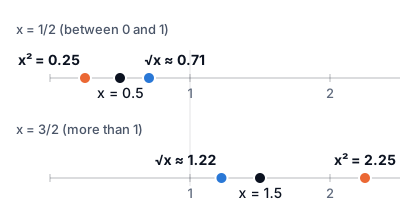
See it. Powers and roots push numbers in opposite directions, and the direction depends on whether the number is below or above 1.
Edge cases.
- Even roots of negative numbers aren't real. (−8)1/3 = −2 is fine, but (−4)1/2 is not a real number.
- √(x²) = |x|, not x. √((−3)²) = √9 = 3.
- A negative exponent doesn't make the number negative. 2−3 = 1/8 > 0, and (−2)−3 = 1/(−8) = −1/8.
SAT-level example. If x = 8−2/3 + 4−1/2, what is 1/x?
- 8−2/3 = 1 ÷ 82/3. The cube root of 8 is 2, and 2² = 4, so 8−2/3 = 1/4.
- 4−1/2 = 1 ÷ √4 = 1/2.
- x = 1/4 + 1/2 = 3/4.
- 1/x = 4/3.
Typed answer. "What is the value of 82/3 + 16−1/2?" 82/3 = 2² = 4 and 16−1/2 = 1/4, so the value is 17/4. In the SAT box, type 17/4 or 4.25 (an unreduced 34/8 is also accepted).
Check yourself. Evaluate (1/9)−3/2.
Check your answer
The negative exponent flips the fraction: (1/9)−3/2 = 93/2. √9 = 3, and 3³ = 27.
Powers and roots by range
A question may give only a range for x, such as 0 < x < 1, and ask which of x, x², x³, √x or 1/x is greatest or least. Where x sits on the number line decides the order.
| Range | Order (least to greatest) | Test value |
|---|---|---|
| x > 1 | 1/x < √x < x < x² < x³ | x = 2 |
| 0 < x < 1 | x³ < x² < x < √x < 1/x | x = 1/2 |
| −1 < x < 0 | 1/x < x < x³ < x² | x = −1/2 |
| x < −1 | x³ < x < 1/x < x² | x = −2 |
Why it works. Multiplying by a number greater than 1 makes a positive number bigger, and multiplying by a number between 0 and 1 makes it smaller. So for x > 1 each higher power is larger, and for 0 < x < 1 each higher power is smaller. For a negative x, an odd power stays negative and an even power is positive, and the size rules above apply to the distance from 0.
How to spot it: a range for x (0 < x < 1, −1 < x < 0, x > 0) and choices that are powers or roots of the same letter.
SAT-level example. If 0 < x < 1, which of x², x, √x and 1/x is the least?
- Test x = 1/2: x² = 1/4, x = 1/2, √x ≈ 0.71 and 1/x = 2.
- Every x between 0 and 1 behaves the same way: squaring makes it smaller and the square root makes it larger.
- x² is the least (and 1/x the greatest).
If the condition were only x > 0, the order would depend on x: x = 4 gives x² = 16, the greatest.
Trap: testing only x = 2 (or another whole number). The usual order "higher power means bigger" is reversed between 0 and 1, and odd powers of negatives are negative.
Edge cases.
- Endpoints. x = 0 and x = 1 make x, x², x³ and √x all equal. A strict range such as 0 < x < 1 excludes them; x ≥ 0 doesn't.
- Negatives. For x < 0, x² is positive, so x² > x³ always, and √x isn't a real number.
Check yourself. If −1 < x < 0, which is greater, x³ or x?
Check your answer
Test x = −1/2: x³ = −1/8 and x = −1/2. Since −1/8 > −1/2, and every x in the range behaves the same way (x³ is closer to 0), x³ is greater.
Radical equations and extraneous solutions
To solve an equation with a square root, isolate the root and square both sides. Squaring can add a solution: if √A = B, then A = B², but A = B² also holds when √A = −B. A square root is never negative, so any solution that makes the other side negative is extraneous and must be dropped.
How to spot it: √(expression) = expression with x outside the root, and choices such as "5 only", "−2 only", "−2 and 5".
Example. What are all the solutions to √(x + 11) = 1 − x?
- Square both sides: x + 11 = (1 − x)² = 1 − 2x + x².
- Move every term to one side: x² − 3x − 10 = 0, so (x − 5)(x + 2) = 0: x = 5 or x = −2.
- Check x = −2: √9 = 3 and 1 − (−2) = 3 ✓.
- Check x = 5: √16 = 4 but 1 − 5 = −4 ✗. It is extraneous.
- The only solution is −2.
Trap: answering "−2 and 5" because both solve the squared equation. The opposite slip happens too: in √(7x − 12) = x both solutions, 3 and 4, check (√9 = 3 and √16 = 4), so neither should be thrown out.
Isolate the root first. For √(x + 2) + 4 = x, subtract 4 before squaring: √(x + 2) = x − 4. Squaring the original sides would leave a root in the middle term.
Check yourself. Solve √(2x + 3) = x.
Check your answer
Square: 2x + 3 = x², so x² − 2x − 3 = 0 and (x − 3)(x + 1) = 0. x = 3 checks (√9 = 3 ✓), but x = −1 gives √1 = 1 ≠ −1. The only solution is 3.
How hard questions disguise it
For harder questions (L4–L5)
L4 versions mix radicals and powers in one expression, or put a square root in an equation, where squaring can add a solution that doesn't work. Exponents inside equations are exponential equations. Rewrite every root as a fractional exponent, every base as a power of a prime, and check every solution of a radical equation in the original.
Practice
Practice exponent and root rules in timed sets on the exponents practice page.
Common traps
Mixing up the add, subtract and multiply rules
Multiplying powers adds exponents, dividing subtracts, and a power of a power multiplies. Say which operation joins the powers before you touch the exponents.
Combining exponents before matching the bases
4³ × 8² is not 32⁵ or 2⁵. Rewrite each base as a power of 2 first, then apply the rules.
Miscounting the factors
B^a × B^b contains exactly a + b copies of B. Answers one away from a + b come from miscounting.
Treating a sum or difference of powers like a single power
2¹⁰ − 2⁸ is not 2², and 2^(x + 3) is 2^x × 2³, not 2^x + 2³. Factor out the smallest power to turn a sum or difference into a product.
Forgetting to divide by the denominator's power
After factoring the numerator, divide every piece by the denominator. The leftover power and the number in parentheses both stay in the answer.
Misreading a negative or fractional exponent
x^(p/q) means the qth root of x, raised to the pth power, and a negative exponent flips the fraction: (2/3)^(−2) = (3/2)² = 9/4. Raise both numerator and denominator.
Rewriting a power through a known one wrong
If 3^x = 5, then 9^x = (3^x)² = 25 and 3^(x + 2) = 3^x × 3² = 45. Square, don't double, and multiply by the power of the base, not by the exponent.
Answering a value instead of the exponent asked for
Exponent questions produce powers, factors and partial exponents along the way. Check whether the question asks for x, for a + b, or for the value of a power.
Combining exponent equations wrong
Once both equations are written as equations in the exponents, add or subtract them to build the target, then divide by the coefficient you actually get.
Squaring a sum term by term
(a + b)² is a² + 2ab + b², not a² + b², and √(x²) is |x|, not x. Expand or simplify carefully.
Stopping before the largest prime factor
After you factor out the common power, the other factor (like 2⁴ − 1 = 15 = 3 × 5) usually holds the largest prime. Factor it completely before you choose.
Multiplying exponents when multiplying powers
3⁴ × 3⁵ = 3⁹ (add the exponents), not 3²⁰; only a power of a power multiplies: (3⁴)⁵ = 3²⁰.
Comparing powers by the exponent alone
2³⁰ has the bigger exponent, but 2³⁰ = 8¹⁰ < 9¹⁰ = 3²⁰. Rewrite with a common exponent (or base) first.
Combining a sum of powers like one power
2ᵏ + 2ᵏ = 2ᵏ⁺¹, not 4ᵏ = 2²ᵏ. The two agree only at k = 1.
Misreading a negative or fractional exponent
16<sup>−1/2</sup> = 1/√16 = 1/4, not −8 or −4, and 8<sup>2/3</sup> = (cube root of 8)² = 4.
Comparing powers without checking where x is
For 0 < x < 1, x² < x and √x > x; for −1 < x < 0, x³ > x. Test a fraction and a negative before you decide, not only x = 2.
Rational exponents and radicals mixed up
x^(2/3) is the cube root of x²: the denominator is the root, the numerator the power. It isn't (2/3)x or 1/∛(x²), and (8x⁶)^(1/3) = 2x²: the root applies to the 8 too.
Keeping a solution that squaring added
Squaring both sides of √(x + 11) = 1 − x gives x = −2 and x = 5, but at x = 5 the right side is −4 and a square root is never negative. Check every solution in the original equation.