SAT Math lesson · Simplifying
SAT equivalent expressions: expanding, rearranging, rational expressions
Equivalent expressions for SAT Math: expand products, solve a formula for one variable, combine rational expressions, match coefficients of identities, and divide polynomials.
The core idea
SAT equivalent-expression questions reward careful, complete steps: multiply every term by every term, undo a formula's operations in reverse order, put fractions over a common denominator, and match coefficients when two expressions are equal for all x. Check any choice by substituting a simple number.
Core ideas
Words used here
- Expression: numbers and letters joined by +, −, × or ÷, with no equals sign, such as 2x + y.
- Term: one piece of an expression between + and − signs. In 2x + y − 5, the terms are 2x, y and −5.
- Coefficient: the number that multiplies a variable, such as 2 in 2x.
- Numerator and denominator: the top and the bottom of a fraction.
- Rational expression: a fraction with a variable in it, such as 2/(x − 1).
- Distribute (or expand): multiply the number outside the parentheses by every term inside: 3(x + 2) = 3x + 6.
- Identity: an equation that is true for every value of the letters, such as (a + b)² = a² + 2ab + b².
- Do the same thing to both sides, and collect the variable you want on one side.
- Combine fractions over a common denominator. With numbers: 1/3 + 1/4 = 4/12 + 3/12 = 7/12. With letters it works the same way: 1/a + 1/b = b/(ab) + a/(ab) = (a + b)/(ab).
- Special products (three identities to know):
- (a + b)² = a² + 2ab + b². Why: (a + b)(a + b) = a² + ab + ab + b². Check: (3 + 2)² = 25 and 9 + 12 + 4 = 25.
- (a − b)² = a² − 2ab + b².
- (a + b)(a − b) = a² − b².
- Aim for the expression, not the variables: often x/y, 2x + y or a² + b² can be found without finding x or y.
- Never divide by an expression that might be zero. In x² = 5x, dividing by x gives x = 5 and loses x = 0. Factor instead: x(x − 5) = 0, so x = 0 or x = 5.
On the SAT
- Equivalent-expression questions are usually "Which expression is equivalent to …?" with four choices. To check a choice, substitute a simple value such as x = 2 into the question and the choice: different values rule the choice out.
- Desmos can check equivalence: graph the given expression and a choice; equivalent expressions draw the same graph.
- Questions about a constant ("for all values of x, … what is k?") are often student-produced responses: type the number, a fraction such as 7/2 if needed.
Try it. Expand (x + 4)².
Show the answer
- Use (a + b)² = a² + 2ab + b² with a = x and b = 4.
- a² = x², 2ab = 2 × x × 4 = 8x, b² = 16.
- So (x + 4)² = x² + 8x + 16.
- Check with x = 1: (1 + 4)² = 25 and 1 + 8 + 16 = 25 ✓.
Express one variable in terms of another
"x in terms of y" means a formula for x that uses only y and numbers. Clear any fractions, move every term with x to one side, factor out x if needed, and divide by what multiplies x.
Why it works. Every step is one you can undo (adding, subtracting, or multiplying or dividing by something that isn't 0). So the formula you end with describes exactly the same pairs of x and y as the equation you started with. Factoring out x is what lets you divide: xy + 3x = 7 becomes x(y + 3) = 7, so x = 7/(y + 3).
How to spot it: "which of the following gives x in terms of y", with answer choices that contain y.
Example. If 1/x + 1/y = 1/4, express x in terms of y.
- Subtract 1/y from both sides: 1/x = 1/4 − 1/y.
- Use the common denominator 4y: 1/4 = y/(4y) and 1/y = 4/(4y). So 1/x = (y − 4)/(4y).
- Take the reciprocal of both sides (flip each fraction: the reciprocal of a/b is b/a): x = 4y/(y − 4).
- Check with y = 8: x = 32/(8 − 4) = 32/4 = 8, and 1/8 + 1/8 = 2/8 = 1/4 ✓.
Trap: flipping each term separately to get x = 4 − y. The reciprocal of a sum is not the sum of the reciprocals: 1/(2 + 2) = 1/4, but 1/2 + 1/2 = 1.
Try it. If 5x + 2y = 3x + 8, express x in terms of y.
Show the answer
- Subtract 3x from both sides: 2x + 2y = 8.
- Subtract 2y from both sides: 2x = 8 − 2y.
- Divide both sides by 2: x = 4 − y.
- Check with y = 0: x = 4, and 5(4) + 0 = 20 = 3(4) + 8 ✓.
Edge cases.
- Dividing adds a condition. x = 4y/(y − 4) needs y ≠ 4. If y = 4, the original equation says 1/x = 1/4 − 1/4 = 0, which no x can satisfy.
- Test the answer choices with a number. Pick an easy y, find x from the original equation, then see which choice gives the same x.
SAT-level example. If a = (2b + 3)/(b − 1), what is b in terms of a?
- Multiply both sides by (b − 1): a(b − 1) = 2b + 3.
- Expand: ab − a = 2b + 3.
- Collect the b-terms on one side: ab − 2b = a + 3.
- Factor out b: b(a − 2) = a + 3.
- Divide by (a − 2): b = (a + 3)/(a − 2), for a ≠ 2.
- Check with b = 3: a = (6 + 3)/2 = 4.5, and (4.5 + 3)/(4.5 − 2) = 7.5/2.5 = 3 ✓.
Check yourself. If xy + 3x = 7, express x in terms of y.
Check your answer
Factor out x: x(y + 3) = 7, so x = 7/(y + 3) (y ≠ −3). Check with y = 4: x = 1, and 1 × 4 + 3 × 1 = 7 ✓.
Combining rational expressions
A rational expression is a fraction with a variable in it. Add or subtract them like number fractions: rewrite both over a common denominator (for example, the product of the two denominators), combine the numerators (tops), then simplify.
Why it works. You can only add fractions that count pieces of the same size. Rewriting over a common denominator multiplies each fraction by a form of 1, such as (x + 1)/(x + 1), so its value doesn't change; only the size of the pieces does.
How to spot it: sums or differences of fractions with variables in the denominator.
Example. Simplify 2/(x − 1) − 2/(x + 1).
First see it with a number. If x = 4, this is 2/3 − 2/5 = 10/15 − 6/15 = 4/15. Now do the same steps with x:
- Common denominator: (x − 1)(x + 1) = x² − 1.
- Rewrite each fraction: 2/(x − 1) = 2(x + 1)/(x² − 1) and 2/(x + 1) = 2(x − 1)/(x² − 1).
- Subtract the numerators: 2(x + 1) − 2(x − 1) = 2x + 2 − 2x + 2 = 4.
- Result: 4/(x² − 1). Check with x = 4: 4/(16 − 1) = 4/15 ✓.
Trap: writing −2(x − 1) as −2x − 2. The second term changes sign too: −2(x − 1) = −2x + 2.
Edge cases.
- Factor the denominators first. The common denominator may be smaller than their product. In 1/(x² − 4) + 1/(x − 2), x² − 4 = (x − 2)(x + 2) already contains x − 2. So 1/(x² − 4) + (x + 2)/(x² − 4) = (x + 3)/(x² − 4).
- Cancel factors, never terms. (x² − 4)/(x + 2) = (x − 2)(x + 2)/(x + 2) = x − 2 (for x ≠ −2). But (x² + 4)/(x + 2) does not simplify: x² + 4 has no factor x + 2.
- Values that make a denominator 0 stay forbidden, even after a factor cancels.
SAT-level example. Which expression is equivalent to 1/(x − 2) − 1/(x + 2)?
- Common denominator (x − 2)(x + 2) = x² − 4.
- Numerator: (x + 2) − (x − 2) = 4. The parentheses matter: the minus sign reaches both terms of x − 2.
- So the difference is 4/(x² − 4).
SAT-level example. For x ≠ 0, 1 and −1, simplify (1 − 1/x) ÷ (1 − 1/x²).
- Write each bracket as one fraction: 1 − 1/x = (x − 1)/x and 1 − 1/x² = (x² − 1)/x².
- Dividing by a fraction is multiplying by its reciprocal: (x − 1)/x × x²/(x² − 1).
- Factor x² − 1 = (x − 1)(x + 1): (x − 1)/x × x²/((x − 1)(x + 1)).
- Cancel (x − 1) and one x: x/(x + 1).
- Check with x = 2: (1 − 1/2) ÷ (1 − 1/4) = (1/2) ÷ (3/4) = 2/3, and 2/(2 + 1) = 2/3 ✓.
Check yourself. Write 3/x + 2/(x + 1) as one fraction.
Check your answer
Common denominator x(x + 1): [3(x + 1) + 2x]/(x(x + 1)) = (5x + 3)/(x² + x). Check with x = 1: 3 + 1 = 4, and 8/2 = 4 ✓.
Value of an expression, not the variables
Look at the expression the question wants, and build it from the given equations by adding, subtracting or multiplying them. Solving for each variable also works, but takes longer.
Why it works. You may add, subtract or multiply true equations by a number, and they stay true. If the combination you build matches the target exactly, its value is fixed, even when the separate variables are not.
How to spot it: two equations and a question about a combination like 4a + b or x/y.
Example. If 3a + 2b = 14 and a − b = 3, what is 4a + b?
- Add the left sides: (3a + a) + (2b − b) = 4a + b.
- Add the right sides: 14 + 3 = 17.
- So 4a + b = 17.
- Check: a = 4 and b = 1 solve both equations (12 + 2 = 14 and 4 − 1 = 3), and 4(4) + 1 = 17 ✓.
Multiplying works the same way: if x + y = 6, then 3x + 3y − 4 = 3(x + y) − 4 = 3 × 6 − 4 = 18 − 4 = 14.
Trap: solving for a only and answering 4.
Edge cases.
- The expression can be fixed when the variables aren't. x + 2y = 5 has endless solutions, but every one of them gives 3x + 6y = 15.
- And the reverse: knowing x + y = 6 doesn't fix xy (it could be 5 or 9 or 0).
- For a ratio like x/y, rearrange to x = (some number) × y, then substitute.
Example. If 4x + 6y = 18, what is the value of 2x + 3y + 1?
- Divide the equation by 2: 2x + 3y = 9.
- So 2x + 3y + 1 = 9 + 1 = 10, though x and y themselves are unknown.
- By contrast, x + 3y can't be found: x = 0, y = 3 gives 9, but x = 3, y = 1 gives 6.
SAT-level example. If 2x − 3y = 0 and y ≠ 0, what is (x + y)/(x − y)?
- From 2x = 3y, x = 1.5y.
- Top: x + y = 1.5y + y = 2.5y. Bottom: x − y = 1.5y − y = 0.5y.
- (2.5y)/(0.5y) = 5. The y cancels because y ≠ 0.
- Check with y = 2 and x = 3: (3 + 2)/(3 − 2) = 5 ✓.
Check yourself. If a + 2b = 7 and 2a + b = 8, what is a − b?
Check your answer
Subtract the first equation from the second: (2a − a) + (b − 2b) = 8 − 7, so a − b = 1. (Here a = 3 and b = 2.)
Special products
Match the given information to one of the three identities (equations true for every value): (a + b)² = a² + 2ab + b², (a − b)² = a² − 2ab + b², and (a + b)(a − b) = a² − b². Given a sum and a product, square the sum. Given x − 1/x, square it to reach x² + 1/x².
How to spot it: a² + b², (a − b)², x² + 1/x², or a sum times a difference.
Example. If x − 1/x = 3, what is x² + 1/x²?
- Square both sides: (x − 1/x)² = 3² = 9.
- Expand with (a − b)² = a² − 2ab + b², where a = x and b = 1/x. The middle term is 2ab = 2 × x × (1/x) = 2. So x² − 2 + 1/x² = 9.
- Add 2 to both sides: x² + 1/x² = 11.
Trap: squaring term by term (x² − 1/x² = 9). This loses the middle term −2.
Try it. If a + b = 7 and ab = 10, what is a² + b²?
Show the answer
- Square the sum: (a + b)² = a² + 2ab + b², so 49 = a² + b² + 2(10).
- That is 49 = a² + b² + 20. Subtract 20 from both sides: a² + b² = 29.
- Check: a = 5 and b = 2 have sum 7 and product 10, and 25 + 4 = 29 ✓.
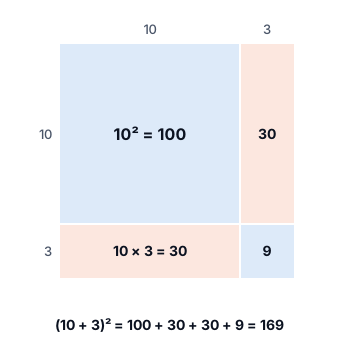
See it. (a + b)² is the area of a square with side a + b. Split each side into a and b, and the square splits into four pieces: a², b² and two a × b rectangles. Those two rectangles are the 2ab.
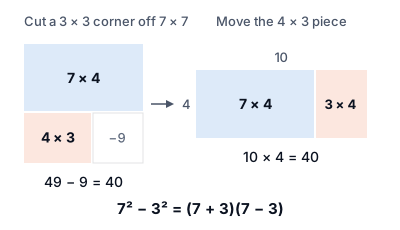
The same picture, with a corner cut out instead, explains (a + b)(a − b) = a² − b²:
Edge cases.
- (a − b)² = (b − a)². Squaring removes the sign, so both equal a² − 2ab + b².
- a² + b² needs two facts. From a + b alone you can't find it; you also need ab (or a − b).
- Sum and difference together give the product: (a + b)² − (a − b)² = 4ab. If a + b = 9 and a − b = 5, then ab = (81 − 25) ÷ 4 = 14.
Two signs. If a² + b² = 25 and ab = 12, then (a + b)² = 25 + 24 = 49, so a + b = 7 or −7 (a = 3, b = 4, or a = −3, b = −4). Only a condition such as "a and b are positive" picks 7.
Expanding a product of binomials. (4x − 2)(3x + 8): first × first, 12x²; the two middle products, 32x and −6x; last × last, −16. So it equals 12x² + 26x − 16. Dropping one middle product (12x² + 32x − 16) is a common trap.
SAT-level example. If x + 1/x = 4, what is x⁴ + 1/x⁴?
- Square both sides: x² + 2 × x × (1/x) + 1/x² = 16, so x² + 2 + 1/x² = 16 and x² + 1/x² = 14.
- Square again: x⁴ + 2 × x² × (1/x²) + 1/x⁴ = 196, so x⁴ + 2 + 1/x⁴ = 196.
- x⁴ + 1/x⁴ = 194.
- Check: x = 2 + √3 solves x + 1/x = 4 (its reciprocal is 2 − √3). Then x² = 7 + 4√3 and 1/x² = 7 − 4√3, which add to 14 ✓.
The trap answer 256 = 4⁴ raises each term to the fourth power and drops the middle terms.
Check yourself. If a − b = 3 and ab = 10, what is a² + b²?
Check your answer
(a − b)² = a² − 2ab + b², so a² + b² = (a − b)² + 2ab = 9 + 20 = 29. (a = 5 and b = 2 fit.)
Constants that make an identity
If two polynomials are equal for all values of x, they are the same polynomial, so the coefficients of each power of x match: x² with x², x with x, constant with constant.
How to spot it: "for all values of x, where a and k are constants", or "the expression … is equivalent to …".
Example. If (3x + a)(2x − 5) = 6x² + kx − 20 for all values of x, what is the value of k?
- Expand the left side: 6x² − 15x + 2ax − 5a.
- Constants: −5a = −20, so a = 4.
- x-terms: k = −15 + 2a = −15 + 8 = −7.
- Check with x = 1: (3 + 4)(2 − 5) = −21, and 6 − 7 − 20 = −21 ✓.
Trap: matching only one pair of terms. Here the constant term finds a first; the x-term then gives k.
A square. If (ax + 3)² = 16x² + kx + 9 for all x, with a > 0, then a² = 16, so a = 4, and k = 2(4)(3) = 24.
Check yourself. If (x + a)(x − 3) = x² + kx − 12 for all x, what is k?
Check your answer
Constants: −3a = −12, so a = 4. x-terms: k = −3 + a = 1. Check: (x + 4)(x − 3) = x² + x − 12 ✓.
Dividing a polynomial by a binomial
p(x)/(x + w) can be written as a quotient plus a remainder over the divisor: p(x)/(x + w) = q(x) + t/(x + w). Multiplying by x + w turns this into p(x) = q(x)(x + w) + t, which you can expand and match.
How to spot it: "The expression (…)/(2x − 5) is equivalent to rx + s + t/(2x − 5), where r, s and t are constants."
Example. (6x² − 3x − 28)/(2x − 5) is equivalent to rx + s + t/(2x − 5). What is t?
- Write 6x² − 3x − 28 = (rx + s)(2x − 5) + t = 2rx² + (2s − 5r)x + (t − 5s).
- x²: 2r = 6, so r = 3.
- x: 2s − 15 = −3, so s = 6.
- Constants: t − 30 = −28, so t = 2.
- Check with x = 0: −28/(−5) = 5.6, and 0 + 6 + 2/(−5) = 6 − 0.4 = 5.6 ✓.
Shortcut for the remainder. t is the value of p at the zero of the divisor: 2x − 5 = 0 at x = 5/2, and 6(25/4) − 3(5/2) − 28 = 37.5 − 7.5 − 28 = 2.
Trap: answering s (the quotient's constant) when t is asked, or forgetting that the divisor's leading coefficient (2 here) multiplies r.
Check yourself. (x² + 5x + 9)/(x + 2) = x + s + t/(x + 2). Find s and t.
Check your answer
x² + 5x + 9 = (x + s)(x + 2) + t = x² + (s + 2)x + (2s + t). So s + 2 = 5, s = 3, and 6 + t = 9, t = 3. Check: at x = −2, 4 − 10 + 9 = 3 ✓.
How hard questions disguise it
For harder questions (L4–L5)
L4 versions hide the target expression ("what is the value of (x + y)/(x − y)?") or put variables in the answer choices. At L5, the SAT asks for a constant that makes two expressions equivalent for all x, or the remainder after dividing by a binomial; manipulation also feeds quadratics (rearrange to ax² + bx + c = 0, then factor) and functions (put an expression into f, then simplify). Look at what the question asks for before you start, and work toward it directly.
Practice
Practice rearranging and simplifying in timed sets on the algebraic manipulation practice page.
Common traps
Dropping or misusing the cross term
(a + b)² = a² + 2ab + b², (a − b)² = a² − 2ab + b², and their difference is 4ab. Write the identity out in full, including the 2 and the sign of the middle term, before substituting.
Not distributing across parentheses
A factor outside parentheses, or a divisor under a whole expression, reaches every term: k(x − y) = kx − ky and (y − b)/a = y/a − b/a. Copy coefficients exactly before moving terms.
Sign slips when moving terms
Moving a term across the equals sign flips its sign, and only that term's sign. Check your rearranged equation by plugging in a simple value.
Answering y/x, a given value, or a relabeled equation
The number in the given equation is rarely the answer, and swapping letters doesn't solve anything. Check that your final expression is the one the question asks for.
Skipping the last division, or doing it wrong
After collecting terms you may have 5y = 3x; x/y is then 5/3. Undo multiplication by dividing, and finish isolating the quantity asked for.
Adding fractions without a true common denominator
t/a + t/b is t(a + b)/(ab), not t/(a + b). Rewrite each fraction over the common denominator, scaling its numerator by the same factor as its denominator.
Scaling the given value wrong
If x + y = 6, then 3x + 3y − 4 = 3 × 6 − 4: the 3 multiplies the given value, and the − 4 is applied once, unscaled. Factor the target to expose the given expression.
Dividing by a variable that could be zero
Dividing both sides by x quietly assumes x ≠ 0 and can lose a solution. Factor instead, unless the question rules out zero.
Cubing x + 1/x and forgetting the cross terms
(x + 1/x)³ = x³ + 1/x³ + 3(x + 1/x). So x³ + 1/x³ = s³ − 3s, where s = x + 1/x. Subtract 3s, not 3, and don't stop at the square.
Thinking the variables must be found (or that every expression is fixed)
One equation fixes its left side and every multiple of it, plus constants; it doesn't fix x, y or a different mix of them. Scale the equation to match the expression asked for.
Slips in the square identities
(3x − 7)² = 9x² − 42x + 49: keep the middle term, double it, check its sign, and square the coefficient too. A product of two binomials has two middle products.
Combining fractions wrongly
Multiply each numerator by the OTHER fraction's denominator, and when subtracting, put the second numerator in parentheses so the minus sign reaches every term.
Rearranging a formula
Undo operations in reverse order, applying each step to the whole side. Divide every term by the coefficient, finish with the square root when the variable was squared, and check by substituting numbers.