GMAT Quant lesson · Consecutive & digits
GMAT consecutive integers and digit problems: sums and place value
Consecutive integers and digits for GMAT Quant: sum = mean × count, consecutive evens and odds, reversed-digit differences, and place-value equations.
The core idea
Consecutive integers are evenly spaced, so their mean is the middle value and their sum is mean × count. Digit problems become algebra once you write a number by place value: a two-digit number with tens digit t and units digit u is 10t + u.
Core ideas
Words used here
- Consecutive integers: whole numbers in a row, each 1 more than the one before: 4, 5, 6, 7.
- Consecutive even (or odd) integers: even (or odd) numbers in a row, each 2 more than the one before: 10, 12, 14 or 7, 9, 11.
- Mean (average): the sum of the numbers ÷ how many numbers there are.
- Count: how many numbers are in the set.
- Evenly spaced: the gap between neighbors is always the same.
- Digit: one of 0, 1, 2, …, 9.
- Place value: what a digit is worth because of its position. In 352, the 3 is worth 300, the 5 is worth 50 and the 2 is worth 2.
- Tens digit / units digit: in 47, the tens digit is 4 and the units digit is 7.
- Sum = mean × count. For consecutive integers, the mean is the middle value, and it equals (first + last) ÷ 2. For 4, 5, 6, 7, 8: mean = (4 + 8) ÷ 2 = 6, and sum = 6 × 5 = 30.
- How many integers from a to b (both included): b − a + 1. From 4 to 8 that is 8 − 4 + 1 = 5.
- Consecutive evens or odds step by 2. The same mean rule applies.
- Place value: a two-digit number with tens digit t and units digit u is 10t + u (47 = 10 × 4 + 7). A three-digit number is 100h + 10t + u.
- Reversing the two digits changes the number by 9 × (t − u).
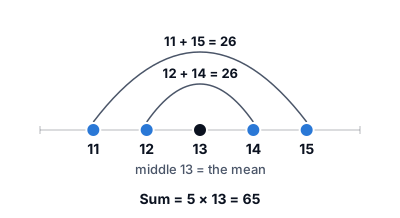
Try it. The sum of 5 consecutive integers is 65. What is the largest of them?
Show the answer
- Mean: 65 ÷ 5 = 13. With 5 numbers (an odd count), 13 is the middle number.
- Two on each side: 11, 12, 13, 14, 15.
- Largest: 15. Check: 11 + 12 + 13 + 14 + 15 = 65. ✓
Sum of consecutive integers
Divide the sum by the count to get the mean. With an odd count, the mean is the middle integer. With an even count, the mean is halfway between the two middle integers (it ends in .5). Then step out to the ends.
Why it works. The integers pair off around the middle: the first and last average to the middle, and so do the second and second-to-last. So on average every term equals the middle value, and sum = mean × count.
How to spot it: "the sum of n consecutive integers is S".
Example. The sum of 8 consecutive integers is 228. What is the least of them?
- Mean: 228 ÷ 8 = 28.5.
- The count, 8, is even, so 28.5 is halfway between the two middle integers, 28 and 29.
- Put 4 integers on each side of 28.5: 25, 26, 27, 28 and 29, 30, 31, 32.
- Least: 25.
- Check: (first + last) ÷ 2 × count = (25 + 32) ÷ 2 × 8 = 28.5 × 8 = 228. ✓
Runs that cross zero. For −5 through 8, each negative number cancels its positive partner: −5 + 5 = 0, −4 + 4 = 0, and so on down to −1 + 1 = 0. Zero adds nothing. What is left is 6 + 7 + 8 = 21.
Trap: answering 28.5 or 28, the middle, instead of the least.
Edge cases.
- An even count gives a mean ending in .5. If the count is odd and the mean ends in .5 (or the count is even and the mean is whole), no such run of integers exists.
- Runs can include negatives and zero. 7 consecutive integers with sum 0 run from −3 to 3.
GMAT-level example. For which of these counts can 100 be written as the sum of that many consecutive positive integers? I. 3 II. 5 III. 8
- I: the mean would be 100 ÷ 3 = 33.3…, not a whole number. With an odd count the mean must be the middle integer, so 3 is not possible.
- II: the mean is 100 ÷ 5 = 20, the middle term: 18 + 19 + 20 + 21 + 22 = 100 ✓.
- III: the mean is 100 ÷ 8 = 12.5, halfway between 12 and 13: 9 + 10 + … + 16 = 100 ✓.
- Answer: II and III.
Check yourself. The sum of 7 consecutive integers is 0. What is the largest?
Check your answer
The mean is 0, the middle term, so the integers are −3 to 3. The largest is 3.
Consecutive even or odd integers
Consecutive even (or odd) integers go up by 2 each time. The same mean rule works. Write the set around its middle: m − 4, m − 2, m, m + 2, m + 4.
Why it works. Consecutive even or odd integers are still evenly spaced, just with steps of 2, so the mean is still the middle (or halfway between the two middle ones).
How to spot it: "consecutive even integers", "consecutive odd integers".
Example. The sum of 5 consecutive even integers is 170. What is the greatest?
- Middle (the mean): 170 ÷ 5 = 34.
- Step by 2 on each side: 30, 32, 34, 36, 38.
- Greatest: 38. Check: 30 + 32 + 34 + 36 + 38 = 170. ✓
Trap: stepping by 1 (32, 33, 34, 35, 36) and answering 36.
Try it. The sum of 4 consecutive odd integers is 72. What is the smallest?
Show the answer
- Mean: 72 ÷ 4 = 18. The count is even, so 18 is halfway between the two middle odd numbers, 17 and 19.
- Step by 2 outward: 15, 17, 19, 21.
- Smallest: 15. Check: 15 + 17 + 19 + 21 = 72. ✓
Edge cases.
- The first n odd numbers add to n²: 1 + 3 + 5 + 7 = 16 = 4².
- An even count of consecutive odd integers has an even mean (between two odd numbers), as in the Try it: 18.
- Products have negative twins. If two consecutive even integers multiply to 168, they are 12 and 14, or −14 and −12.
GMAT-level example. The product of two consecutive positive even integers is 168. What is their sum?
- Call them n and n + 2, so n(n + 2) = 168.
- The two numbers are close together, so each is close to √168 ≈ 13. Try 12 and 14: 12 × 14 = 168 ✓.
- Sum: 12 + 14 = 26.
- Without "positive", −14 and −12 also work, with sum −26.
Check yourself. What is the sum of the first 15 odd positive integers?
Check your answer
15² = 225. (Mean (1 + 29) ÷ 2 = 15, times 15 terms.)
Reversed digits
Write the number as 10t + u (t is the tens digit, u is the units digit). Its reversal is 10u + t. The difference is (10t + u) − (10u + t) = 9t − 9u = 9(t − u). So any reversal difference is a multiple of 9, and dividing it by 9 gives the gap between the digits.
Why it works. In 10t + u, the tens digit is worth 10 and the units digit 1. Reversing swaps those values, so each digit gains or loses 9 per unit of its size, and the difference is 9(t − u).
How to spot it: "when the digits are reversed, the number increases/decreases by …".
Example. A two-digit number is 27 more than the number formed by reversing its digits. Its units digit is half its tens digit. What is the number?
- The difference: 9(t − u) = 27, so t − u = 27 ÷ 9 = 3.
- The units digit is half the tens digit: u = t ÷ 2.
- Put this into step 1: t − t/2 = 3, so t/2 = 3 and t = 6. Then u = 6 ÷ 2 = 3.
- The number is 63. Check: 63 − 36 = 27, and 3 is half of 6. ✓
Trap: answering 36, the reversed number.
Edge cases.
- The sum of a number and its reversal is (10t + u) + (10u + t) = 11(t + u), a multiple of 11.
- Three digits: (100h + 10t + u) − (100u + 10t + h) = 99(h − u). The middle digit cancels.
- A leading digit can't be 0, so for a two-digit number and its reversal both to be two-digit numbers, both digits must be 1 to 9.
GMAT-level example. A two-digit number plus its reversal is 121, and the number is 45 more than its reversal. What is the number?
- Sum: 11(t + u) = 121, so t + u = 11.
- Difference: 9(t − u) = 45, so t − u = 5.
- Add the two equations: 2t = 16, so t = 8 and u = 3.
- The number is 83. Check: 83 + 38 = 121 ✓ and 83 − 38 = 45 ✓.
Check yourself. A three-digit number minus its reversal is 396. What is its hundreds digit minus its units digit?
Check your answer
99(h − u) = 396, so h − u = 4.
Place-value equations
Turn the digit facts into equations with 10t + u (or 100h + 10t + u). Remember that each digit is a whole number from 0 to 9.
Why it works. Place value is what makes 36 different from 63: 36 is 3 tens and 6 ones, 10 × 3 + 6. Writing 10t + u keeps that meaning; t + u is only the digit sum.
How to spot it: "a two-digit number is k times the sum of its digits", "the hundreds digit is twice the units digit".
Example. A two-digit number equals 4 times the sum of its digits, and its units digit is 3 more than its tens digit. What is the number?
- The number is 10t + u, and the sum of its digits is t + u. So 10t + u = 4(t + u) = 4t + 4u.
- Collect the t's on one side and the u's on the other: 10t − 4t = 4u − u, so 6t = 3u. Divide both sides by 3: u = 2t.
- The second fact says u = t + 3. So 2t = t + 3, which gives t = 3. Then u = 2 × 3 = 6.
- The number is 36. Check: 3 + 6 = 9, and 4 × 9 = 36. ✓
Counting digits. Each 2 × 5 makes a 10. In 2¹² × 5⁹, nine 2s pair with the nine 5s: 2⁹ × 5⁹ = 10⁹. That leaves 2³ = 8. So 2¹² × 5⁹ = 8 × 10⁹ = 8,000,000,000: the 8 plus nine zeros, which is 10 digits.
Trap: writing the number as t + u. That ignores place value.
Try it. The digits of a two-digit number add up to 11. Reversing the digits makes the number 27 larger. What is the number?
Show the answer
- The reversal is larger, so the units digit is the bigger one: u − t = 27 ÷ 9 = 3.
- Also t + u = 11. Add the two equations: 2u = 14, so u = 7 and t = 11 − 7 = 4.
- The number is 47. Check: 74 − 47 = 27, and 4 + 7 = 11. ✓
Edge cases.
- Digits are whole numbers from 0 to 9, and a leading digit is at least 1. That limits the solutions.
- One equation can have several solutions. List every pair of digits that fits.
- Powers of 10 count digits: a × 10ᵏ, with a a single digit from 1 to 9, has k + 1 digits.
GMAT-level example. How many two-digit numbers are equal to 7 times the sum of their digits?
- 10t + u = 7(t + u) = 7t + 7u, so 3t = 6u and t = 2u.
- t must be a digit from 1 to 9: u = 1 gives 21, u = 2 gives 42, u = 3 gives 63, u = 4 gives 84. u = 5 would make t = 10, which isn't a digit.
- So there are 4 such numbers.
- Check 84: 8 + 4 = 12, and 7 × 12 = 84 ✓.
Check yourself. How many digits does 4⁸ × 5¹³ have?
Check your answer
4⁸ = 2¹⁶. Pair thirteen 2s with the thirteen 5s: 2¹⁶ × 5¹³ = 2³ × 10¹³ = 8 × 10¹³. That is an 8 and thirteen zeros: 14 digits.
How hard questions disguise it
For harder questions (L4–L5)
L4 versions ask about every possible set ("the sum of any 4 consecutive integers is never divisible by 4", because n + (n + 1) + (n + 2) + (n + 3) = 4n + 6 always leaves remainder 2) or about consecutive multiples. At L5, consecutive sets link to averages, since the mean equals the median (the middle value) for any evenly spaced set, and to sequences, where consecutive multiples form an arithmetic sequence with sum = average × number of terms. Write the set around its middle term to keep the algebra short.
Practice
Practice consecutive-integer and digit questions in timed sets on the consecutive integers practice page.
Common traps
Stopping at the middle, or finding the mean wrong
The mean of consecutive integers is (first + last) ÷ 2, and it is the middle of the set, not its largest or smallest member. Step out from the middle to the end the question asks about.
Reporting the wrong number
Consecutive and digit questions produce several related numbers (least, greatest, reversed, difference). Check which one the question asks for.
Miscounting the steps or the terms
In a set of n consecutive integers with n odd, the ends are (n − 1) ÷ 2 steps from the middle; consecutive odds or evens step by 2. From −a to b there are a + b + 1 integers, counting 0.
Checking only one condition
A digit question usually gives two facts, such as the digit sum and the reversal difference. A choice that satisfies only one of them is a trap.
Mishandling the negative integers in a run
In a run from −5 to 8, the negatives cancel 1 through 5 exactly, leaving 6 + 7 + 8. Cancel pairs carefully and keep the sign of the starting number.
Shifting a block of consecutive integers wrong
The next n consecutive integers are each n larger than their partners in the first block, so the new sum is the old sum + n × n. It is not double the old sum.
Reading place value wrong
A digit's value depends on its position: the 4 in 3,045 is worth 40. Write each digit times its place value before adding or subtracting.
Counting the digits of a product of powers wrong
Pair each 2 with a 5 to make tens: 2¹² × 5⁹ = 2³ × 10⁹ = 8 followed by nine zeros, which is 10 digits. Count the zeros plus the digits of the leftover factor.
Expecting an integer middle for an even count
With an even number of consecutive integers, the mean falls halfway between the two middle integers. Look for a .5 mean, not an integer.
Missing or adding cases when writing a number as a consecutive sum
Test every length n from 2 up to the longest run that still starts at 1 or more. An odd n works when n divides the number, an even n works when the number ÷ n ends in .5, and the number on its own is not a sum.
Counting numbers after a digit swap
Swapping the first and last digits changes the value by 99 × (their difference). Then count digits: the leading digit can't be 0, and any digit the swap doesn't touch can be 0 to 9.