GRE Quant lesson · Quadratics
GRE quadratics: factoring, roots and the zero-product property
Quadratics for GRE Quant: factor trinomials, use the zero-product property, the difference-of-squares shortcut, sums and products of roots, and x² = x.
The core idea
Most GRE quadratics factor quickly: find two numbers that multiply to the constant and add to the middle coefficient, then set each factor to zero. Never divide both sides by x, since that throws away the solution x = 0, and use identities like a² − b² = (a + b)(a − b) to skip solving altogether.
Core ideas
Words used here
- Quadratic: an expression or equation where the highest power of x is x², such as x² − 2x − 35.
- Coefficient: the number that multiplies a variable (−2 in −2x). Constant: the number with no variable (−35).
- Factor (verb): rewrite as a product, that is, as things multiplied together. A factor (noun) is one of those things: (x − 7) is a factor of (x − 7)(x + 5).
- Root (or solution): a value of x that makes the quadratic equal 0.
- Standard form: ax² + bx + c = 0, with everything on one side and 0 on the other.
- Perfect square: a number that is a whole number times itself, such as 9 = 3 × 3 or 49 = 7 × 7.
- Standard form first: move everything to one side, so the other side is 0, before you factor.
- Zero-product property: if A × B = 0, then A = 0 or B = 0. A product can only be 0 if one of its parts is 0.
- To factor x² + bx + c, find two numbers whose product is c and whose sum is b. Why: (x + p)(x + q) = x² + (p + q)x + pq.
- Sum and product of the roots: for x² + bx + c = 0, the roots add to −b and multiply to c. Written as x² − Sx + P = 0, the roots add to S and multiply to P.
- Difference of squares: a² − b² = (a + b)(a − b).
On the GRE
- The on-screen calculator helps with the arithmetic, not the factoring: find the two roots first.
- Quantitative Comparison: "x² − 5x + 6 = 0; Quantity A: x" means x can be either root. Compare both roots with Quantity B; if they fall on different sides (or one equals it), the answer is "cannot be determined".
- Select-all: "Which of the following values of x satisfy …? Indicate all such values." Select every root listed, including x = 0 when it is one.
Try it. Factor x² + 7x + 12 and find its roots.
Show the answer
- Find two numbers with product 12 and sum 7: 3 and 4 (3 × 4 = 12, 3 + 4 = 7).
- So x² + 7x + 12 = (x + 3)(x + 4).
- Set each factor to 0: x + 3 = 0 gives x = −3, and x + 4 = 0 gives x = −4.
- Check x = −3: 9 − 21 + 12 = 0 ✓.
Factoring a trinomial
A trinomial is an expression with three terms, such as x² − 2x − 35. To factor it, find two numbers whose product is the constant (the number with no x) and whose sum is the coefficient of x. Write the two factors, then set each one to 0. Each root has the opposite sign of the number in its factor.
Why it works. Multiply out (x + p)(x + q): you get x² + px + qx + pq = x² + (p + q)x + pq. So the two numbers you need are exactly the pair whose sum is the x-coefficient and whose product is the constant. The roots are −p and −q, because those values make a factor 0.
How to spot it: x² + bx + c = 0 with whole-number coefficients.
Example. Solve x² − 2x − 35 = 0.
- You need product −35 and sum −2. The factor pairs of 35 are 1 and 35, and 5 and 7. The product is negative, so one number is negative. −7 and 5 work: −7 × 5 = −35 and −7 + 5 = −2.
- Write the factors: (x − 7)(x + 5) = 0.
- Set each factor to 0: x − 7 = 0 gives x = 7, and x + 5 = 0 gives x = −5.
- x = 7 or x = −5. Check x = 7: 49 − 14 − 35 = 0 ✓. Check x = −5: 25 + 10 − 35 = 0 ✓.
Trap: writing (x + 7)(x − 5). It expands to x² + 2x − 35, so the middle sign is wrong and so are both roots.
Try it. Solve x² + x − 20 = 0.
Show the answer
- Product −20, sum 1 (the coefficient of x is 1): the numbers are 5 and −4.
- (x + 5)(x − 4) = 0, so x = −5 or x = 4.
- Check x = 4: 16 + 4 − 20 = 0 ✓.
Edge cases.
- Take out a common factor first. 3x² − 12x − 36 = 3(x² − 4x − 12) = 3(x − 6)(x + 2). The roots are 6 and −2. The 3 is never 0, so it adds no root.
- When the x² coefficient isn't 1, split the middle term. For 2x² + 7x + 3, find two numbers with product 2 × 3 = 6 and sum 7: 6 and 1. Then 2x² + 6x + x + 3 = 2x(x + 3) + 1(x + 3) = (2x + 1)(x + 3). The roots are −1/2 and −3.
- A perfect square has one root. x² − 10x + 25 = (x − 5)², so x = 5 is the only solution.
- No whole-number pair? Then the roots aren't integers, or there are no real roots. On the GRE, recheck the signs, or use the sum and product of the roots.
GRE: Quantitative Comparison. Information: x² − 5x − 14 = 0. Quantity A: x. Quantity B: −3.
- Factor: (x − 7)(x + 2) = 0, so x = 7 or x = −2.
- Both solutions are greater than −3, so the answer is (A) whichever one x is.
- If Quantity B were 0, x = 7 would make A greater and x = −2 would make B greater: (D).
GRE-level example. If 3x² − 6x = 45, what is the positive difference between the two solutions?
- Move everything to one side first: 3x² − 6x − 45 = 0.
- Take out the common factor 3: 3(x² − 2x − 15) = 0, so x² − 2x − 15 = 0.
- Find two numbers with product −15 and sum −2: −5 and 3. So (x − 5)(x + 3) = 0.
- The roots are x = 5 and x = −3.
- Positive difference: 5 − (−3) = 8.
- Check x = −3: 3(9) − 6(−3) = 27 + 18 = 45 ✓.
Check yourself. Factor x² − 13x + 36 and give its roots.
Check your answer
Product 36 and sum −13: −4 and −9. So x² − 13x + 36 = (x − 4)(x − 9), with roots 4 and 9. Check x = 4: 16 − 52 + 36 = 0 ✓.
Zero-product property
The zero-product property says: a product equals zero only if at least one factor (one of the things multiplied) is zero. So set each factor equal to zero, one at a time. This works for any number of factors.
Why it works. Two numbers that are both non-zero always have a non-zero product. So if A × B = 0, at least one of A and B must be 0. No such rule exists for any other number: A × B = 6 allows endless pairs, such as 2 × 3, 1 × 6 and 12 × 1/2.
How to spot it: an equation already written as a product equal to zero, or one that factors into one.
Example. What are the solutions of (2x − 3)(x + 4) = 0?
- First factor: 2x − 3 = 0. Add 3 to both sides: 2x = 3. Divide both sides by 2: x = 3/2.
- Second factor: x + 4 = 0. Subtract 4 from both sides: x = −4.
- x = 3/2 or x = −4.
Trap: using the property when the product equals a number other than zero. For (x − 1)(x − 2) = 6, setting x − 1 = 6 is wrong. Expand and move the 6 first: x² − 3x + 2 − 6 = 0, so x² − 3x − 4 = 0, which is (x − 4)(x + 1) = 0. The roots are x = 4 and x = −1.
Edge cases.
- A factor that is never 0 gives no root. In (x² + 1)(x − 2) = 0, x² + 1 is at least 1, so the only solution is x = 2.
- A fraction is 0 only when its top is 0. (x − 3)/(x + 1) = 0 means x = 3. The value x = −1 isn't a solution; it isn't even allowed, because you can't divide by 0.
- Repeated factors count once when the question asks for different solutions. (x − 2)²(x + 1) = 0 has 2 different solutions: 2 and −1.
GRE: select-all. Which of the following values of x satisfy (x − 4)(x + 1) = 3(x − 4)? Indicate all such values.
- Don't divide by x − 4. Move everything to one side: (x − 4)(x + 1 − 3) = 0, that is (x − 4)(x − 2) = 0.
- So x = 4 and x = 2 are both solutions. Dividing first would keep only x = 2.
GRE-level example. How many different real numbers x satisfy (x² − 9)(x² + 4)(x + 3) = 0?
- Set each factor to 0 in turn.
- x² − 9 = 0 gives x² = 9, so x = 3 or x = −3.
- x² + 4 = 0 gives x² = −4. No real number squared is negative, so this factor gives nothing.
- x + 3 = 0 gives x = −3, which we already have.
- The different solutions are 3 and −3: 2.
The answers 4 and 5 come from counting the repeated −3 or the impossible x² = −4.
Check yourself. Solve x(x + 5) = 14.
Check your answer
The product equals 14, not 0, so expand and move the 14 first: x² + 5x − 14 = 0. Then (x + 7)(x − 2) = 0, so x = −7 or x = 2. Check x = 2: 2 × 7 = 14 ✓.
Difference of squares
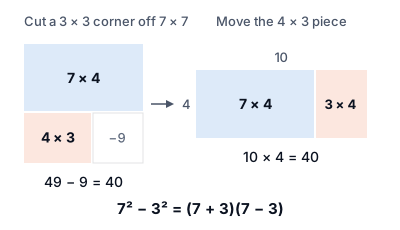
a² − b² = (a + b)(a − b). Why: (a + b)(a − b) = a² − ab + ab − b², and the middle terms cancel. Use it to work out differences of large squares, and to get x − y from x² − y² and x + y.
How to spot it: two perfect squares (numbers like 49 = 7²) subtracted, or x² − y² with one of its factors given.
Example. Compute 63² − 37².
- Use a = 63 and b = 37: 63² − 37² = (63 + 37)(63 − 37).
- 63 + 37 = 100 and 63 − 37 = 26.
- 100 × 26 = 2,600.
With letters: if x² − y² = 24 and x + y = 6, then (x + y)(x − y) = 24, so 6(x − y) = 24. Divide both sides by 6: x − y = 4.
Trap: computing (63 − 37)² = 26² = 676. That is a different expression.
See it. Cut a 3 × 3 corner out of a 7 × 7 square. What is left has area 49 − 9 = 40. Slide one piece of it, and it becomes a rectangle 7 − 3 = 4 wide and 7 + 3 = 10 long.
Edge cases.
- It needs a minus sign. a² + b² does not factor into (a + b)(a − b).
- Higher powers can factor twice. x⁴ − 16 = (x² + 4)(x² − 4) = (x² + 4)(x + 2)(x − 2).
- Products near a round number: 49 × 51 = (50 − 1)(50 + 1) = 50² − 1² = 2,500 − 1 = 2,499.
GRE: Numeric Entry. If x + y = 8 and x² − y² = 20, what is x − y?
- x² − y² = (x + y)(x − y), so 20 = 8(x − y).
- x − y = 20/8. Type 20 over 8, or 5 over 2: fractions need not be reduced.
GRE-level example. What is the greatest prime factor of 99² − 1?
- 1 = 1², so 99² − 1 is a difference of squares: (99 − 1)(99 + 1) = 98 × 100.
- Factor each part into primes: 98 = 2 × 7² and 100 = 2² × 5².
- So 99² − 1 = 2³ × 5² × 7². The primes are 2, 5 and 7.
- The greatest is 7.
- Check: 99² = 9,801, so 99² − 1 = 9,800 = 8 × 25 × 49 ✓.
Check yourself. If x + y = 12 and x² − y² = 48, what is x?
Check your answer
(x + y)(x − y) = 48, so 12(x − y) = 48 and x − y = 4. Add x + y = 12 and x − y = 4: 2x = 16, so x = 8 (and y = 4). Check: 64 − 16 = 48 ✓.
Sum and product of roots
For x² + bx + c = 0, the roots (the solutions) add to −b and multiply to c. Why: if the roots are r and s, the equation is (x − r)(x − s) = 0, which expands to x² − (r + s)x + rs = 0. Use this to find a missing root or coefficient without solving everything.
With a leading coefficient. For ax² + bx + c = 0, divide every term by a first. The roots then add to −b/a and multiply to c/a.
How to spot it: one root is given, or the question asks for the sum or product of the roots.
Example. One root of x² − 7x + k = 0 is 3. What is k?
- The coefficient of x is −7, so the roots add to 7. The other root is 7 − 3 = 4.
- k is the product of the roots: 3 × 4 = 12.
- Check: 3² − 7(3) + 12 = 9 − 21 + 12 = 0 ✓.
Other expressions follow from the same two facts. For example, 1/3 + 1/4 = (3 + 4)/(3 × 4) = sum ÷ product = 7/12.
Trap: answering 7, the sum, as the value of k.
See it. The curve y = x² − 2x − 8 crosses the x-axis at its roots, −2 and 4. They add to 2 (= −b) and multiply to −8 (= c). Change a, b and c: the readout keeps the sum and product even when the roots aren't whole numbers, and shows where y is below 0.
y = x² − 2x − 8. It opens up (a > 0). Vertex (1, −9), on the line x = 1.
Discriminant b² − 4ac = 36.
Roots x = −2 and x = 4. Sum = −b/a = 2, product = c/a = −8.
y < 0 between the roots (−2 < x < 4), and y > 0 outside them.
Edge cases.
- The facts hold for any roots, whole or not. x² − 2x − 4 = 0 has roots 1 + √5 and 1 − √5: their sum is 2 and their product is 1 − 5 = −4.
- No real roots. If b² − 4ac < 0 (for example x² + x + 5), the curve never meets the x-axis. Don't use "sum = −b" to claim real roots exist.
- A double root counts twice. x² − 6x + 9 = 0 has the root 3 twice: the "sum" is 6 and the "product" is 9.
GRE: Quantitative Comparison. Information: r and s are the two solutions of 2x² − 6x − 3 = 0. Quantity A: r + s. Quantity B: rs.
- The discriminant is 36 + 24 = 60 > 0, so there are two real solutions.
- r + s = −(−6)/2 = 3 and rs = −3/2. Quantity A is greater: (A).
- If Quantity A were r and Quantity B were 0, the answer would be (D): the product is negative, so one solution is positive and one is negative, and nothing says which one is r.
GRE-level example. The roots of 2x² − 10x + k = 0 are r and s, and r − s = 3. What is k?
- Divide by 2: x² − 5x + k/2 = 0. So r + s = 5 and rs = k/2.
- Add r + s = 5 and r − s = 3: 2r = 8, so r = 4. Then s = 5 − 4 = 1.
- rs = 4 × 1 = 4, so k/2 = 4 and k = 8.
- Check: 2(16) − 10(4) + 8 = 32 − 40 + 8 = 0 ✓ and 2(1) − 10(1) + 8 = 0 ✓.
Check yourself. If r and s are the roots of x² − 5x + 3 = 0, what is r² + s²?
Check your answer
r + s = 5 and rs = 3. Since (r + s)² = r² + 2rs + s², r² + s² = 5² − 2(3) = 19. (The roots are real, because 25 − 12 = 13 > 0.)
The x² = x trap
Bring every term to one side and factor out the common x. Never divide both sides by x: that erases the root x = 0.
Why it works. Dividing both sides by x is allowed only when x ≠ 0, and the equation doesn't promise that. So dividing quietly throws away the case x = 0. Factoring keeps every case: x(x² − 9) = 0 means "x = 0, or x² = 9".
How to spot it: an equation with x on both sides and no constant term, such as x³ = 9x.
Example. How many real solutions does x³ = 9x have?
- Subtract 9x from both sides: x³ − 9x = 0.
- Factor out x: x(x² − 9) = 0.
- x² − 9 is a difference of squares: (x − 3)(x + 3). So x(x − 3)(x + 3) = 0.
- Set each factor to 0: x = 0, x = 3 or x = −3. That is 3 solutions.
The same idea works for any repeated factor. In (x − 2)² = 3(x − 2), subtract 3(x − 2) from both sides and factor out (x − 2): (x − 2)[(x − 2) − 3] = 0, which is (x − 2)(x − 5) = 0. So x = 2 or x = 5.
Trap: dividing by x to get x² = 9 and answering 2.
Edge cases.
- If the question says x ≠ 0 (or x > 0), dividing by x is fine, and you must drop 0 from the answer.
- Even and odd powers. x² = 9 has two real roots, 3 and −3. x³ = 27 has one real root, 3.
- "Could be" vs. "must be". If x² = x, then x could be 0 and x could be 1, but neither value must be true.
GRE: Quantitative Comparison. Information: x² = 6x. Quantity A: x. Quantity B: 6.
- Factor: x² − 6x = x(x − 6) = 0, so x = 0 or x = 6.
- x = 6 makes the quantities equal, and x = 0 makes Quantity B greater, so the answer is (D).
- If the information also said x ≠ 0, only x = 6 is left and the answer would be (C). Dividing by x at the start silently assumes that.
GRE-level example. If x⁴ = 4x², which of the following could be the value of x? Indicate all such values. −2, 0, 2
- Move everything to one side: x⁴ − 4x² = 0.
- Factor out x²: x²(x² − 4) = 0, which is x²(x − 2)(x + 2) = 0.
- So x = 0, x = 2 or x = −2.
- All three values work: select −2, 0 and 2.
- Check x = −2: (−2)⁴ = 16 and 4(−2)² = 16 ✓. Dividing by x² first would have given only ±2, which drops 0.
Check yourself. How many solutions does x(x − 4) = 3x have?
Check your answer
Expand and move 3x: x² − 4x − 3x = 0, so x² − 7x = 0 and x(x − 7) = 0. There are 2 solutions: 0 and 7.
How hard questions disguise it
For harder questions (L4–L5)
L4 versions need rearranging before factoring (x(x − 1) = 12 becomes x² − x − 12 = 0) or ask for an expression of the roots, like the sum of their squares. At L5, quadratics combine with inequalities (x² − x − 12 < 0 holds between the roots) and with functions (f(x) = x² − 4x; for which inputs is f(x) = f(3)?). Factor first, then decide what the question asks you to do with the roots.
Practice
Practice factoring and roots in timed sets on the quadratics practice page.
Common traps
Picking the other root or an in-between value
A quadratic usually has two roots, and both are among the choices, along with steps like the value of x − a. Check which root, or which quantity, the question wants, and whether the question rules one out.
Reading a coefficient as a root
In x² − Sx + P = 0, S is the sum of the roots and P is their product. Neither coefficient is a root, and the sum and product answer different questions.
Sign slips in factors and roots
The factor (x − 7) gives the root +7, and (x + 5) gives −5: each root has the opposite sign of the number in its factor. Plug a root back in to confirm.
Solving for x or y when the question asks for an expression
If the question asks for x − y, the values of x, y or x + y are steps or givens. Keep the target expression in view.
Mishandling a difference of squares
a² − b² = (a + b)(a − b): multiply the sum by the difference. It is not (a − b)², and given a² − b² and a + b, you divide to get a − b.
Losing a root
Dividing both sides by x, or by (x − a), throws away the root that makes it zero. Move everything to one side, factor, and set every factor to zero.
Misusing the sum and product of the roots
For roots r and s, r + s = −b/a and rs = c/a, and expressions like 1/r + 1/s = (r + s)/(rs) follow from them. Don't assume the roots are equal, opposite or symmetric unless the equation forces it.
Miscounting the b values that give integer roots
Integer roots of x² + bx + c are a factor pair of c, and b is minus their sum. For c > 0 both roots share a sign: each unordered pair gives one b with positive roots and one with negative roots.
Comparing with only one root
x² = 16 allows 4 and −4; x² = 5x allows 0 and 5. Compare every root, and drop one only when the information rules it out.
Sign slips with roots
(x − 3) is zero at x = 3, the sum of the roots of ax² + bx + c is −b/a, and 'r and s are the roots' doesn't say which is larger.