GRE Quant lesson · Min / max
GRE max/min problems: greatest and least possible values
Greatest and least possible value questions on GRE Quant: maximize one value by minimizing the others, integer rounding, overlap bounds, distinct values.
The core idea
To push one quantity to its extreme, push everything else to the opposite extreme the rules allow. Read every constraint (integer, positive, different, at least) because each one changes how small or large the other values can go.
Core ideas
Words used here
- Maximize: make as large as possible. Minimize: make as small as possible.
- Constraint: a rule the numbers must follow, such as "at least $10 each" or "all different".
- Integer: a whole number, such as −2, 0 or 7. Positive integers are 1, 2, 3, …
- Distinct: all different from each other.
- Overlap: the people who are in both of two groups.
- Round up: go to the next whole number (7.1 → 8). Round down: drop the decimal part (14.3 → 14).
- Median: the middle value when the values are sorted. Mean: the average.
- To make one value as big as possible, make all the others as small as possible. The rules (constraints) decide how small they can go.
- Total = average × count. So a fixed average fixes the total that the values share.
- Whole-number answers: round up when you need enough (buses for everyone). Round down when you can't go over a limit (tickets you can afford).
- Overlap of two groups A and B inside a total T: the least overlap is A + B − T (or 0 if that is negative). The greatest overlap is the smaller of A and B.
- Distinct values push each other apart. The smallest k distinct positive integers are 1, 2, …, k, and they add up to k(k + 1) ÷ 2. For k = 4: 1 + 2 + 3 + 4 = 10 = (4 × 5) ÷ 2.
Try it. Four different positive integers add up to 30. What is the greatest possible value of the largest one?
Show the answer
- Make the other three as small as possible. They must be different and positive: 1, 2 and 3.
- Their sum: 1 + 2 + 3 = 6.
- Largest: 30 − 6 = 24. Check: 1 + 2 + 3 + 24 = 30. ✓
Maximize one, minimize the others
To maximize (make as large as possible) one value, find the total first. Then give every other value the smallest amount the rules allow. What is left is the maximum.
Why it works. With a fixed total, the values compete for one budget. Every dollar given to the others is a dollar the target doesn't get, so the target is largest when the others take the least the rules allow.
How to spot it: "what is the greatest possible value of the largest (or of one) of…".
Example. Five friends share $100. Each receives a whole-dollar amount of at least $10, and no two receive the same amount. What is the most one friend can receive?
- The other four get as little as the rules allow. They need at least $10 each and must all be different: $10, $11, $12 and $13.
- Their total: 10 + 11 + 12 + 13 = 46.
- The largest share: 100 − 46 = $54.
Trap: giving the other four $10 each (answer $60). This ignores "no two the same".
Edge cases.
- Read the lower limit: "positive" means at least 1, "non-negative" allows 0, and some questions set their own minimum.
- "Different" forces steps of at least 1 between the values.
- To make one value as small as possible, make the others as large as the rules allow.
GRE-level example. Six different positive integers have an average of 15. What is the greatest possible value of the second-largest?
- Total: 6 × 15 = 90.
- Make the four smallest as small as possible: 1, 2, 3 and 4, which add to 10. The two largest share 90 − 10 = 80.
- The largest must be greater than the second-largest, so the second-largest is less than half of 80. It can't be 40 (then the largest would also be 40), so it is at most 39.
- 39 works, with 41 as the largest: the second-largest is 39.
- Check: 1 + 2 + 3 + 4 + 39 + 41 = 90 ✓.
Check yourself. Six positive integers (not necessarily different) have a mean of 8. What is the greatest possible value of the largest?
Check your answer
Total: 48. The other five are 1 each: 5. Largest: 48 − 5 = 43.
Integer constraints and rounding
When the answer must be a whole number (an integer), divide first. Then round in the direction the situation needs: up if you need enough, down if you can't go over a limit.
Why it works. You can't hire 7.14 buses or buy 14.3 tickets. The real question is the smallest whole number that is enough (round up) or the largest whole number that stays within the limit (round down).
How to spot it: "least number of buses/boxes", "greatest number of items she can buy".
Example. Each bus holds 42 students. What is the least number of buses needed for 300 students? And with $100, what is the greatest number of $7 tickets you can buy?
- Buses: 300 ÷ 42 ≈ 7.14. Check 7 buses: 7 × 42 = 294, which leaves 6 students behind. So round up: 8 buses.
- Tickets: 100 ÷ 7 ≈ 14.3. Check 15 tickets: 15 × 7 = $105, which is too much. So round down: 14 tickets (14 × 7 = $98).
Least possible maximum. 50 books go on 6 shelves. The fullest shelf has at least 9 books, because 8 books on every shelf would hold only 6 × 8 = 48.
Trap: rounding 7.14 down to 7 buses, which leaves 6 students behind.
Try it. A shop packs 250 cards into boxes that hold 24 cards each. What is the least number of boxes it needs?
Show the answer
- 250 ÷ 24 ≈ 10.4.
- 10 boxes hold only 10 × 24 = 240 cards, which is 10 short.
- Round up: 11 boxes (11 × 24 = 264 ≥ 250).
Edge cases.
- Exact division needs no rounding: 294 students fit in exactly 7 buses.
- Two limits at once. Work out each whole-number limit, then take the one that binds.
- Least possible maximum: spread the items as evenly as possible; the fullest group has at least total ÷ groups, rounded up.
GRE-level example. A school orders pizzas for 125 students. Each student eats 3 slices, and each pizza has 8 slices. Pizzas cost $11 each. What is the least the school can spend?
- Slices needed: 125 × 3 = 375.
- Pizzas: 375 ÷ 8 = 46.875. 46 pizzas give only 368 slices, so round up to 47.
- Cost: 47 × $11 = $517 (with 376 − 375 = 1 slice to spare).
Check yourself. 70 chairs go into 8 rows. What is the least possible number of chairs in the fullest row?
Check your answer
70 ÷ 8 = 8.75, so at least one row has 9 chairs (8 rows of 8 hold only 64).
Least and greatest overlap
The overlap is the people who are in both groups. It is greatest when the smaller group sits completely inside the larger group. It is least when as many people as possible are in only one group.
Why it works. For the least overlap, put as many people as possible in only one group. The total runs out after T people, so the extra A + B − T people must be counted twice: they are in both. For the greatest overlap, remember that the overlap is part of each group, so it can't be bigger than the smaller one.
How to spot it: "what is the least (or greatest) possible number who are in both?"
Example. Of 60 guests, 38 ate fish and 35 ate chicken. What are the least and greatest possible numbers who ate both?
- Least: 38 + 35 = 73, but there are only 60 guests. So at least 73 − 60 = 13 people are counted twice, that is, ate both. (This happens when every guest ate at least one dish.)
- Greatest: the overlap can't be bigger than the smaller group, so 35 (every chicken eater also ate fish).
Trap: assuming the least overlap is 0. That would need 38 + 35 = 73 guests.
Try it. Of 50 students, 32 like math and 29 like science. What are the least and greatest possible numbers who like both?
Show the answer
- Least: 32 + 29 − 50 = 61 − 50 = 11.
- Greatest: the smaller group, 29.
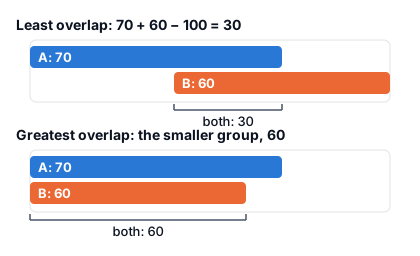
Try it. The same 100 people. Slide "both" from its greatest value, 60, down. Below 30, "neither" would be negative, so those values are impossible.
Dog only = 70 − 45 = 25. Cat only = 60 − 45 = 15. Both = 45.
At least one = 70 + 60 − 45 = 85. The "both" group was counted twice, so it's subtracted once.
Neither = 100 − 85 = 15.
Edge cases.
- If A + B ≤ total, the least overlap is 0.
- If "neither" has a minimum, less room is left inside the circles, so the least overlap goes up.
- Three groups: the least number in all three is total − (the people missing from each group, added up), if that is positive.
GRE-level example. Of 80 students, 55 passed math and 48 passed English. At least 5 failed both. What is the least possible number who passed both?
- At least 5 failed both, so at most 80 − 5 = 75 passed at least one subject.
- 55 + 48 = 103 passes are shared among at most 75 students, so at least 103 − 75 = 28 passed both.
- Check: 28 both, 27 math only, 20 English only, 5 neither: 28 + 27 + 20 + 5 = 80 ✓.
Check yourself. Of 100 people, 70 own a car, 75 own a bike and 80 own a phone. What is the least possible number who own all three?
Check your answer
30 people lack a car, 25 lack a bike and 20 lack a phone. At most 30 + 25 + 20 = 75 people lack something, so at least 100 − 75 = 25 own all three.
Distinct values under a constraint
When the values must be distinct (all different) and something else is fixed, such as the median (middle value) or the mean (average), place the fixed value first. Then pack the other values as tightly as the rules allow.
Why it works. Different integers can't share a value, so the tightest they can be packed is consecutive integers. Packing the values you don't care about tightly leaves the most room for the one you do.
How to spot it: "different integers" together with a median, mean or range condition.
Example. Five different positive integers have a median of 10 and a mean of 12. What is the greatest possible value of the largest?
- Total: 5 × 12 = 60.
- Sorted, the values are ?, ?, 10, ?, ?. The median 10 is the 3rd value.
- The two values below 10 should be as small as possible: 1 and 2.
- The 4th value must be more than 10 (all values are different), so the smallest it can be is 11.
- Largest: 60 − (1 + 2 + 10 + 11) = 60 − 24 = 36. Check: 1, 2, 10, 11, 36 has median 10 and sum 60, so mean 60 ÷ 5 = 12. ✓
Least possible largest value. Here you do the opposite: pack the values tightly just below the largest. Five different positive integers that add up to 40 need a largest value of at least 10. If the largest were 9, the biggest possible sum would be 9 + 8 + 7 + 6 + 5 = 35, which is less than 40. And 10 works: 10 + 9 + 8 + 7 + 6 = 40.
Trap: setting the 4th value equal to 10, which repeats the median.
Edge cases.
- "Different" vs. "not necessarily different" changes the answer: four positive integers adding to 30 can have largest 27 (1, 1, 1, 27), but if they must be different it is 24.
- An even number of values with a median: the two middle values average to the median and must be different.
GRE-level example. Six different positive integers have a median of 9 and a mean of 10. What is the greatest possible value of the largest?
- Total: 6 × 10 = 60. Sorted: a < b < c < d < e < f, and the median is (c + d) ÷ 2 = 9, so c + d = 18.
- Make a and b as small as possible: 1 and 2.
- e must be more than d, so keep d small: c = 8 and d = 10 (c < d, c + d = 18). Then e = 11.
- f = 60 − (1 + 2 + 8 + 10 + 11) = 60 − 32 = 28.
- Check: 1, 2, 8, 10, 11, 28 adds to 60, and its median is (8 + 10) ÷ 2 = 9 ✓. (c = 7 and d = 11 would force e = 12 and give only 27.)
Check yourself. Four different positive integers add up to 30. What is the least possible value of the largest?
Check your answer
If the largest were 8, the biggest possible sum would be 8 + 7 + 6 + 5 = 26, too small. With 9: 9 + 8 + 7 + 6 = 30 ✓. The answer is 9.
Greatest and least values on the GRE
The GRE gives you an on-screen calculator, so messy arithmetic is never the obstacle; the faster route is still to reason first and calculate only what the comparison needs.
- Quantitative Comparison (QC). When a quantity isn't fixed, find its full range, then compare.
- Example. Five different positive integers have an average of 12. Quantity A: the largest of the integers. Quantity B: 45.
- The sum is 60. The largest is greatest when the others are 1, 2, 3 and 4: 60 − 10 = 50. It is least when the integers are bunched: 14 + 13 + 12 + 11 + 10 = 60, so 14.
- The largest can be anything from 14 to 50, so against 45 the answer is (D). Against 55 it would be (B), and against 13, (A).
- Rounding. "The least number of boxes needed" rounds up; "the greatest number of boxes filled completely" rounds down. QC questions often put the two side by side.
- Numeric Entry (NE). For the cheapest mix of pack sizes, compare a few ways to finish the order (one more big pack or some small ones) rather than trusting the cheaper-per-item pack all the way.
How hard questions disguise it
For harder questions (L4–L5)
L4 versions combine two constraints (distinct values and an average) or ask for the least possible value of the largest member, which means spreading the values as evenly as possible. At L5, optimization appears inside averages, median and range (the greatest possible range with a fixed median) and overlapping sets (the greatest possible number in neither group). List the constraints first, then decide which values go to their extremes.
Practice
Practice greatest and least possible value questions in timed sets on the max/min practice page.
Common traps
Ignoring 'different', 'positive' or 'at least'
If the integers must be different and positive, the smallest the others can be is 1, 2, 3 and so on; if each person must get at least $10, nobody gets less. Use the true minimums the rules allow.
Minimizing the wrong number of other values
To maximize one of n values, push all n − 1 others to their minimum, then subtract their sum from the total. An even split, the total itself or the minimum share is a trap.
Forgetting a median is one of the values
A fixed median is one of the numbers, and the values above it must be at least the median. The values below it can still be as small as the rules allow.
Mixing up least and greatest overlap
The greatest overlap is the smaller group. The least overlap is A + B − total, and it is zero only when the groups fit side by side.
Measuring the overlap the wrong way
The difference between the two group sizes isn't an overlap, and the people outside one group aren't the overlap either. Compare A + B with the total.
Rounding the wrong way
Minimum buses or shelves needed rounds up; the most items you can afford rounds down. Check your answer and the next value on either side against the condition.
Forgetting a fixed fee
A setup fee comes out of the budget once, before the per-item costs. Subtract it first, then divide what's left by the price per item.
Off by one on the least possible largest value
For the least possible largest value, pack the values tightly just below it. Five different positive integers summing to 40 need a largest of at least 10, because 9 + 8 + 7 + 6 + 5 is only 35.
Using a common value that isn't the least
If 4p = 6q = 9r with p, q, r positive integers, the smallest common value is the least common multiple, LCM(4, 6, 9) = 36, giving p = 9, q = 6, r = 4. Answer with the sum asked for, not the common value.
Breaking a rule while minimising the other values
To maximise one value, make every other one as small as the rules allow: different values, the fixed median in the middle, and one more number between the median and the largest.
Greatest and least values: GRE traps
Find a value's least and greatest possible values before comparing it with a number; inside that range the answer is (D), outside it the order is fixed.