GRE Quant lesson · Mental math
GRE mental math: estimation, order of operations, quick products
Mental arithmetic for GRE Quant: estimate to eliminate, compare sizes, order of operations, 25 and 125 tricks and identity shortcuts. The on-screen calculator is there, but these moves are faster.
The core idea
The GRE gives you an on-screen calculator, but speed still comes from doing less arithmetic, not faster arithmetic. Round when the choices are far apart, use friendly numbers and identities to turn hard products into easy ones, and follow the order of operations exactly.
Core ideas
Words used here
- Estimate: a quick, rough answer from rounded numbers.
- Benchmark: an easy number to compare with, such as 1/2 or 1.
- Order of operations: the fixed order for the steps of a calculation (below).
- Exponent: the small raised number. It says how many times to multiply a number by itself: 3² = 3 × 3 = 9.
- Reciprocal: 1 divided by a number. For a fraction, turn it upside down: the reciprocal of 4 is 1/4, and the reciprocal of 1/4 is 4.
- Identity: an equation that is true for every value of its letters, such as (a + b)(a − b) = a² − b².
- Power of 10: 10, 100, 1,000 and so on.
- Round to friendly numbers when the answer choices are far apart.
- Order of operations: (1) parentheses, (2) exponents, (3) × and ÷ from left to right, (4) + and − from left to right.
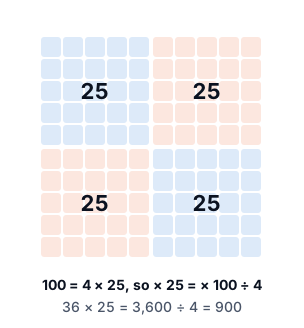
- Friendly factors: 5 = 10 ÷ 2, 25 = 100 ÷ 4 and 125 = 1,000 ÷ 8. So "× 25" is the same as "× 100, then ÷ 4".
- Dividing by a decimal is multiplying by its reciprocal: 0.25 = 1/4, so ÷ 0.25 is the same as × 4.
- Identities: (a + b)(a − b) = a² − b², (a + b)² = a² + 2ab + b² and (a − b)² = a² − 2ab + b² turn products near round numbers into easy ones.
- Compare with benchmarks such as 1/2 and 1, or by cross-multiplying.
- The on-screen calculator: the GRE has one, and it is useful for an ugly division. But keying a long expression is slow and easy to get wrong, so the shortcuts below usually win, especially in Quantitative Comparison, where you only need to know which quantity is bigger.
Try it. Work out 25 × 36 and 4.2 ÷ 0.5 in your head. It is quicker than keying them into the on-screen calculator.
Show the answer
- 25 × 36: × 25 is × 100 then ÷ 4. 36 ÷ 4 = 9, and 9 × 100 = 900.
- 4.2 ÷ 0.5: 0.5 = 1/2, so ÷ 0.5 is × 2. 4.2 × 2 = 8.4.
Estimate to eliminate
Round each awkward number to a nearby friendly one, and work out the simple version. Choose the answer nearest to your estimate. Calculate more exactly only if two choices are close together.
Why it works. Rounding changes each number by only a few percent, so the estimate lands within a few percent of the true value. Answer choices on estimation questions are usually much farther apart than that (often a factor of 10), so the estimate picks the right one.
How to spot it: "approximately", "closest to", or choices that differ by a factor of 10.
Example. Which is closest to (612 × 0.48) ÷ 2.97?
- Round: 612 ≈ 600, 0.48 ≈ 0.5 and 2.97 ≈ 3.
- 600 × 0.5 = 300 (half of 600).
- 300 ÷ 3 = 100.
- The answer is about 100. (The exact value is about 98.9.)
Trap: losing a zero while rounding and choosing 10 or 1,000.
Edge cases.
- Round in opposite directions when you multiply, so the errors partly cancel: 612 down to 600 and 0.48 up to 0.5.
- Dividing by a number you rounded down makes the estimate too big; rounding up makes it too small.
- Close choices (within about 5% of each other) need a more careful calculation.
GRE-level example. Which is closest to √(0.0049 × 810) ÷ 0.21? (A) 3 (B) 9 (C) 30 (D) 90 (E) 300
- Round: 0.0049 ≈ 0.005 and 810 ≈ 800. Then 0.005 × 800 = 4.
- √4 = 2.
- 0.21 ≈ 0.2, and 2 ÷ 0.2 = 10.
- The closest choice is (B) 9. (The exact value is about 9.49.)
Check yourself. Which is closest to 4.02 × 199.8 ÷ 0.399: 20, 200, 2,000 or 20,000?
Check your answer
4 × 200 ÷ 0.4 = 800 ÷ 0.4 = 2,000.
Compare magnitudes
To compare sizes (magnitudes), compare fractions with a benchmark such as 1/2, or cross-multiply. For decimals, compare digit by digit from the left: tenths first, then hundredths. For powers, rewrite them with the same base or the same exponent.
Why it works. When numbers are all close to the same benchmark, the small differences from the benchmark are easier to compare than the numbers themselves. A larger "extra" above 1/2 means a larger number.
How to spot it: "which is greatest?", "order from least to greatest".
Example. Order 7/13, 5/9 and 0.56 from least to greatest.
- Each number is a little more than 1/2. Find how much more:
- 7/13 − 1/2 = 14/26 − 13/26 = 1/26.
- 5/9 − 1/2 = 10/18 − 9/18 = 1/18.
- 0.56 − 0.5 = 0.06.
- Compare the extra parts: 1/26 ≈ 0.038, 1/18 ≈ 0.056, and 0.06.
- Order: 7/13 < 5/9 < 0.56.
Trap: assuming the fraction with the bigger numbers (7/13) is bigger.
Edge cases.
- Negative numbers reverse the order: 7/13 < 5/9, so −7/13 > −5/9.
- Same top, different bottoms: the bigger bottom gives the smaller fraction (3/7 < 3/5).
- Fractions just below 1: compare the gaps to 1. 11/12 is 1/12 below 1 and 12/13 is 1/13 below 1, so 12/13 is larger.
GRE-level example. Order 0.3, (0.3)², √0.3 and 1/0.3 from least to greatest.
- (0.3)² = 0.09: squaring a number between 0 and 1 makes it smaller.
- √0.3 ≈ 0.55 (because 0.55² ≈ 0.30): a square root of a number between 0 and 1 is larger than the number.
- 1/0.3 = 10/3 ≈ 3.33.
- Order: (0.3)² < 0.3 < √0.3 < 1/0.3.
On the GRE (Quantitative Comparison). Look for structure before you calculate. Quantity A: 36% of 75. Quantity B: 75% of 36. Both equal 36 × 75 ÷ 100 = 27, so the answer is that the quantities are equal. If Quantity B were 75% of 35, it would be smaller (the same 75% of a smaller number), so Quantity A would be greater, again with no arithmetic.
Check yourself. Which is larger, 11/12 or 12/13?
Check your answer
12/13: it is only 1/13 below 1, while 11/12 is 1/12 below 1.
Order of operations
Work in this order: parentheses, then exponents, then multiplication and division from left to right, then addition and subtraction from left to right. × and ÷ have the same rank, so neither goes first; the same is true for + and −.
Why it works. The order is an agreement, so that every written expression has exactly one value. It matches how we read 3 × 4 + 2: "three fours, then add two".
How to spot it: an expression that mixes +, −, × and ÷.
Example. Evaluate 40 − 24 ÷ 6 × 2 + 3².
- No parentheses. Exponent: 3² = 3 × 3 = 9. Now the expression is 40 − 24 ÷ 6 × 2 + 9.
- × and ÷ from left to right: 24 ÷ 6 = 4, then 4 × 2 = 8. Now it is 40 − 8 + 9.
- and − from left to right: 40 − 8 = 32, then 32 + 9 = 41.
Trap: working out 8 + 9 first gives 40 − 17 = 23. Doing 6 × 2 before the division gives 24 ÷ 12 = 2 and 40 − 2 + 9 = 47. Both are wrong.
Try it. Evaluate 18 − 12 ÷ 3 × 2 + 1.
Show the answer
- × and ÷ from left to right: 12 ÷ 3 = 4, then 4 × 2 = 8.
- Now 18 − 8 + 1. From left to right: 18 − 8 = 10, then 10 + 1 = 11.
Edge cases.
- A fraction bar groups like parentheses: (6 + 4)/2 = 5, not 6 + 2.
- A minus sign and a power: −3² = −9, but (−3)² = 9.
- Chains of ÷ go left to right: 48 ÷ 4 ÷ 2 = 12 ÷ 2 = 6, not 48 ÷ 2 = 24.
GRE-level example. Evaluate (−2)³ − 2² × 3 + 18 ÷ (−3)².
- Parentheses and powers: (−2)³ = −8, 2² = 4, (−3)² = 9.
- Now −8 − 4 × 3 + 18 ÷ 9.
- × and ÷: 4 × 3 = 12 and 18 ÷ 9 = 2. Now −8 − 12 + 2.
- Left to right: −20 + 2 = −18.
On the GRE (Quantitative Comparison). A QC question can set an expression against a plain number. Quantity A: 48 ÷ 4 × 2 − 3². Quantity B: 15. Exponents first, then × and ÷ from left to right: 48 ÷ 4 = 12, 12 × 2 = 24, and 24 − 9 = 15, so the two quantities are equal. Doing 4 × 2 first gives 48 ÷ 8 − 9 = −3 and the wrong answer, and reading −3² as +9 is the other common slip.
Check yourself. Evaluate 48 ÷ 4 ÷ 2 × 3.
Check your answer
Left to right: 48 ÷ 4 = 12, 12 ÷ 2 = 6, 6 × 3 = 18.
Multiplying and dividing by 5, 25 and 125
Replace the awkward factor with a power of 10 and an easy division: 5 = 10 ÷ 2, 25 = 100 ÷ 4 and 125 = 1,000 ÷ 8.
Why it works. 125 × 56 = (1,000 ÷ 8) × 56 = 1,000 × (56 ÷ 8). Multiplying and dividing can be done in either order, so do the easy division first.
Dividing by a decimal. Dividing by a number is the same as multiplying by its reciprocal (1 divided by that number). Write the decimal as a fraction first:
- 0.5 = 1/2, so ÷ 0.5 is × 2.
- 0.25 = 1/4, so ÷ 0.25 is × 4.
- 0.2 = 1/5, so ÷ 0.2 is × 5.
- 0.125 = 1/8, so ÷ 0.125 is × 8.
- 0.05 = 5/100 = 1/20, so dividing by 0.05 is the same as multiplying by 20.
Why? Dividing by 1/4 asks "how many quarters fit into this number?", and each 1 holds 4 quarters.
How to spot it: a factor of 5, 25 or 125, or a divisor like 0.25 or 0.125.
Example. Compute 125 × 56 and 3.6 ÷ 0.25.
- 125 × 56: × 125 is × 1,000 then ÷ 8. 56 ÷ 8 = 7, and 7 × 1,000 = 7,000.
- 3.6 ÷ 0.25: 0.25 = 1/4, so ÷ 0.25 is × 4. 3.6 × 4 = 14.4.
Trap: dividing 3.6 by 0.25 and getting 0.9. That is 3.6 × 0.25. Dividing by a number between 0 and 1 makes the result bigger.
Try it. Work out 7 ÷ 0.05 and 24 × 25.
Show the answer
- 7 ÷ 0.05: 0.05 = 1/20, so it is 7 × 20 = 140.
- 24 × 25: 24 ÷ 4 = 6, and 6 × 100 = 600.
Edge cases.
- If the division isn't exact, the trick still works with a decimal: 25 × 18 = 1,800 ÷ 4 = 450.
- Percents use the same facts: 12.5% = 1/8, 25% = 1/4, 20% = 1/5.
- × 0.125 is ÷ 8: 0.125 × 72 = 9.
GRE-level example. What is 0.125 × 4,800 ÷ 0.25?
- × 0.125 is ÷ 8: 4,800 ÷ 8 = 600.
- ÷ 0.25 is × 4: 600 × 4 = 2,400.
- Check: 0.125 ÷ 0.25 = 0.5, and 0.5 × 4,800 = 2,400 ✓.
Check yourself. Compute 36 × 125.
Check your answer
36 × 1,000 ÷ 8 = 36,000 ÷ 8 = 4,500.
Identity shortcuts
An identity is an equation that is true for every value. Two identities make products near a round number easy:
Why it works. These are the same identities as in algebra, with numbers in place of letters. 102 × 98 is (100 + 2)(100 − 2), and the cross terms +200 and −200 cancel, leaving 100² − 2².
- (a + b)(a − b) = a² − b² for two numbers the same distance above and below a center, such as 102 × 98.
- (a − b)² = a² − 2ab + b² (and (a + b)² = a² + 2ab + b²) for squares near a round number, such as 99².
How to spot it: two factors on either side of a round number (98 × 102), or a square like 99² or 51².
Example. Compute 102 × 98 and 99².
- 102 × 98: the center is 100 and each number is 2 away. (100 + 2)(100 − 2) = 100² − 2² = 10,000 − 4 = 9,996.
- 99² = (100 − 1)² = 100² − 2 × 100 × 1 + 1² = 10,000 − 200 + 1 = 9,801.
Telescoping products shrink in a similar way. In (3/2)(4/3)(5/4)…(10/9), the top of each fraction cancels the bottom of the next one. Only the first bottom (2) and the last top (10) are left: 10/2 = 5.
Trap: writing (100 − 1)² as 10,000 − 1. That drops the middle term, −200.
Try it. Work out 51² and 47 × 53.
Show the answer
- 51² = (50 + 1)² = 2,500 + 2 × 50 × 1 + 1 = 2,500 + 100 + 1 = 2,601.
- 47 × 53 = (50 − 3)(50 + 3) = 2,500 − 9 = 2,491.
Edge cases.
- The center must be exactly halfway. 97 × 105 is centered on 101: (101 − 4)(101 + 4) = 10,201 − 16 = 10,185.
- Differences of squares of big numbers: 1,001² − 999² = (1,001 + 999)(1,001 − 999) = 2,000 × 2 = 4,000.
- Telescoping needs every middle term to cancel. Write out the first two and last two factors to see what survives.
GRE-level example. Compute (1 − 1/2²)(1 − 1/3²)(1 − 1/4²) … (1 − 1/10²).
- Each factor is a difference of squares: 1 − 1/k² = (k² − 1)/k² = (k − 1)(k + 1)/(k × k).
- So the product is (1 × 3)/(2 × 2) × (2 × 4)/(3 × 3) × (3 × 5)/(4 × 4) × … × (9 × 11)/(10 × 10).
- Split it into two telescoping products: (1/2 × 2/3 × 3/4 × … × 9/10) × (3/2 × 4/3 × 5/4 × … × 11/10).
- The first leaves 1/10 and the second leaves 11/2.
- Product: 1/10 × 11/2 = 11/20.
On the GRE (Quantitative Comparison). Quantity A: 47 × 53. Quantity B: 50² − 8. Since 47 × 53 = (50 − 3)(50 + 3) = 50² − 9, Quantity A is 1 less than Quantity B, so B is greater. Estimating both as "about 2,500" can't separate them.
Numeric Entry. "What is 1,002² − 998²?" (1,002 − 998)(1,002 + 998) = 4 × 2,000 = 8,000, so you type 8000. A fraction answer such as (1 − 1/3²)(1 − 1/4²)…(1 − 1/12²) = 13/18 goes in two boxes, and an unreduced 26/36 is also accepted.
Check yourself. Compute 97 × 105.
Check your answer
Centered on 101: 101² − 4² = 10,201 − 16 = 10,185.
How hard questions disguise it
For harder questions (L4–L5)
At L4 and L5, pure arithmetic rarely appears alone; it sits inside other skills. A percent, ratio or work question ends with an ugly division, and the choices are far enough apart that an estimate is enough. Fractions with large denominators can often be compared with benchmarks instead of long division. Before you calculate, look at the choices: how far apart they are tells you how exact you need to be.
Practice
Build speed with short timed sets on the mental math practice page.
Common traps
Losing track of the decimal point
Answer choices that differ by a factor of 10 are built to catch a slipped decimal. Do a rough size check (about 100? about 1,000?) before you choose.
Doing × before ÷, or working right to left
Multiplication and division have equal rank, as do addition and subtraction. Within each pair, work strictly left to right.
Subtracting too early or losing a sign
Finish every × and ÷ before any subtraction, and carry each negative sign along: a negative divided by a negative is positive. Put brackets around each product in your head before you start.
Stopping one operation short
In a long expression, it is tempting to stop once a clean number appears. Count the operations in the expression and make sure you used each one.
Multiplying when you should divide by a decimal
Dividing by a number between 0 and 1 makes the result bigger. If your answer got smaller, you multiplied.
Miscounting the groups in a product
A choice that is exactly one or two groups of 25 away from the answer comes from a slip while regrouping. After the shortcut, check that the result divided by 25 (or 125) gives back the other factor.
Estimating the wrong quantity
A good estimate of the wrong thing is still wrong. Before rounding, decide whether the question wants the part cut, the part left, or the whole.
Misusing an identity shortcut
(N − a)(N + a) = N² − a² with no middle term, while (a − b)² = a² − 2ab + b² keeps one. Match the pattern exactly, and square, don't double.
Mis-cancelling a telescoping product
In (3/2)(4/3)…(10/9), everything cancels except the first denominator and the last numerator, leaving 10/2. Write the first and last factors in full before cancelling.
Calculating exactly when an estimate is enough
If the choices are far apart, exact long division wastes a minute. Round first and only refine if two choices are close.
Working left to right through powers, or misreading −3²
Powers come before × and ÷, which come before + and −: 48 ÷ 4 × 2 − 3² = 24 − 9 = 15. And −3² = −9, because the square applies before the minus sign; only (−3)² is 9.
Missing that p% of q equals q% of p
36% of 75 and 75% of 36 are both 36 × 75 ÷ 100 = 27. Look for a swap before you calculate either one.
Treating a product near a square as the square
47 × 53 = 50² − 3² = 2,491, not 2,500. When two quantities are close, a rough estimate can't decide the comparison; use the identity.
Guessing a telescoping product from its first factors
Write 1 − 1/j² as ((j − 1)/j) × ((j + 1)/j) and cancel in pairs: (1 − 1/3²)(1 − 1/4²)…(1 − 1/12²) = (2/12) × (13/3) = 13/18.