GRE Quant lesson · Absolute value
GRE absolute value: two-case equations, distance and inequalities
Absolute value on GRE Quant: split equations into two cases, read |x − a| as distance, turn absolute value inequalities into ranges, and handle sums.
The core idea
Absolute value is distance from zero, so |x − a| is the distance between x and a on the number line. An equation |E| = k (k > 0) splits into E = k and E = −k; an inequality |E| < k becomes −k < E < k, and |E| > k becomes two separate ranges, E > k or E < −k.
Core ideas
Words used here
- Absolute value |x|: the distance from x to 0 on the number line. It is never negative: |5| = 5 and |−5| = 5.
- Case: one possibility that you solve on its own, such as "the inside is positive".
- Inequality: a statement with < (less than), ≤ (less than or equal to), > (greater than) or ≥ (greater than or equal to).
- Range: all the numbers between two end values. The end values are the endpoints.
- Coefficient: the number that multiplies a variable, such as 3 in 3x.
- Integer: a whole number, such as −2, 0 or 7.
- Absolute value removes the sign. If x ≥ 0, then |x| = x. If x < 0, then |x| = −x, which is positive: |−7| = −(−7) = 7.
- |x − a| is the distance from x to a. For example, |9 − 4| = 5, and 9 is 5 steps from 4.
- |E| = k, where E is an expression and k is a number: if k > 0, then E = k or E = −k (two cases). If k = 0, then E = 0. If k < 0, there is no solution.
- |E| < k means E is less than k away from 0: −k < E < k. |E| > k means E is more than k away from 0: E > k or E < −k.
- Check every answer in the original equation when you split into cases.
Try it. Solve |x − 7| = 3.
Show the answer
- Case 1: x − 7 = 3. Add 7 to both sides: x = 10.
- Case 2: x − 7 = −3. Add 7 to both sides: x = 4.
- Check: |10 − 7| = 3 ✓ and |4 − 7| = |−3| = 3 ✓. So x = 10 or x = 4, the two numbers 3 away from 7.
Two-case equations
An absolute value |E| (the distance from E to 0) equals k when E = k or E = −k. Write both equations and solve each one.
Why it works. |E| = k says E sits k steps away from 0. When k > 0, the number line has exactly two such points, k and −k. That's why there are exactly two cases.
How to spot it: |linear expression| = number.
Example. If |2x + 3| = 11, what is the product of the possible values of x?
- Case 1: 2x + 3 = 11. Subtract 3 from both sides: 2x = 8. Divide both sides by 2: x = 4.
- Case 2: 2x + 3 = −11. Subtract 3 from both sides: 2x = −14. Divide both sides by 2: x = −7.
- Check: |2(4) + 3| = |11| = 11 ✓ and |2(−7) + 3| = |−11| = 11 ✓.
- Product: 4 × (−7) = −28.
When x is on both sides, check every answer. In |x − 3| = 2x, case 1 (x − 3 = 2x) gives x = −3, but then the right side is 2(−3) = −6, and no absolute value equals −6. Case 2 (x − 3 = −2x) gives 3x = 3, so x = 1, and |1 − 3| = 2 = 2(1) ✓. The only solution is x = 1.
Trap: answering 4 alone (only the positive case).
Try it. What is the sum of the solutions of |5 − x| = 4?
Show the answer
- Case 1: 5 − x = 4. Subtract 5 from both sides: −x = −1, so x = 1.
- Case 2: 5 − x = −4. Subtract 5 from both sides: −x = −9, so x = 9.
- Sum: 1 + 9 = 10.
Edge cases.
- Isolate the bars first. 3|x − 1| + 2 = 14 becomes 3|x − 1| = 12, so |x − 1| = 4. Only then split: x = 5 or x = −3.
- |E| = 0 has one case, E = 0. |E| = a negative number has no solution, so don't split at all.
- |x| = −x is not a two-case equation. It is true for every x ≤ 0, a whole range of answers.
- Sum of the solutions. The two solutions of |x − c| = k (k > 0) are c + k and c − k. They are symmetric around c, so they always add to 2c.
GRE-level example. If 2|x − 3| − 5 = 7, what is the sum of all possible values of x?
- Isolate the absolute value: 2|x − 3| = 12, so |x − 3| = 6.
- Case 1: x − 3 = 6, so x = 9. Case 2: x − 3 = −6, so x = −3.
- Sum: 9 + (−3) = 6.
- Shortcut: the solutions are 6 steps either side of 3, so they add to 2 × 3 = 6.
On the GRE (Quantitative Comparison). |x − 3| = 5. Quantity A: x. Quantity B: 4. The two cases give x = 8 and x = −2, one above 4 and one below, so the relationship cannot be determined. Against −3 instead, both solutions are greater, so Quantity A is greater.
Numeric Entry. "If |2x − 7| = 3, what is the sum of all possible values of x?" 2x − 7 = 3 gives x = 5, and 2x − 7 = −3 gives x = 2. Type 7.
Check yourself. Solve |x + 2| = 3x − 4.
Check your answer
Case 1: x + 2 = 3x − 4 gives x = 3. Check: |5| = 5 and 3(3) − 4 = 5 ✓. Case 2: x + 2 = −(3x − 4) gives 4x = 2, so x = 1/2. Check: the right side is 3/2 − 4 = −5/2, which is negative, so it fails. The only solution is x = 3.
Distance on the number line
Read |x − a| (an absolute value) as "the distance from x to a". Read |x + a| as "the distance from x to −a", because x + a = x − (−a). Many equations then solve with a picture.
Why it works. The distance between two points on a number line is the larger number minus the smaller one. |x − a| gives exactly that without your knowing which is larger: if x ≥ a it equals x − a, and if x < a it equals a − x. In both cases it is the distance.
How to spot it: |x − a| = |x − b|, "x is within d of a", or a number line in the question.
Example. If |x − 4| = |x + 6|, what is x?
- |x − 4| is the distance from x to 4. |x + 6| is the distance from x to −6.
- So x is the same distance from 4 and from −6: it is the point halfway between them.
- Halfway point: (4 + (−6)) ÷ 2 = −2 ÷ 2 = −1.
- Check: |−1 − 4| = |−5| = 5 and |−1 + 6| = |5| = 5 ✓.
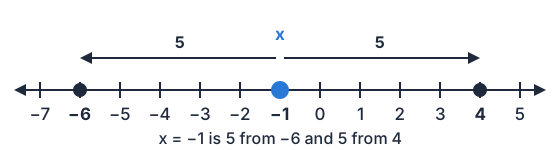
By algebra: x − 4 = x + 6 has no solution (it says −4 = 6). The other case, x − 4 = −x − 6, gives 2x = −2, so x = −1.
Trap: setting x − 4 = x + 6, finding no solution, and not trying the other case.
Edge cases.
- |x − a| = |x − b| with a ≠ b has exactly one solution, the midpoint (a + b)/2. If a = b, every x works.
- |x − a| < |x − b| means x is closer to a: everything on a's side of the midpoint.
- Order doesn't matter inside the bars: |a − b| = |b − a|, and |x| = |−x|.
GRE-level example. A point x on the number line is twice as far from −3 as it is from 6. What is the sum of all possible values of x?
- Write the distances: |x + 3| = 2|x − 6|.
- Between −3 and 6: x + 3 = 2(6 − x), so 3x = 9 and x = 3. Check: it is 6 from −3 and 3 from 6 ✓.
- To the right of 6: x + 3 = 2(x − 6), so x = 15. Check: it is 18 from −3 and 9 from 6 ✓.
- To the left of −3: −(x + 3) = 2(6 − x) gives x = 15, which is not left of −3, so this part has no solution.
- Sum: 3 + 15 = 18.
Check yourself. Which x satisfy |x − 1| < |x − 7|?
Check your answer
x must be closer to 1 than to 7. The midpoint is (1 + 7)/2 = 4, so x < 4. Check x = 3: 2 < 4 ✓. Check x = 5: 4 < 2 is false ✓.
Absolute value inequalities
|E| < k means E is less than k away from 0: −k < E < k. This is a compound inequality (three parts), so do each step to all three parts. |E| > k means E > k or E < −k: two separate ranges.
Why it works. |E| < k says E is less than k away from 0: every point strictly between −k and k, which is one piece. |E| > k says E is more than k away from 0: everything to the right of k and everything to the left of −k, which is two pieces.
How to spot it: an absolute value with <, ≤, > or ≥, often with "how many integers".
Example. How many integers x satisfy |3x − 6| ≤ 9?
- Write the compound inequality: −9 ≤ 3x − 6 ≤ 9.
- Add 6 to all three parts: −3 ≤ 3x ≤ 15.
- Divide all three parts by 3: −1 ≤ x ≤ 5.
- The integers are −1, 0, 1, 2, 3, 4, 5. Count: last − first + 1 = 5 − (−1) + 1 = 7.
As a picture: 3x − 6 = 3(x − 2), so the inequality says 3|x − 2| ≤ 9, which is |x − 2| ≤ 3. So x is at most 3 away from 2.
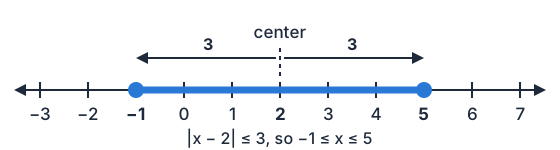
The dots are filled because ≤ includes the endpoints. With < instead, −1 and 5 are left out and only 5 integers work (0 to 4). The opposite, |x − 2| > 3, is everything outside: x < −1 or x > 5.
Trap: solving only 3x − 6 ≤ 9 (giving x ≤ 5) and forgetting the lower end, −1.
Try it. How many integers x satisfy |2x + 1| < 7?
Show the answer
- −7 < 2x + 1 < 7.
- Subtract 1 from all three parts: −8 < 2x < 6.
- Divide all three parts by 2: −4 < x < 3.
- The endpoints are not included, so the integers are −3, −2, −1, 0, 1, 2: 6 integers.
Explore. This is |x − 2| ≤ 3, the picture above. Move the center and the distance, switch between ≤ and ≥, or make the inequality strict, and watch the solution set and the integer count change.
|x − 2| ≤ 3 means: the distance from x to 2 is at most 3.
So −1 ≤ x ≤ 5. Filled dot at −1, filled dot at 5.
Integers in it: −1, 0, 1, 2, 3, 4, 5, which is 5 − (−1) + 1 = 7 integers.
Edge cases.
- k ≤ 0. |E| < 0 has no solution. |E| ≤ 0 means E = 0. |E| > 0 is every number except where E = 0. |E| > −3 is every number.
- Divide out a coefficient first. |2x − 6| < 4 means 2|x − 3| < 4, so |x − 3| < 2 and 1 < x < 5.
- From a range back to a bar. a < x < b is the same as |x − center| < half-width, with center (a + b)/2 and half-width (b − a)/2.
GRE-level example. How many integers x satisfy 2 < |x − 1| ≤ 5?
- The distance from x to 1 must be more than 2 and at most 5.
- To the right of 1: 1 + 2 < x ≤ 1 + 5, so 3 < x ≤ 6. Integers: 4, 5, 6.
- To the left of 1: 1 − 5 ≤ x < 1 − 2, so −4 ≤ x < −1. Integers: −4, −3, −2.
- Total: 6 integers.
- Check the ends: x = 3 and x = −1 are exactly 2 away, so they are out ✓. x = 6 and x = −4 are exactly 5 away, so they are in ✓.
On the GRE (Quantitative Comparison). |x − 9| < 4. Quantity A: x. Quantity B: 12. The inequality means 5 < x < 13. x can be 6 (less than 12) or 12.5 (more), so the relationship cannot be determined. Against 13, every allowed x is smaller, so Quantity B is greater.
On the GRE (select all). "Which of the following could be the value of x if |x − 3| < 5? −3, −2, 0, 7.5, 8." The range is −2 < x < 8, so select 0 and 7.5; the endpoints −2 and 8 are excluded.
Check yourself. Write −3 < x < 9 as an absolute value inequality.
Check your answer
The center is (−3 + 9)/2 = 3 and the half-width is (9 − (−3))/2 = 6, so |x − 3| < 6.
Sums of absolute values
Think in distances: |x − a| + |x − b| is the distance from x to a plus the distance from x to b. Between a and b, this total is always the gap between them. Outside, it grows. For the algebra, split the number line where each expression inside the bars equals zero, and solve in each part.
Why it works. Between a and b, moving x to the right adds to one distance exactly what it takes from the other, so the sum stays equal to the gap between a and b. Outside, both distances grow as x moves away, so the sum is larger than the gap. So the least possible value of |x − a| + |x − b| is the gap.
How to spot it: two or more absolute values added, or one inside another.
Example. Solve |x − 2| + |x + 3| = 9.
- The key points are 2 and −3 (where x − 2 = 0 and x + 3 = 0). The gap between them is 2 − (−3) = 5.
- Between −3 and 2 the total is always 5, not 9. So the solutions are outside.
- If x > 2, both insides are positive: (x − 2) + (x + 3) = 9. Simplify: 2x + 1 = 9. Subtract 1: 2x = 8. Divide by 2: x = 4. This is greater than 2, so keep it.
- If x < −3, both insides are negative, so |x − 2| = 2 − x and |x + 3| = −x − 3. Then (2 − x) + (−x − 3) = 9. Simplify: −2x − 1 = 9. Add 1: −2x = 10. Divide by −2: x = −5. This is less than −3, so keep it.
- x = 4 or x = −5. Check: |4 − 2| + |4 + 3| = 2 + 7 = 9 ✓ and |−5 − 2| + |−5 + 3| = 7 + 2 = 9 ✓.
If the right side equals the gap exactly, as in |x − 2| + |x + 3| = 5, every x from −3 to 2 is a solution, not just two values.
Trap: keeping an answer from a part of the number line it doesn't belong to. Each answer must fit the condition of its part (for example, x > 2).
Edge cases.
- Right side smaller than the gap: no solution. |x − 2| + |x + 3| = 4 is impossible, because the sum is never below 5.
- One absolute value inside another. Peel from the outside. ||x − 1| − 2| = 1 means |x − 1| − 2 = 1 or |x − 1| − 2 = −1. So |x − 1| = 3 or |x − 1| = 1, which gives x = 4, −2, 2 or 0: four solutions.
GRE-level example. What is the least possible value of |x − 1| + |x − 4| + |x − 10|?
- This is the total distance from x to three points: 1, 4 and 10.
- For any x between 1 and 10, the distances to 1 and to 10 add to the gap, 10 − 1 = 9. Outside that range they add to more than 9.
- The middle term |x − 4| is smallest, 0, at x = 4, which is between 1 and 10.
- So the least value is 9 + 0 = 9, at x = 4.
- Check: |4 − 1| + |4 − 4| + |4 − 10| = 3 + 0 + 6 = 9 ✓. At x = 5 the total is 4 + 1 + 5 = 10.
With several points, the total distance is smallest at the middle point (the median).
On the GRE (Quantitative Comparison). Quantity A: |x + y|. Quantity B: |x| + |y|. If xy > 0 (same signs) they are equal; if xy < 0 (opposite signs) part of the sum cancels, so Quantity B is greater. With no information about the signs, the relationship cannot be determined, since x = 2, y = 3 gives 5 and 5 but x = 2, y = −3 gives 1 and 5.
Check yourself. How many solutions does ||x − 1| − 2| = 1 have?
Check your answer
4: x = 0, 2, −2 and 4 (see the edge cases). Check x = −2: |−3| = 3, and |3 − 2| = 1 ✓.
How hard questions disguise it
For harder questions (L4–L5)
L4 versions ask for the sum or product of all solutions, or put x on both sides (like |x − 3| = 2x), where one case fails the check. At L5, absolute value combines with inequalities (|x − 1| < 4 and x² > 9 together) and with sign rules from odd/even and signs (|x| = −x means x ≤ 0). Draw the number line, mark the key points, and test one value in each part.
Practice
Practice absolute value equations and inequalities in timed sets on the absolute value practice page.
Common traps
Solving only one case
|E| = k has two solutions when k > 0, E = k and E = −k, and |x − a| > k holds on both sides of a. Write both cases before solving either, then pick the one the question asks for.
Forgetting to divide by the coefficient
In |3x − 6| < 9, dividing all three parts of −9 < 3x − 6 < 9 (after adding 6) by 3 gives −1 < x < 5. Divide every part, center and bound alike, and finish each case all the way to x.
Adding the wrong parts of the solutions
When you add the two solutions of |px − a| = b, the ±b parts cancel and 2a/p remains. Add the full solutions, not pieces of them.
Sign slips inside the bars or while solving
|x + 4| is the distance from −4, not from 4, and the negative case −(x − a) = … flips every sign inside. Write each case with parentheses and solve it line by line.
Keeping a solution that breaks its own case
When the other side contains x, a case can produce a value that makes that side negative, which no absolute value can equal. Plug every candidate back into the original equation.
Measuring a distance wrong
The distance between −3 and 5 is |5 − (−3)| = 8: points on opposite sides of 0 add their distances from 0. The midpoint is half that distance from each.
Counting the endpoints of a range wrong
Strict inequalities exclude the endpoints, and ≤ includes them. List the first and last integers that work, rounding the lower end up and the upper end down, then count from first to last plus one.
Dropping the bars or misreading what's inside
An absolute value is never negative: |3 − 8| = 5. Work out what's inside each pair of bars exactly as written, then take its size, and keep the operation between the bars.
Expecting exactly two solutions
|x − 2| + |x + 3| = 5 holds for every x from −3 to 2, because between the two points the total distance is always 5. A sum of absolute values can have a whole range of solutions.
Solving |x| < a negative number
An absolute value is never negative, so |E| < −3 has no solution and |E| > −3 is always true. Check the sign of the right side first.
Unwrapping nested bars wrong
||x − a| − b| ≤ c means b − c ≤ |x − a| ≤ b + c: integers on both sides of a, minus the ones too close to a. Keep both bounds, and when the two bands meet, count the integers they share only once.
Sum of two distances as a single distance
|x − a| + |x − b| equals the gap between a and b everywhere between them, and grows by 2 per step outside. Find where it reaches the bound on each side, ends included.
Solving only the positive case
|x − 3| = 5 has two solutions, 8 and −2. Dropping −2 makes x against 4 look like "Quantity A is greater" when it cannot be determined.
Including an endpoint a strict inequality excludes
|x − 3| < 5 means −2 < x < 8. At x = −2 or x = 8, |x − 3| equals 5, which is not less than 5.
Assuming |x + y| = |x| + |y|
|x + y| = |x| + |y| only when x and y don't have opposite signs: x = 3, y = −1 gives |x + y| = 2 but |x| + |y| = 4.