GMAT Quant lesson · Overlapping sets
GMAT overlapping sets: Venn diagrams, matrices, neither and both
Overlapping sets on GMAT Quant: two-set and three-set Venn formulas, the double-set matrix, and finding neither or both from totals, with worked examples.
The core idea
When groups overlap, adding them counts the overlap twice, so subtract it once: total = A + B − both + neither. For two yes/no traits, a 2 × 2 table makes every number one subtraction away; for three groups, track exactly-two and all-three regions carefully.
Core ideas
Words used here
- Set (or group): a collection of people or things, such as "people who like tea".
- Overlap, or both: the people who are in two groups at the same time.
- Only A: people in group A and in no other group.
- Neither: people in none of the groups.
- At least one: people in one group or in more than one. "At least one" plus "neither" is everyone.
- Exactly one: people in one group only, not in two or three.
- Union: another name for "at least one".
- Venn diagram: a drawing with one circle for each group, inside a box for everyone.
- Double-set matrix: a table with two rows, two columns and totals, used when everyone has two yes/no traits.
- Why we subtract the overlap. A person who likes tea and coffee is counted once in "tea" and again in "coffee". So A + B counts the overlap twice. Subtract it once, and everyone is counted exactly once.
- Two sets: total = A + B − both + neither.
- Only A = A − both. At least one = A + B − both.
- Three sets: total = A + B + C − (AB + AC + BC) + ABC + neither. Here AB is everyone in both A and B (this count includes the people in all three groups), and ABC is the people in all three groups.
- Double-set matrix: every row and every column adds up to its total, so you can find each empty cell with one subtraction.
- Smallest and largest overlap: the overlap is at least A + B − total (or 0, if that number is negative), and at most the size of the smaller group.
Try it. Of 50 students, 30 play football, 24 play tennis and 9 play both. How many play neither sport?
Show the answer
- At least one sport: 30 + 24 − 9 = 54 − 9 = 45.
- Neither: 50 − 45 = 5.
- Check with the regions: football only = 30 − 9 = 21, tennis only = 24 − 9 = 15, and 21 + 15 + 9 = 45. ✓
Two-set Venn diagram
Start with the overlap in the middle. Then fill in each "only" region by subtraction. Then fill in the outside (neither).
Why it works. The four regions (A only, both, B only, neither) don't overlap, and every person is in exactly one of them. So the regions add up to the total, and each one can be found by subtraction.
How to spot it: two groups that share some members, such as people who like tea and people who like coffee.
Example. Of 70 people, 45 like tea, 38 like coffee and 20 like both. How many like tea only, and how many like at least one of the two drinks?
- Write 20 in the middle, where the circles overlap.
- Tea only: 45 − 20 = 25.
- Coffee only: 38 − 20 = 18.
- At least one: 25 + 20 + 18 = 63. The formula gives the same number: 45 + 38 − 20 = 83 − 20 = 63.
- Neither: 70 − 63 = 7.
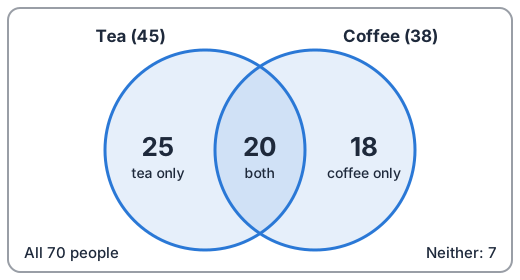
Trap: answering 45 for "tea only". The 45 still includes the 20 people who like both drinks.
Explore. The tea and coffee numbers, with the overlap as a slider. The set totals stay fixed at 45 and 38, so a bigger overlap makes both "only" regions smaller and "neither" bigger. Push "both" down far enough and "neither" would have to be negative: those numbers are impossible.
Tea only = 45 − 20 = 25. Coffee only = 38 − 20 = 18. Both = 20.
At least one = 45 + 38 − 20 = 63. The "both" group was counted twice, so it's subtracted once.
Neither = 70 − 63 = 7.
Edge cases.
- "Only" vs. "at least". "Like tea" (45) includes the people who like both; "like only tea" (25) doesn't.
- Both can't exceed either set, and neither can't be negative, so A + B − both ≤ total.
- Given ratios between regions, call the overlap b and write every region in terms of b.
GMAT-level example. In a survey of 120 people, 3 times as many like only jazz as like both jazz and rock. 40 people like rock, and 20 like neither. How many like jazz?
- Call the number who like both b. Then only jazz = 3b and only rock = 40 − b.
- The four regions add to 120: 3b + b + (40 − b) + 20 = 120.
- Simplify: 3b + 60 = 120, so b = 20.
- Jazz (only jazz plus both) = 3b + b = 4b = 80.
- Check: 60 + 20 + 20 + 20 = 120 ✓.
Check yourself. Of 80 people, 50 read paper A, 45 read paper B and 10 read neither. How many read only B?
Check your answer
At least one: 70. Both: 50 + 45 − 70 = 25. Only B: 45 − 25 = 20.
Three-set Venn diagram
Fill the diagram from the center outward: first the people in all three groups, then each "exactly two" region, then each "only" region. Or use the three-set formula.
How to spot it: three groups, with counts for each pair of groups and for all three together.
Example. Of 100 students, 50 take math, 40 take art and 30 take music. 12 take math and art, 10 take math and music, and 8 take art and music. Each of these three pair counts includes the 5 students who take all three. How many take none?
Formula method:
- Add the three groups: 50 + 40 + 30 = 120.
- Subtract the pairs: 12 + 10 + 8 = 30, and 120 − 30 = 90.
- Add back the students in all three: 90 + 5 = 95 take at least one subject.
- None: 100 − 95 = 5.
Why step 3? A student in all three groups is counted 3 times in step 1, and removed 3 times in step 2 (once in each pair). After step 2 that student is not counted at all, so add the triple back once.
Diagram method (center outward):
- All three: 5.
- Exactly two: math and art only = 12 − 5 = 7; math and music only = 10 − 5 = 5; art and music only = 8 − 5 = 3.
- Only one: math only = 50 − 7 − 5 − 5 = 33; art only = 40 − 7 − 3 − 5 = 25; music only = 30 − 5 − 3 − 5 = 17.
- Inside the circles: 33 + 25 + 17 + 7 + 5 + 3 + 5 = 95, so 100 − 95 = 5 take none.
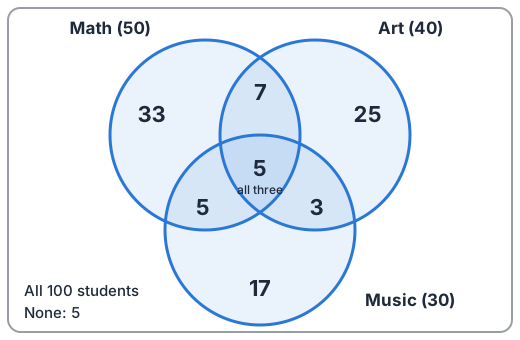
If a question gives exactly two (the pair regions without the triple, here 7 + 5 + 3 = 15), use: total = A + B + C − (exactly two) − 2 × (all three) + neither. Check: 120 − 15 − 2 × 5 = 95. ✓
Trap: forgetting to add the 5 back after subtracting the pairs.
Explore. The same 100 students, with the number in all three subjects as a slider. The subject totals and pair totals stay fixed, so moving the center changes every other region. Each extra student in the center adds one to "at least one", so "none" drops by one.
Only one set: Math 33, Art 25, Music 17. Exactly two: 15. All three: 5.
At least one = 50 + 40 + 30 − (12 + 10 + 8) + 5 = 95.
The center is added 3 times, subtracted 3 times with the pairs, then added back once. None = 100 − 95 = 5.
Edge cases.
- Know which pair counts you have. "12 take math and art" usually includes the triple; "exactly two" counts don't.
- Exactly one = the three "only" regions. At least two = exactly two + all three.
- Every region must be 0 or more. That limit is how "greatest possible" questions about three sets are solved.
GMAT-level example. Of 200 employees, 110 speak English, 70 speak French and 60 speak Spanish. 30 speak exactly two of these languages and 10 speak all three. How many speak none of them?
- Add the three groups: 110 + 70 + 60 = 240.
- A person in exactly two groups was counted twice; subtract each once: 240 − 30 = 210.
- A person in all three was counted three times; subtract 2 for each: 210 − 2 × 10 = 190. These 190 speak at least one language.
- None: 200 − 190 = 10.
Check yourself. In the math, art and music example, how many students take exactly one subject?
Check your answer
The "only" regions: 33 + 25 + 17 = 75.
Double-set matrix
When everyone has two yes/no traits, draw a 2 × 2 table with a total for each row, each column and the whole group. Each row and each column adds up, so you can fill the empty cells one subtraction at a time.
Why it works. Every person lands in exactly one of the four cells, so each row total and each column total is the sum of its cells. That gives enough equations to fill any table with three or more known cells and totals.
How to spot it: two traits that split everyone, such as full-time or part-time, and degree or no degree.
Example. A company has 200 employees, and 120 of them are full-time. 130 employees have a degree, and 70 of those are part-time. How many full-time employees have no degree?
- Write the known numbers in the table: total 200, full-time 120, degree 130, part-time with a degree 70.
- Part-time: 200 − 120 = 80.
- Full-time with a degree: the degree column has 130 people, and 70 of them are part-time, so 130 − 70 = 60.
- Full-time without a degree: 120 − 60 = 60.
| Degree | No degree | Total | |
|---|---|---|---|
| Full-time | 60 | 60 | 120 |
| Part-time | 70 | 10 | 80 |
| Total | 130 | 70 | 200 |
Check: every row and column adds up (60 + 60 = 120, 70 + 10 = 80, 60 + 70 = 130, 60 + 10 = 70).
Trap: subtracting 70 from 120. The 70 is a part-time cell, so it doesn't belong in the full-time row.
Edge cases.
- Percents or fractions only: choose a total, such as 100, and fill the table with counts.
- "Of the women, 30%…" is a percent of a row, not of the whole group.
- The matrix and the Venn diagram hold the same information. The "neither" region is the no–no cell.
GMAT-level example. At a school, 60% of the students are girls. 30% of the girls and 45% of the boys walk to school. What percent of the students walk, and what percent of the walkers are girls?
- Pick 100 students: 60 girls and 40 boys.
- Girls who walk: 30% of 60 = 18. Boys who walk: 45% of 40 = 18.
- Walkers: 18 + 18 = 36, so 36% of the students walk.
- Girls among the walkers: 18 ÷ 36 = 50%.
Check yourself. Of 300 voters, 180 are under 40. 120 support a plan, and 50 of the supporters are 40 or over. How many under-40s don't support the plan?
Check your answer
Under-40 supporters: 120 − 50 = 70. Under-40s who don't support it: 180 − 70 = 110.
Neither and both
Use total = A + B − both + neither, and solve for the missing number.
Why it works. The formula is a head count: everyone is either in at least one group (A + B − both) or in neither. So total = (A + B − both) + neither.
How to spot it: "how many are in neither group", or "how many are in both" when the neither count is given.
Example. Of 90 club members, 52 swim, 41 run and 11 do neither. How many do both?
- At least one: 90 − 11 = 79.
- Swim + run counts the "both" people twice: 52 + 41 = 93.
- The extra count is the overlap: both = 93 − 79 = 14.
Smallest and largest values. The overlap and the neither group grow and shrink together. Take 100 residents, 60 who own a dog and 50 who own a cat:
- Greatest neither: make the overlap as large as possible, so every cat owner also owns a dog. Then 60 people own a pet, and neither = 100 − 60 = 40.
- Least neither: neither can't be below 0. If neither = 0, all 100 own a pet, so both = 60 + 50 − 100 = 10.
Trap: subtracting the 11 from one group only.
Try it. At a party of 40 guests, 25 ate cake, 22 ate fruit and 6 ate neither. How many ate both?
Show the answer
- At least one: 40 − 6 = 34.
- Cake + fruit: 25 + 22 = 47.
- Both: 47 − 34 = 13.
Edge cases.
- Both ≤ the smaller group, and neither ≥ 0. So both is at least A + B − total.
- More overlap means more neither: each extra person in "both" frees one place outside the circles.
GMAT-level example. In a class of 40, 26 study French and 18 study German. What are the greatest and least possible numbers who study neither language?
- Greatest neither: make the overlap as large as possible. All 18 German students also study French. Then 26 study at least one, and neither = 40 − 26 = 14.
- Least neither: make the overlap as small as possible. 26 + 18 = 44 is more than 40, so at least 4 study both. With exactly 4 in both, 40 study at least one, and neither = 0.
Check yourself. In the swimming and running example (90 members, 52 swim, 41 run, 11 neither), how many only swim?
Check your answer
Both = 14, so only swim = 52 − 14 = 38.
How hard questions disguise it
For harder questions (L4–L5)
L4 versions give percents instead of counts, or leave a region unknown and ask for the least or greatest possible value. At L5, sets combine with optimization ("what is the greatest possible number who do neither?") and with probability ("a member is chosen at random; what is the probability they do exactly one?"). Sketch the diagram or table, label every region, and solve one region at a time.
Practice
Practice Venn and matrix questions in timed sets on the overlapping sets practice page.
Common traps
Double-counting the overlap
People in both groups appear once in A and again in B. A + B − both counts them exactly once; adding the overlap again, or keeping A + B, overcounts.
Building the 'neither' group wrong
Neither = total − (everyone in at least one group). Subtract the whole union, not just the overlap or just the 'only' regions.
Answering a different region
A Venn question produces several region sizes along the way. Label each region on a sketch and match the question's words (only, both, exactly one, at least one, neither) to it.
Mishandling the all-three region
If the pairwise overlaps include people in all three groups, the formula adds the triple back once. If 'exactly two' is given instead, subtract twice the triple. Check which kind of count the stem gives.
Subtracting the wrong cells in the matrix
In a double-set matrix, each row and column must add to its total. Fill in the table cell by cell instead of subtracting whole rows or columns that overlap.
Answering the wrong cell of the matrix
A row or column total is not a single cell, and 'non-senior girls' is a different cell from 'senior boys'. Name the row and the column the question asks for before you read off a number.
Mixing up the least and greatest possible values
More overlap means more people in neither; a larger 'neither' group forces more overlap. Push the overlap to its extreme (the smaller group, or A + B − total) and read off the other quantities from there.
Dividing by the wrong group in a conditional share
'What share of the home workers are in sales' divides the people who are in both groups by all home workers. Find the share in both groups first, then divide by the group named after 'of'.
Weighting two group rates wrong
An overall rate sits between the two group rates, closer to the larger group. Each group's share is the other group's distance from the overall rate divided by the gap between the two rates.