GMAT Quant lesson · Odd/even & signs
GMAT odd/even and positive/negative rules: parity and signs
Odd, even, positive and negative rules for GMAT Quant: parity of expressions, signs of products, must-be-true questions, xy < 0 cases, counting evens.
The core idea
Parity (odd or even) and sign questions don't need actual values, only rules: even × anything is even, odd ± odd is even, and a product is negative exactly when it has an odd number of negative factors. When the rules get confusing, test small numbers, including 0, negatives and fractions when they're allowed.
Core ideas
Words used here
- Integer: a whole number with no fraction part: …, −2, −1, 0, 1, 2, …
- Even: an integer that 2 divides with nothing left over: …, −4, −2, 0, 2, 4, …
- Odd: an integer that leaves 1 left over when you divide it by 2: …, −3, −1, 1, 3, …
- Parity: whether an integer is odd or even. "Same parity" means both are odd or both are even.
- Positive / negative: greater than 0 / less than 0. Zero is neither.
- Sign: whether a number is positive or negative.
- Product: the result of a multiplication. Each number being multiplied is a factor.
- Counterexample: one example where a statement is false.
- Inclusive: the two end numbers of a range are counted too.
- Adding and subtracting: odd ± odd = even, even ± even = even, odd ± even = odd. For example, 3 + 5 = 8, 4 + 6 = 10 and 3 + 4 = 7.
- Multiplying: if any factor is even, the product is even (2 × 7 = 14). A product is odd only when every factor is odd (3 × 5 = 15).
- Powers keep parity: n² = n × n is odd exactly when n is odd (3² = 9, 4² = 16).
- Sign of a product: count the negative factors. An odd number of negatives gives a negative product; an even number gives a positive product (if no factor is 0). For example, (−2) × (−3) = 6, but (−2) × (−3) × (−1) = −6.
- Even powers are never negative: (−3)² = 9. Odd powers keep the sign: (−2)³ = −8.
- Zero is even, and it is neither positive nor negative.
Try it. If p is even and q is odd, is p + q² odd or even?
Show the answer
- q² = q × q = odd × odd = odd.
- p + q² = even + odd = odd.
- Check with p = 2 and q = 3: 2 + 9 = 11, which is odd. ✓
Parity of an expression
Replace each variable by "odd" or "even". Then apply the rules one term at a time (a term is a part joined to the rest by + or −). Check the result with small numbers: 1 for odd, 2 for even.
Why it works. An even number is 2 × (an integer); an odd number is an even number + 1. So odd + odd = even + even + 2, which is even. A product with an even factor keeps that factor of 2, so it is even.
How to spot it: "if a is odd and b is even, which of the following is odd?"
Example. If a is odd and b is even, is a² + 3b + ab odd or even?
- a² = a × a = odd × odd = odd.
- 3b = odd × even = even.
- ab = odd × even = even.
- Add the terms: odd + even = odd, and odd + even = odd again. The result is odd.
- Check with a = 1 and b = 2: 1 + 3 × 2 + 1 × 2 = 1 + 6 + 2 = 9, which is odd. ✓
Trap: thinking 3b is odd because 3 is odd. One even factor makes the whole product even.
Edge cases.
- 0 is even, and negative numbers have parity too: −3 is odd.
- Division has no parity rule. 6 ÷ 2 = 3 is odd, 8 ÷ 2 = 4 is even, and 6 ÷ 4 isn't an integer at all.
- Powers keep parity: nᵏ (k ≥ 1) is odd exactly when n is odd.
GMAT-level example. a and b are integers and a² + b is odd. Which must be odd? I. a + b II. ab + b III. a³ − b
- a² has the same parity as a, so a + b has the same parity as a² + b: odd. I must be odd.
- a³ − b also has the same parity as a + b (subtracting and adding b give the same parity): odd. III must be odd.
- II: ab + b = b(a + 1). Try a = 1, b = 0: a² + b = 1 is odd, but b(a + 1) = 0 is even. So II need not be odd.
- Answer: I and III.
Check yourself. Is (n + 1)(n + 4) even for every integer n?
Check your answer
Yes. n + 1 and n + 4 differ by 3, an odd number, so one of them is even.
Sign of a product
Count the negative factors. Remember that an even power is never negative. An odd count of negatives makes the product negative; an even count makes it positive (if no factor is zero).
Why it works. Multiplying by a negative number flips the sign. Two flips cancel. So only the number of negative factors matters: odd → negative, even → positive.
How to spot it: facts like x < 0 < y, and a question like "which must be negative?"
Example. If x < 0 < y and z < 0, what is the sign of xy²z³?
- x is negative.
- y² is positive, because a square of a nonzero number is positive.
- z³ = z × z × z has three negative factors, so z³ is negative.
- The negative factors are x and z³: that is two. Two is even, so the product is positive. (Check: x = −1, y = 2, z = −1 gives (−1) × 4 × (−1) = 4.)
When you multiply several chosen numbers, the product is negative when 1, 3, 5, … of them are negative. Count each of those cases and add them.
Trap: counting z³ as positive because it is a power. Only even powers are always positive (or 0).
Try it. What is the sign of (−1)⁵ × (−4)² × 3?
Show the answer
- (−1)⁵ has an odd power, so it stays negative: −1.
- (−4)² has an even power, so it is positive: 16.
- 3 is positive.
- One negative factor (an odd count), so the product is negative: −1 × 16 × 3 = −48.
Edge cases.
- A zero factor makes the product 0, which is neither positive nor negative.
- Division follows the same rule: negative ÷ negative is positive.
- Two facts together. If abc < 0 and bc > 0, then a < 0, because bc is positive and the whole product is negative.
GMAT-level example. If abc < 0 and bc > 0, which must be true? I. a < 0 II. b > 0 III. ab/c < 0
- abc = a × (bc), with bc positive. For abc to be negative, a < 0. I is true.
- bc > 0 means b and c have the same sign, but both could be negative (b = c = −1). II need not be true.
- ab/c = a × (b/c). b and c have the same sign, so b/c > 0, and a < 0. So ab/c < 0. III is true.
- Answer: I and III.
Check yourself. Two different numbers are chosen from {−3, −2, 1, 4, 5}. How many pairs have a negative product?
Check your answer
One negative and one positive: 2 × 3 = 6 pairs.
Must be true, with parity
"Must be true" means true in every possible case. To decide:
Why it works. With parity there are only four cases: each of two variables is odd or even. Checking every allowed case is a complete proof, and one failing case is a complete disproof.
- To show a statement is not always true, find one counterexample. One example where it fails shows the statement is not always true.
- To show a statement must be true, use the rules, or check every case (for example "m odd, n even" and "m even, n odd").
Roman-numeral questions. The question lists statements I, II and III. The answer choices look like "I only", "I and II only" or "I, II and III". Check each statement on its own and mark it true or false. Then choose the answer that lists exactly the true ones.
How to spot it: "which of the following must be true?" with odd/even conditions.
Example. m and n are integers, and m + n is odd. Which must be true? I. mn is even. II. m − n is odd. III. m² + n is odd.
- m + n is odd, so one of m and n is even and the other is odd. (Two odds or two evens would give an even sum.)
- I: one of the factors of mn is even, so mn is even. ✓
- II: m − n = (m + n) − 2n. The number 2n is even, and odd − even = odd. So m − n is odd. ✓
- III: m² has the same parity as m. So m² + n has the same parity as m + n, which is odd. ✓
- All three must be true: the answer is I, II and III. (Check: m = 3, n = 2 gives 6, 1, 11; m = 2, n = 3 gives 6, −1, 7.)
A counterexample in action: "If m + n is odd, must m be odd?" No: m = 2 and n = 3 give m + n = 5, which is odd, but m is even. That one example shows the statement is not always true.
Counting uses the same rule: a product is even unless every factor is odd, so count the all-odd choices and subtract them from the total. Picking one number from {1, 2, 3} and one from {4, 5} gives 3 × 2 = 6 pairs; 2 of them (1 and 5, 3 and 5) are all odd, so 6 − 2 = 4 have an even product.
Trap: testing only m odd and n even. The other case, m even and n odd, must work too.
Try it. x and y are integers, and xy is odd. Which must be true? I. x + y is even. II. x − y is odd. III. x² is odd.
Show the answer
- xy is odd, so both x and y are odd.
- I: odd + odd = even. True. ✓
- II: odd − odd = even, so II is false. Counterexample: x = 3 and y = 1 give x − y = 2, which is even.
- III: x is odd, so x² is odd. True. ✓
- Answer: I and III only.
Edge cases.
- Zero and negative numbers are allowed unless the question rules them out. They often supply the counterexample.
- "Could be true" needs only one case where the statement works.
GMAT-level example. x and y are integers, and x² − y² is odd. Which must be true? I. x + y is odd II. xy is even III. x/y is not an integer
- x² − y² = (x + y)(x − y). A product is odd only if both factors are odd, so x + y is odd. I must be true.
- x + y odd means one of x and y is even, so xy is even. II must be true.
- III: x = 2, y = 1 gives 4 − 1 = 3 (odd), but x/y = 2 is an integer. III need not be true.
- Answer: I and II only.
Check yourself. Must n² + n + 1 be odd for every integer n?
Check your answer
Yes. n² + n = n(n + 1), a product of consecutive integers, is even. Even + 1 is odd.
Opposite signs: xy < 0
xy < 0 means x and y have opposite signs: one is positive and the other is negative. That gives two cases. Use the other facts to rule one case out, or check each statement in both cases.
Why it works. A product is negative exactly when the two signs differ. A quotient follows the same sign rule, so x/y < 0 says the same thing as xy < 0 (with y ≠ 0).
How to spot it: xy < 0, x/y < 0, or "x and y have opposite signs".
Example. If xy < 0 and x − y > 0, which must be true: x > 0, y > 0, or x/y > 0?
- xy < 0, so one of x and y is positive and the other is negative.
- x − y > 0 means x > y. A positive number is always larger than a negative one, so x > 0 > y.
- Check the choices. x > 0: true. y > 0: false. x/y is positive ÷ negative, which is negative, so x/y > 0 is false.
- Must be true: x > 0.
Squares hide signs in the same way. If x² = 9, then x = 3 or x = −3. If y² = 16, then y = 4 or y = −4. With xy < 0 the signs are opposite, so (x, y) is (3, −4) or (−3, 4). Then x + y = −1 or x + y = 1.
Trap: assuming x > y means both numbers are positive.
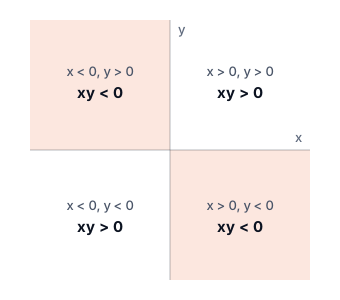
Edge cases.
- xy ≤ 0 also allows x = 0 or y = 0 (the axes).
- With opposite signs, |x − y| = |x| + |y|: the two numbers are on opposite sides of 0.
- x + y can have either sign; it takes the sign of the number farther from 0.
GMAT-level example. If xy < 0 and |x| > |y|, which must be true? I. x + y has the same sign as x II. x − y has the same sign as x III. x² > xy
- I: x is farther from 0 than y, and they have opposite signs, so x wins the sum. True.
- II: x − y adds x and the opposite of y, which has the same sign as x. Two numbers of the same sign add to that sign. True.
- III: x² > 0 and xy < 0, so x² > xy. True.
- Answer: I, II and III.
Check yourself. x² = 25, y² = 4 and xy < 0. What are the possible values of x − y?
Check your answer
(x, y) = (5, −2) gives 7; (x, y) = (−5, 2) gives −7. So 7 or −7.
Counting evens and odds in a range
Find the first even (or odd) number in the range and the last one. Then the count is (last − first) ÷ 2 + 1. Why + 1? (last − first) ÷ 2 counts the steps of 2 between them, and there is always one more number than steps. For example, 2, 4, 6 has (6 − 2) ÷ 2 = 2 steps but 3 numbers.
If the range crosses zero, you can also count each side separately and add zero (for evens).
How to spot it: "how many even (odd) integers are there from a to b, inclusive?"
Example. How many odd integers are there from −9 to 14, inclusive?
- First odd: −9. Last odd: 13 (14 is even, so step back to 13).
- Distance: 13 − (−9) = 13 + 9 = 22.
- Steps of 2: 22 ÷ 2 = 11.
- Count: 11 + 1 = 12.
- Check by counting each side: −9, −7, −5, −3, −1 is 5 odds, and 1, 3, 5, 7, 9, 11, 13 is 7 odds. 5 + 7 = 12. ✓
Pairs use the same counts. An odd sum needs one odd and one even number. With 5 odd cards and 4 even cards, there are 5 × 4 = 20 pairs with an odd sum.
Trap: halving the number of integers. That works only when the range has as many odds as evens. From −9 to 13 there are 13 − (−9) + 1 = 23 integers: 12 odd and 11 even, so 23 ÷ 2 is wrong. Use the first and last odd number instead.
Try it. How many even integers are there from −5 to 10, inclusive?
Show the answer
- First even: −4. Last even: 10.
- (10 − (−4)) ÷ 2 + 1 = 14 ÷ 2 + 1 = 7 + 1 = 8.
- Check: −4, −2, 0, 2, 4, 6, 8, 10. That is 8 numbers, and 0 is counted once. ✓
Edge cases.
- "Between" may leave out the ends. Find the first and last allowed numbers.
- An odd number of integers splits unevenly: one parity has one more member.
- Combine with another condition by subtracting (see the example).
GMAT-level example. How many integers from 1 to 100 are odd but not multiples of 3?
- Odd integers: 1 to 99, (99 − 1) ÷ 2 + 1 = 50.
- Odd multiples of 3: 3, 9, 15, …, 99, going up by 6: (99 − 3) ÷ 6 + 1 = 17.
- Odd but not multiples of 3: 50 − 17 = 33.
Check yourself. One integer is picked from 1 to 10 and one from 1 to 7. How many pairs have an even sum?
Check your answer
Even + even: 5 × 3 = 15. Odd + odd: 5 × 4 = 20. Total 35 (of 70 pairs).
How hard questions disguise it
For harder questions (L4–L5)
L4 versions mix parity with must-be-true logic and don't say the numbers are integers. Then fractions are possible, and the odd/even rules don't apply to them. At L5, signs combine with inequalities (multiplying both sides by a variable whose sign you don't know) and with absolute value (the distance from 0, written |x|; |x| = −x exactly when x ≤ 0). When the question allows them, test four kinds of numbers: a positive integer, a negative integer, zero and a fraction.
Practice
Practice parity and sign questions in timed sets on the odd/even and signs practice page.
Common traps
Mishandling zero
Zero is an even integer, and it is neither positive nor negative. Count it once, with neither the positives nor the negatives.
Counting only one side of zero
A range like −7 to 12 has evens on both sides of zero. Count each side separately, then add zero.
Counting the evens or odds in a range wrong
Count from the first qualifying number to the last in steps of 2: (last − first) ÷ 2 + 1. 'Inclusive' keeps both ends, and the count starts at the range's lower end, not at 1.
Counting pairs by parity wrong
An odd sum needs one odd and one even, so multiply the odd count by the even count; two odds or two evens give an even sum. An unordered pair is counted once.
Missing a case for an even product
A product is even if at least one factor is even, so the only odd products come from all-odd selections. Count those and subtract from the total.
Miscounting the negatives that make a product negative
A product is negative exactly when it has an odd number of negative factors: 1, 3, 5 and so on. List every odd count the problem allows, and respect any limit on how many values can be negative.
Misjudging the sign of a power
An even power of a negative number is positive; an odd power stays negative. Exponents add only when powers are multiplied.
Forgetting that xy < 0 means opposite signs
If x² = 9, y² = 16 and xy < 0, then x and y are 3 and −4 or −3 and 4, so x + y is 1 or −1. Take square roots first, then apply the sign condition.
Forgetting that non-integers exist
Odd and even apply only to integers. If the question doesn't say x is an integer, test fractions such as 1/2 before deciding that something must be true.
Assuming a variable is positive
Unless the question says so, a variable can be negative or zero. Test a negative value whenever a rule seems to hold too easily.
Reading a shifted range as if it were centered on zero
|x − h| ≤ k means h − k ≤ x ≤ h + k, a range centered on h, not on 0. Write both ends before you count the values on each side of zero.
Parity of a product of two factors
A product is odd only when every factor is odd. Replace each term by odd or even (n² has n's parity), find the parity n needs, then count those n.