GMAT Quant lesson · Exponential equations
GMAT exponential equations: common bases, doubling and exponents
Exponential equations on GMAT Quant: rewrite both sides with a common base, count doubling and halving periods, and solve for an exponent by factoring.
The core idea
When both sides of an equation are powers of the same base, the exponents must be equal, so rewrite each side as a power of one prime and solve the linear equation in the exponents. Doubling and halving questions are the same idea: count how many factors of 2 separate the start from the end.
Core ideas
Words used here
- Base and exponent: in 3⁴, the base is 3 and the exponent (or power) is 4. It means 3 × 3 × 3 × 3 = 81.
- Exponential equation: an equation with the unknown in the exponent, such as 2x = 32.
- Prime: a whole number above 1 whose only factors are 1 and itself: 2, 3, 5, 7 and so on.
- Common base: the same base on both sides of an equation.
- Doubling time: the time it takes an amount to double (multiply by 2). Half-life: the time it takes an amount to halve (divide by 2).
- Growth factor: the number the start is multiplied by. From 300 to 9,600 is a factor of 32, because 300 × 32 = 9,600.
- Coefficient: a number that multiplies something, such as 5 in 5 × 2x.
- Same base, same exponent: if am = an (with a positive and not 1), then m = n. For example, 2x = 2⁵ means x = 5.
- Rewrite bases as powers of one prime: 4 = 2², 8 = 2³, 16 = 2⁴, 9 = 3², 27 = 3³, 25 = 5².
- Power of a power: (am)n = amn. The outer exponent multiplies the whole inner exponent: (2²)x+1 = 22(x+1) = 22x+2.
- Doubling: amount = start × 2k, where k = number of doublings = time ÷ doubling time. For halving, multiply by 1/2 each period instead.
- Sums of powers: factor out the smallest power first: 2x + 2x+2 = 2x(1 + 4).
Try it. Solve 3x−1 = 81.
Show the answer
- Write 81 as a power of 3: 3 × 3 × 3 × 3 = 81, so 81 = 3⁴.
- Now 3x−1 = 3⁴, so the exponents are equal: x − 1 = 4.
- Add 1 to both sides: x = 5.
Rewrite with a common base
Write both sides as powers of the same prime (the common base). Multiply out the exponents, then set them equal. Put parentheses around each exponent before you multiply, because the outer power multiplies every term inside it: (3²)x+1 is 32x+2, not 32x+1.
Why it works. For a positive base other than 1, different exponents always give different values: 3¹, 3², 3³, … keep growing, and no value repeats. So if two powers of the same base are equal, their exponents must be equal. That is what lets you drop the base and compare the exponents.
How to spot it: different bases that are powers of the same number, such as 9 and 27.
Example. Solve 9x+1 = 27x−1.
- 9 = 3², so 9x+1 = 32(x+1) = 32x+2.
- 27 = 3³, so 27x−1 = 33(x−1) = 33x−3.
- The bases match, so the exponents are equal: 2x + 2 = 3x − 3.
- Subtract 2x from both sides: 2 = x − 3. Add 3 to both sides: x = 5.
- Check: 9⁶ = 3¹² and 27⁴ = 3¹² ✓.
With two unknowns, the same step gives a ratio. If 4x = 8y and x + y = 10: 4x = 22x and 8y = 23y, so 2x = 3y. That means x : y = 3 : 2. So x is 3 parts and y is 2 parts of the total 10. One part is 10 ÷ 5 = 2, so x = 6 and y = 4. Check: 2(6) = 12 = 3(4) ✓.
Trap: writing x + 1 = x − 1 and deciding there is no solution.
Try it. Solve 25x = 125x−2.
Show the answer
- 25 = 5², so 25x = 52x. 125 = 5³, so 125x−2 = 53x−6.
- Set the exponents equal: 2x = 3x − 6.
- Subtract 2x from both sides: 0 = x − 6, so x = 6.
- Check: 25⁶ = 5¹² and 125⁴ = 5¹² ✓.
Edge cases.
- Base 1 breaks the rule. 1x = 1⁵ is true for every x.
- Fractions and roots are powers too. 1/8 = 2−3 and √2 = 21/2.
- Not every number is a whole power of the base. 2x = 5 has a solution, but it isn't a whole number. Since 2² = 4 < 5 < 8 = 2³, the solution is between 2 and 3. GMAT questions then ask for a range like this.
GMAT-level example. If (1/4)x−2 = 8x+1, what is x?
- Write both bases as powers of 2: 1/4 = 2−2 and 8 = 2³.
- Left side: (2−2)x−2 = 2−2(x−2) = 2−2x+4. The −2 multiplies both terms.
- Right side: (2³)x+1 = 23x+3.
- Set the exponents equal: −2x + 4 = 3x + 3, so 1 = 5x and x = 1/5.
- Check: −2(1/5) + 4 = 3.6 and 3(1/5) + 3 = 3.6 ✓.
Check yourself. Solve 23x = 4x+2.
Check your answer
4x+2 = 22x+4, so 3x = 2x + 4 and x = 4. Check: 2¹² = 4⁶ = 4,096 ✓.
Doubling and halving time
Divide the final amount by the starting amount to get the growth factor. Write that factor as a power of 2. The exponent is the number of doublings (or halvings). Multiply it by the length of one period.
Why it works. Each period multiplies the amount by the same factor, so k periods multiply it by 2k. Dividing the final amount by the start removes the starting size and leaves only the growth factor, and the exponent of that factor counts the periods.
How to spot it: "doubles every…", "half-life", "triples each year".
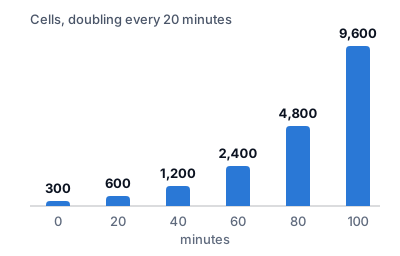
Example. A bacteria culture doubles every 20 minutes. Starting from 300 cells, how long until there are 9,600?
- Growth factor: 9,600 ÷ 300 = 32.
- 32 = 2 × 2 × 2 × 2 × 2 = 2⁵, so there are 5 doublings.
- Time: 5 × 20 minutes = 100 minutes.
| Minutes | 0 | 20 | 40 | 60 | 80 | 100 |
|---|---|---|---|---|---|---|
| Cells | 300 | 600 | 1,200 | 2,400 | 4,800 | 9,600 |
Halving works the same way. A substance has a half-life of 6 hours. To go from 80 grams to 5 grams: 80 ÷ 5 = 16 = 2⁴, so 4 half-lives (80 → 40 → 20 → 10 → 5). That takes 4 × 6 = 24 hours.
Trap: finding the factor 32 and then multiplying 32 by 20. The 20 minutes goes with each doubling, and there are only 5 doublings.
Try it. A town's population triples every 4 years. How long does it take to grow from 50 to 1,350?
Show the answer
- Growth factor: 1,350 ÷ 50 = 27.
- 27 = 3 × 3 × 3 = 3³, so the population triples 3 times.
- Time: 3 × 4 = 12 years. (50 → 150 → 450 → 1,350.)
Edge cases.
- Not a whole number of periods. From 300 to 6,000 is a factor of 20. Since 2⁴ = 16 < 20 < 32 = 2⁵, it takes between 4 and 5 doublings: between 80 and 100 minutes.
- Part of a period is not part of the factor. Half a doubling period multiplies by 21/2 ≈ 1.41, not by 1.5.
- Wording. "Increases by 100%" means doubles. "Triples" uses the base 3. "Loses half" means halves.
- Back in time, divide by the factor once per period.
GMAT-level example. A bacteria colony doubles every 3 hours. At 9 a.m. it has 1,600 cells. At what time did it have 100 cells?
- Growth factor from 100 to 1,600: 1,600 ÷ 100 = 16.
- 16 = 2⁴, so 4 doublings happened between the two times.
- 4 doublings take 4 × 3 = 12 hours.
- 100 cells was 12 hours before 9 a.m.: 9 p.m. the day before.
- Check forward: 100 → 200 (midnight) → 400 (3 a.m.) → 800 (6 a.m.) → 1,600 (9 a.m.) ✓.
Check yourself. A sample loses half its mass every 8 hours. What fraction of the sample is left after 2 days?
Check your answer
2 days = 48 hours = 48 ÷ 8 = 6 half-lives. The fraction left is (1/2)⁶ = 1/64.
Solve for an exponent
Get the power alone. If several terms share the same base, factor out the common power first. Then write the number as a power of that base, and match the exponents.
Why it works. 2x+2 = 2x × 2² is the multiplication rule read backward. Once every term is a number times 2x, the terms add like any like terms: one 2x plus four 2x is five 2x.
How to spot it: an unknown in the exponent, sometimes in several terms like 2x + 2x+2.
Example. If 2x + 2x+2 = 160, what is x?
- 2x+2 = 2x × 2² = 4 × 2x.
- So the left side is 2x + 4 × 2x = 5 × 2x (one 2x plus four more).
- 5 × 2x = 160. Divide both sides by 5: 2x = 32.
- 32 = 2⁵, so x = 5. Check: 2⁵ + 2⁷ = 32 + 128 = 160 ✓.
A single power is quicker: 5 × 3x = 405. Divide both sides by 5: 3x = 81 = 3⁴, so x = 4. Always divide off the coefficient before you match powers.
Trap: combining 2x + 2x+2 into 22x+2. Exponents add only when powers are multiplied, not added.
Edge cases.
- Subtraction works the same way. 3x+1 − 3x = 3x(3 − 1) = 2 × 3x.
- Factor out the smallest power, even if it has a negative part: 5x+1 + 5x−1 = 5x−1(5² + 1) = 26 × 5x−1.
- No solution. A positive base to any power is positive, so 2x = 0 and 2x = −4 have no solution.
GMAT-level example. If 5x+1 + 5x−1 = 650, what is x?
- The smallest power is 5x−1. Write 5x+1 = 5x−1 × 5² = 25 × 5x−1.
- Factor: 5x−1(25 + 1) = 26 × 5x−1 = 650.
- Divide by 26: 5x−1 = 25 = 5².
- So x − 1 = 2 and x = 3.
- Check: 5⁴ + 5² = 625 + 25 = 650 ✓.
Check yourself. If 3x+2 − 3x = 72, what is x?
Check your answer
3x(9 − 1) = 72, so 3x = 9 and x = 2. Check: 81 − 9 = 72 ✓.
How hard questions disguise it
For harder questions (L4–L5)
L4 versions mix three bases (2, 4 and 8 in one equation) or ask for a combination like 2x+1 once x is known. At L5, exponential equations meet interest and growth: an amount that grows 10% a year for n years, or a population that triples every 5 years, turns into an equation in the exponent. The answer choices are usually whole numbers, so match powers rather than computing logarithms.
Practice
Practice exponential equations in timed sets on the exponential equations practice page.
Common traps
Setting exponents equal while the bases differ
4^x = 8^(x − 1) does not mean x = x − 1. Rewrite as 2^(2x) = 2^(3x − 3) first, keeping each base's power attached to its own side.
Distributing a shift to the wrong side
If only the right side has (x − c), only the right side's exponent gets the − c after multiplying out. Expand each side's exponent separately.
Sign slips when collecting or substituting
Moving 3x to the other side changes its sign, and substituting y = S − x puts a minus in front of every x. Write the linear equation in the exponents on its own line and solve it carefully.
Solving the exponent equation wrong
(2²)^x = 2^(2x), so 4^x = 2⁶ gives 2x = 6 and x = 3. A power of a power multiplies the exponents; then divide by the coefficient to finish.
Splitting a total by the exponent ratio wrong
If 2x = 3y, then x : y = 3 : 2, so x is 3/5 of x + y. Write the ratio, then take that share of the total.
Counting doubling or halving periods off by one
Going from 300 to 9,600 is a factor of 32 = 2⁵: five doublings, not six. Count factors of 2, then multiply by the full length of one period.
Treating doubling as adding or as multiplying by the count
Doubling k times multiplies by 2^k, not by k or 2k, and it isn't adding the start amount each time. A shrink factor of 16 means 4 halvings, not 16.
Answering a power's value instead of the exponent
If you substitute u = 2^x and find u = 32, the answer is x = 5, not 32. Check that you report x itself, not x + a, 2x or the value of a power.
Dividing, halving or subtracting to find an exponent
An exponent counts how many times the base is multiplied. Find it by writing the value as a power of the base, not by dividing or subtracting.
Landing one power off
Answers one away from the exponent come from miscounting factors. Check by computing the power: 3⁴ = 81, while 3³ = 27 and 3⁵ = 243.
Not factoring out the smaller power
bˣ⁺ˢ − bˣ = bˣ(bˢ − 1): divide by bˢ − 1, not bˢ. Then b²ˣ is (bˣ)², a square, not a double.