GMAT Quant lesson · Speed & distance
GMAT distance, speed and time: average speed and relative speed
How to solve GMAT speed questions: d = rt, average speed over several legs, closing and chasing speeds, unit conversion, head starts and time saved.
The core idea
Distance = speed × time, and average speed is total distance divided by total time, never the average of the speeds. When two things move at once, use the speed at which the gap between them closes: the sum if they move toward each other, the difference if one chases the other.
Core ideas
Words used here
- Speed, or rate: distance per unit of time. 60 miles per hour (60 mph) means 60 miles in each hour. Other units: km/h (kilometers per hour) and m/s (meters per second).
- Leg: one part of a trip, done at one speed.
- Round trip: going somewhere and coming back on the same route.
- Average speed: total distance ÷ total time for the whole trip.
- Gap: the distance between two moving things.
- Closing speed: how fast the gap between two moving things shrinks. Also called relative speed.
- Head start: the distance one traveler covers before the other one starts.
- Least common multiple (LCM): the smallest number that two numbers both divide into. The LCM of 30 and 45 is 90.
- d = r × t (distance = rate × time). So r = d ÷ t, and t = d ÷ r.
- Average speed = total distance ÷ total time. It is not the average of the speeds. For a round trip at speeds u and v, it equals 2uv ÷ (u + v).
- Toward each other: the gap closes at u + v. Same direction (one chases the other): the gap closes at the difference of the speeds.
- Change units first: 1 hour = 60 minutes = 3,600 seconds. So 15 minutes = 15/60 hour = 1/4 hour = 0.25 hour.
| Leg | Distance | Speed | Time = distance ÷ speed |
|---|---|---|---|
| Example | 120 miles | 40 mph | 120 ÷ 40 = 3 hours |
Try it. A runner covers 15 km in 1 hour 15 minutes. What is her speed in km/h?
Show the answer
- Time in hours: 15 minutes = 15/60 = 0.25 hour, so 1 hour 15 minutes = 1.25 hours.
- Speed = distance ÷ time = 15 ÷ 1.25 = 1,500 ÷ 125 = 12 km/h. Check: 12 × 1.25 = 15. ✓
Distance = rate × time
Write down distance, rate (speed) and time. Fill in the two you know and solve for the third. Put the time in hours when the speed is per hour.
Why it works. A speed says how far you go in one unit of time. In t hours at r miles per hour you cover r miles, t times over: d = r × t. The other two forms come from dividing both sides by r or by t.
How to spot it: one traveler, one speed, and a question about distance, speed or time.
Example. A bus covers 195 miles in 3 hours 15 minutes. What is its average speed?
- Time in hours: 15 minutes = 15/60 = 1/4 = 0.25 hour, so the time is 3.25 hours.
- Speed = 195 ÷ 3.25. Multiply both numbers by 100 to remove the decimal: 19,500 ÷ 325 = 60 mph.
- Check: 60 × 3.25 = 180 + 15 = 195. ✓
Trap: dividing by 3.15. That treats 15 minutes as 0.15 hour, but an hour has 60 minutes, not 100.
Edge cases.
- Decimal hours to minutes: multiply the decimal part by 60. 2.4 hours is 2 hours and 0.4 × 60 = 24 minutes, not 2 hours 40 minutes.
- What changes with what. At a fixed speed, twice the distance takes twice the time. Over a fixed distance, twice the speed takes half the time.
- Units must match. A speed in km/h needs a time in hours.
GMAT-level example. A car travels 168 km in 2 hours 24 minutes. At the same speed, how many minutes does it take to travel 105 km?
- Time in hours: 24 minutes = 24/60 = 0.4 hour, so 2.4 hours.
- Speed: 168 ÷ 2.4 = 1,680 ÷ 24 = 70 km/h.
- Time for 105 km: 105 ÷ 70 = 1.5 hours.
- In minutes: 1.5 × 60 = 90 minutes.
- Check by proportion: 105/168 = 5/8 of the distance, and 5/8 of 144 minutes is 90 minutes ✓.
Check yourself. A plane flies 540 miles at 360 mph. How long does the flight take?
Check your answer
540 ÷ 360 = 1.5 hours = 1 hour 30 minutes.
Average speed on a round trip
Choose a one-way distance that is easy to divide, such as the least common multiple (LCM) of the two speeds. Any distance gives the same answer; this one avoids fractions. Find each leg's time, add the times, and divide the total distance by the total time.
Why it works. The average speed is the one steady speed that would cover the same total distance in the same total time. On a round trip the slow leg takes longer, so it pulls the average toward the slow speed. With distance d each way: total time = d/u + d/v = d(u + v)/(uv), and 2d divided by that is 2uv/(u + v).
How to spot it: "goes… and returns along the same route", "average speed for the whole trip".
Example. A cyclist rides to a lake at 30 km/h and back along the same road at 45 km/h. What is her average speed?
- Choose 90 km each way (the LCM of 30 and 45).
- Time there: 90 ÷ 30 = 3 hours. Time back: 90 ÷ 45 = 2 hours. Total time: 3 + 2 = 5 hours.
- Total distance: 90 + 90 = 180 km.
- Average speed: 180 ÷ 5 = 36 km/h.
The formula agrees: 2 × 30 × 45 ÷ (30 + 45) = 2,700 ÷ 75 = 36.
Trap: (30 + 45) ÷ 2 = 37.5. That ignores that the slow leg takes longer (3 hours, not 2), so the slow speed counts more.
See it. Each leg is a block: width = time, height = speed, area = distance. Both blocks have the same area (90 km), but the slow block is wider, so the true average (the line) sits below the plain average of the speeds. Change the speeds to see it move.
Leg 1: 30 km/h for 3 hours = 90 km (the area of the first block).
Leg 2: 45 km/h for 2 hours = 90 km.
Average speed = total distance ÷ total time = 180 ÷ 5 = 36 km/h.
The plain average of the speeds, 37.5, is wrong: more time is spent at the first (slower) speed, so it counts more.
Edge cases.
- Equal times, not equal distances, make the plain average right.
- The round-trip average is always below the plain average of the two speeds, unless they are equal.
- Some targets are impossible. Going out at 30 mph, you can't average 60 mph for the round trip: the time allowed for the whole trip is already used up on the way out.
GMAT-level example. A car drives from A to B at 40 mph. How fast must it drive back for the whole round trip to average 48 mph?
- Pick a one-way distance: 120 miles (the LCM of 40 and 48).
- To average 48 mph over 240 miles, the trip may take 240 ÷ 48 = 5 hours.
- The way out takes 120 ÷ 40 = 3 hours, so 2 hours are left for the way back.
- Speed back: 120 ÷ 2 = 60 mph.
- Check with the formula: 2 × 40 × 60 ÷ (40 + 60) = 4,800 ÷ 100 = 48 ✓.
Check yourself. What is the average speed for a round trip at 30 mph out and 60 mph back?
Check your answer
2 × 30 × 60 ÷ (30 + 60) = 3,600 ÷ 90 = 40 mph, not 45.
Average speed over several legs
Find each leg's distance and time. Then divide the total distance by the total time. A table keeps the numbers in order.
Why it works. The definition is total distance ÷ total time; the legs only help you find those two totals. The result is an average of the leg speeds weighted by time: the legs that take longer count more.
How to spot it: a trip in two or more parts at different speeds, not always the same distance.
Example. A driver goes 90 miles at 45 mph, then 165 miles at 55 mph. What is the average speed?
| Leg | Distance | Speed | Time |
|---|---|---|---|
| 1 | 90 miles | 45 mph | 90 ÷ 45 = 2 hours |
| 2 | 165 miles | 55 mph | 165 ÷ 55 = 3 hours |
| Total | 255 miles | 5 hours |
Average speed: 255 ÷ 5 = 51 mph.
A target average fixes the total time. To average 60 mph over 120 miles, the whole trip may take 120 ÷ 60 = 2 hours. If the first 60 miles at 40 mph took 60 ÷ 40 = 1.5 hours, only 2 − 1.5 = 0.5 hour is left for the last 60 miles. So the speed must be 60 ÷ 0.5 = 120 mph.
Trap: averaging 45 and 55 to get 50. The plain average of the speeds is right only when the legs take equal times.
Explore. The example as blocks: 2 hours at 45 mph and 3 hours at 55 mph. Change the speeds and times; when the two times are equal, the average is exactly halfway between the speeds.
Leg 1: 45 mph for 2 hours = 90 miles (the area of the first block).
Leg 2: 55 mph for 3 hours = 165 miles.
Average speed = total distance ÷ total time = 255 ÷ 5 = 51 mph.
The plain average of the speeds, 50, is wrong: more time is spent at the first (slower) speed, so it counts more.
Edge cases.
- Legs given as parts of the distance ("the first third"): pick a total distance that every speed divides into.
- Legs given as times: weight the speeds by the times directly.
- A stop adds time but no distance, so it lowers the average speed.
GMAT-level example. A cyclist rides the first third of a route at 12 km/h, the next third at 18 km/h and the last third at 36 km/h. What is her average speed for the whole route?
- Pick a total distance that makes each third easy: 108 km, so 36 km per third (36 is the LCM of 12, 18 and 36).
- Times: 36 ÷ 12 = 3 hours, 36 ÷ 18 = 2 hours, 36 ÷ 36 = 1 hour. Total: 6 hours.
- Average speed: 108 ÷ 6 = 18 km/h.
- The plain average of the speeds, (12 + 18 + 36) ÷ 3 = 22, is the trap: most of the time is spent at 12 km/h.
Check yourself. A driver goes 2 hours at 60 mph, stops for 30 minutes, then drives 1.5 hours at 70 mph. What is the average speed for the whole 4 hours?
Check your answer
Distance: 120 + 105 = 225 miles. Time: 2 + 0.5 + 1.5 = 4 hours. Average: 225 ÷ 4 = 56.25 mph.
Relative speed: toward each other or chasing
Treat the gap as the distance and the closing speed (how fast the gap shrinks) as the rate: time = gap ÷ closing speed. Toward each other, add the speeds. Same direction, subtract them.
Why it works. Watch the gap, not the travelers. Moving toward each other, each hour removes both travelers' distances from the gap. Moving the same way, the chaser gains only the amount by which it is faster.
How to spot it: "start toward each other", "how long until they meet", "overtake".
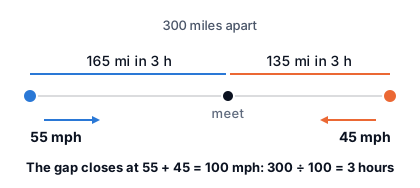
Example. Two trains start 300 miles apart and travel toward each other at 55 mph and 45 mph. When do they meet?
- Each hour the gap shrinks by 55 + 45 = 100 miles.
- Time: 300 ÷ 100 = 3 hours.
- Check: in 3 hours they travel 55 × 3 = 165 and 45 × 3 = 135 miles, and 165 + 135 = 300. ✓
Trap: using the difference (55 − 45 = 10 mph) gives 30 hours. That would describe one train chasing the other.
Edge cases.
- Moving apart (opposite directions, from one point): the gap grows at the sum of the speeds.
- Different start times: work out the head start first, then use the closing speed.
- A circular track: running the same way, the faster runner laps the slower one when it has gained one full lap.
GMAT-level example. Two runners start together on a 400-meter circular track and run in the same direction at 5 m/s and 3 m/s. After how many seconds does the faster runner first lap the slower one? What if they ran in opposite directions?
- Same direction: the faster runner gains 5 − 3 = 2 meters each second.
- Lapping means gaining one full lap, 400 meters: 400 ÷ 2 = 200 seconds.
- Opposite directions: they close the 400-meter loop at 5 + 3 = 8 m/s, so they meet after 400 ÷ 8 = 50 seconds.
- Check: in 200 seconds they run 1,000 m and 600 m, which differ by 400 m ✓.
Check yourself. Two cars 210 km apart drive toward each other at 65 km/h and 75 km/h. How far from the slower car's start do they meet?
Check your answer
They close at 140 km/h, so they meet after 210 ÷ 140 = 1.5 hours. The slower car has gone 65 × 1.5 = 97.5 km.
Converting rate units
Multiply by conversion facts, written so that the units you don't want cancel. For example, there are 3,600 seconds in 1 hour, so a "per second" number becomes a bigger "per hour" number.
Why it works. Each conversion fact can be written as a fraction equal to 1, such as (3,600 seconds)/(1 hour). Multiplying by 1 changes the units but not the amount. Write the fraction so the unit you don't want appears once on top and once on the bottom, and it cancels.
How to spot it: a rate given in one unit and asked for in another.
Example. A sprinter runs 6 meters per second. What is that in kilometers per hour?
- In 1 hour there are 60 × 60 = 3,600 seconds. So in 1 hour she runs 6 × 3,600 = 21,600 meters.
- 1 kilometer = 1,000 meters, so 21,600 ÷ 1,000 = 21.6 km/h.
Shortcut: 3,600 ÷ 1,000 = 3.6, so m/s × 3.6 = km/h. Here, 6 × 3.6 = 21.6.
Trap: dividing by 3,600 instead of multiplying. A runner covers far more distance in an hour than in a second, so the number must get bigger.
Edge cases.
- Going the other way, divide. 72 km/h ÷ 3.6 = 20 m/s.
- Two units at once. For dollars per ounce to dollars per pound, multiply by 16 (ounces per pound).
- Sense check: a per-hour number is bigger than the same per-second number.
GMAT-level example. A machine fills 3/4 of a liter every 9 seconds. How many liters does it fill in 2 hours?
- Rate per second: (3/4) ÷ 9 = 3/36 = 1/12 liter per second.
- 2 hours = 2 × 3,600 = 7,200 seconds.
- Liters: 7,200 × 1/12 = 600 liters.
- Check: 7,200 ÷ 9 = 800 fills of 3/4 liter, and 800 × 3/4 = 600 ✓.
Check yourself. Convert 90 km/h to meters per second.
Check your answer
90 ÷ 3.6 = 25 m/s (90,000 m in 3,600 s).
Head start and catching up
Find the leader's head start: speed × the time it traveled alone. The chaser closes that gap at the difference of the two speeds.
Why it works. Once both are moving, only the gap between them matters, and it shrinks at the difference of the speeds. The head start is simply the size of the gap at the moment the chaser sets off.
How to spot it: "leaves t hours later", "how long until B catches A".
Example. Lin leaves at 1:00 p.m., walking at 4 mph. Her brother follows at 1:30 p.m., biking at 12 mph. When does he catch her?
- Head start: Lin walks alone for 30 minutes = 0.5 hour, so 4 × 0.5 = 2 miles.
- Closing speed: 12 − 4 = 8 mph. The gap shrinks by 8 miles each hour.
- Time to close 2 miles: 2 ÷ 8 = 0.25 hour = 15 minutes after he starts.
- He catches her at 1:30 + 15 minutes = 1:45 p.m.
| Clock time | Lin's distance from home | Brother's distance |
|---|---|---|
| 1:00 p.m. | 0 miles | (not started) |
| 1:30 p.m. | 4 × 0.5 = 2 miles | 0 miles |
| 1:45 p.m. | 4 × 0.75 = 3 miles | 12 × 0.25 = 3 miles |
Trap: counting the 15 minutes from 1:00 instead of from the brother's start.
Try it. A truck leaves a town at 8:00 a.m. at 50 km/h. A car leaves the same town at 9:00 a.m. on the same road at 75 km/h. When does the car catch the truck?
Show the answer
- Head start: the truck drives alone for 1 hour, so 50 × 1 = 50 km.
- Closing speed: 75 − 50 = 25 km/h.
- Time: 50 ÷ 25 = 2 hours after 9:00, so 11:00 a.m.
- Check: by 11:00 the truck has driven 3 hours (50 × 3 = 150 km) and the car 2 hours (75 × 2 = 150 km). ✓
Edge cases.
- The chaser must be faster. At equal speeds the gap never closes.
- Read what is asked: the clock time, the time after the chaser starts, or the distance from the start.
- Passing and pulling ahead: to be 8 miles ahead, the chaser must close the head start and then gain 8 more miles.
GMAT-level example. A truck leaves a depot at 7:00 a.m. at 48 mph. A car leaves the same depot at 7:45 a.m. on the same road at 64 mph. How far from the depot does the car catch the truck?
- Head start: the truck drives alone for 45 minutes = 0.75 hour: 48 × 0.75 = 36 miles.
- Closing speed: 64 − 48 = 16 mph.
- Time to catch up: 36 ÷ 16 = 2.25 hours after the car starts (at 10:00 a.m.).
- Distance: the car drives 64 × 2.25 = 144 miles.
- Check: the truck has driven 3 hours by 10:00, and 48 × 3 = 144 ✓.
Check yourself. In the example, how long after the car starts is it 8 miles ahead of the truck?
Check your answer
It must close the 36-mile gap and then gain 8 more: 44 miles at 16 mph = 2.75 hours = 2 hours 45 minutes (10:30 a.m.).
Speed change and time saved
Write the time at each speed as distance ÷ speed, and subtract the two times. When the speed is unknown, write that difference as an equation, or test the answer choices.
Why it works. Over a fixed distance, time = distance ÷ speed, so time and speed are inversely proportional. Multiplying the speed by k divides the time by k.
How to spot it: "if she had driven 10 mph faster, she would have arrived 1 hour earlier".
Example. On a 200-mile trip, driving 10 mph faster would have saved 1 hour. What was the actual speed?
- Call the actual speed v. Time now: 200 ÷ v. Time if faster: 200 ÷ (v + 10). The difference is 1 hour.
- Test v = 40: 200 ÷ 40 = 5 hours, and 200 ÷ 50 = 4 hours. 5 − 4 = 1 hour. ✓
- Speed = 40 mph.
Trap: assuming that a 25% faster speed saves 25% of the time. Time = distance ÷ speed, so the time is divided by 1.25: 1 ÷ 1.25 = 0.8 of the old time. It saves 20%, not 25%.
For harder questions (L4–L5): solving it with algebra
200/v − 200/(v + 10) = 1. Multiply every term by v(v + 10): 200(v + 10) − 200v = v(v + 10). The left side is 2,000, so v² + 10v − 2,000 = 0. Factor: (v + 50)(v − 40) = 0. A speed can't be negative, so v = 40.
Edge cases.
- Percents don't match. 25% faster means time × 1/1.25 = 0.8 (20% less time). 20% slower means time × 1/0.8 = 1.25 (25% more time).
- Early and late. "10 minutes early" and "10 minutes late" are 20 minutes apart. Convert minutes to hours before using mph.
- Test the answer choices when the equation has the unknown in two denominators.
GMAT-level example. If Raj drives at 60 mph he arrives 10 minutes early; at 45 mph he arrives 10 minutes late. How long is the trip?
- The two trip times differ by 20 minutes = 1/3 hour.
- With distance d: d/45 − d/60 = 1/3.
- Common denominator 180: 4d/180 − 3d/180 = d/180 = 1/3.
- So d = 180 ÷ 3 = 60 miles.
- Check: 60 ÷ 60 = 1 hour and 60 ÷ 45 = 1 hour 20 minutes. The on-time trip takes 1 hour 10 minutes, so 10 minutes early and 10 minutes late ✓.
Check yourself. If you drive 20% slower, by what percent does the trip time go up?
Check your answer
Time is multiplied by 1/0.8 = 1.25, so it goes up by 25%.
How hard questions disguise it
For harder questions (L4–L5)
L4 versions ask for a start time or a distance instead of a duration, or add a stop partway through. L5 versions combine speed with averages (average speed is a mean weighted by time) and with work rates (two workers finishing a job behave like two cars closing a gap). Draw a line, label each leg's distance, speed and time, and fill in the missing numbers.
Practice
Drill these speed patterns on the speed and distance practice page.
Common traps
Averaging the speeds or weighting them wrong
Average speed is total distance ÷ total time, so each speed counts in proportion to the time spent at it. The shortcut 2uv/(u + v) works only for two legs of equal distance.
Misjudging the speed still needed for a target average
A target average fixes the total time. Subtract the time already used, then divide only the remaining distance by the remaining time.
Using the wrong closing speed
Toward each other, the gap shrinks at the sum of the speeds; same direction, at the difference. Picture the gap and ask how fast it changes.
Letting only one object move
When both move, neither covers the whole gap, and they meet halfway only at equal speeds. Each covers a share of the gap in proportion to its own speed; check which starting point the question measures from.
Mishandling a head start or a late start
Whoever starts early covers distance alone first: subtract it from the gap, then use the closing speed for the rest. Check which start the question measures time from.
Mixing units
An hour is 60 minutes and a kilometer is 1,000 meters. Convert everything to the units of the answer before you multiply or divide.
Flipping d = rt
Distance = rate × time, time = distance ÷ rate, and rate = distance ÷ time. Check the units of your answer: miles ÷ mph gives hours.
Answering a trip time instead of the time saved or the speed
Time saved is the difference of two trip times, each found as distance ÷ speed. Then answer the quantity asked: the saving, the actual speed, or a trip time.
Stopping at a total
Total distance and total time are the two pieces of an average speed, not the answer. Divide one by the other.